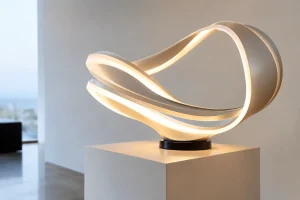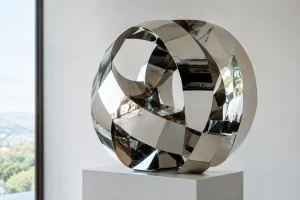
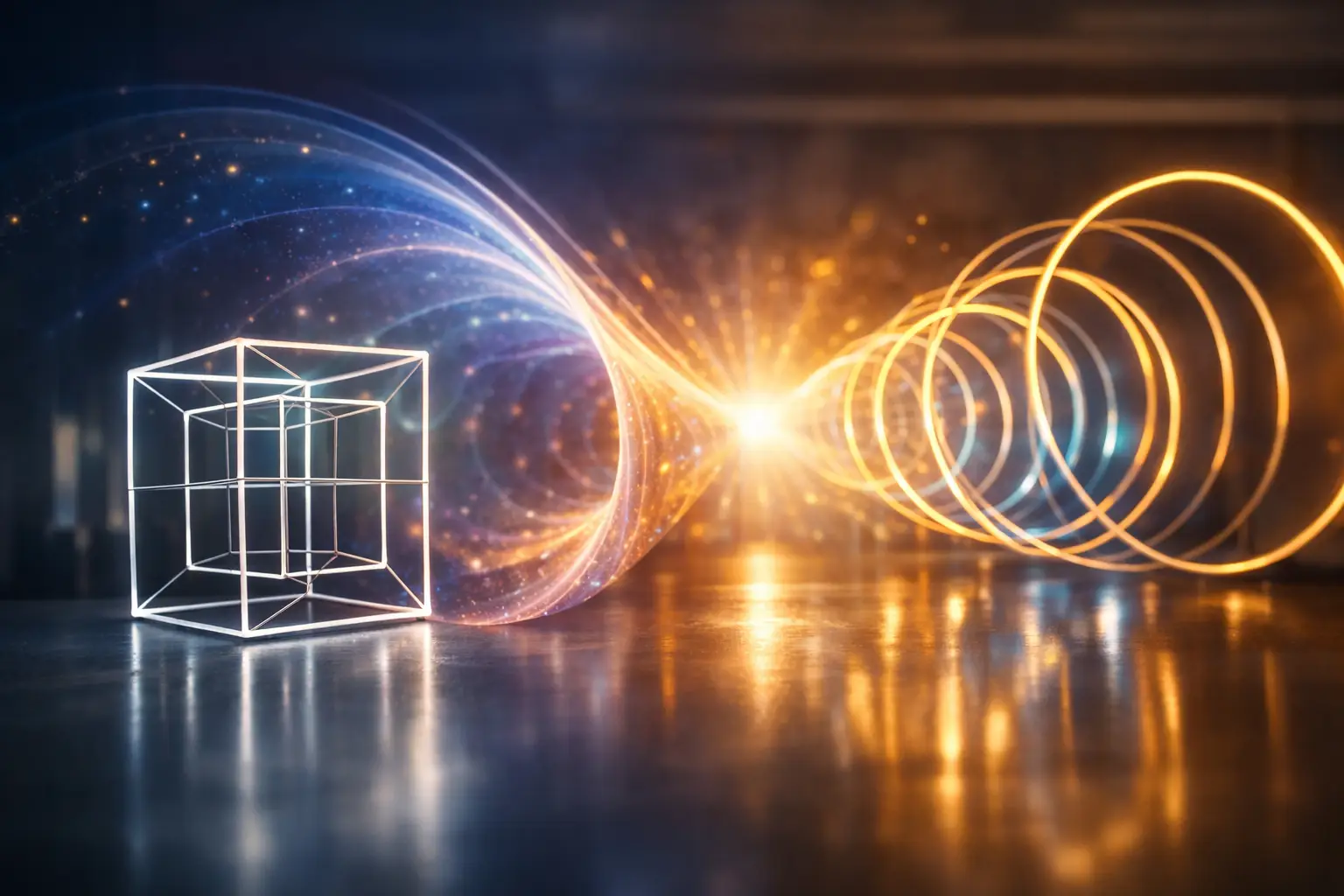
A hypercube can make a room feel larger than its walls. That is the strange, immediate power behind the fourth dimension explained: not as a sci-fi claim that we can physically step outside reality, but as a way of seeing beyond the limits of ordinary perspective. When light, reflection, geometry, and motion are arranged with intention, the eye begins to sense a space that cannot be fully held in a single glance.
For collectors drawn to future-facing art, the fourth dimension is compelling because it sits at the meeting point of mathematics and imagination. It gives sculptural form to a question that has occupied physicists, artists, philosophers, and architects for generations: what would a higher-dimensional object look like from inside a three-dimensional world?
Fourth Dimension Explained: Two Meanings Matter
The phrase “fourth dimension” is often used as though it has one fixed definition. It does not. In physics, it commonly refers to time. In geometry, it refers to an additional direction in space, beyond length, width, and height. Both meanings are legitimate, but they lead to very different conversations.
In Einstein’s framework, we inhabit spacetime. An event is not defined only by where it occurs, but when. Your position in a room can be described with three spatial coordinates. Add the moment you are standing there, and you have a fourth coordinate: time. This is not merely poetic language. Time affects motion, causality, gravity, and the way the universe is measured.
Geometric fourth-dimensional space asks a more visual question. Imagine a direction perpendicular to every direction you already know. That is difficult because our senses evolved to navigate three dimensions, not four. We cannot point toward a fourth spatial direction any more than a figure drawn on paper can point upward, out of its flat surface.
That limitation is exactly where art becomes interesting. A sculpture does not need to prove that a fourth spatial dimension is physically accessible. It can create an encounter with its logic: nested forms, impossible continuity, shifting interiors, and visual depth that seems to exceed the object’s physical boundary.
Why a Tesseract Looks Impossible
A square is a two-dimensional form made from four line segments. Push a square through a new spatial direction and it becomes a cube. Push a cube through another direction unavailable to our three-dimensional intuition and, mathematically, it becomes a tesseract, also called a hypercube.
A tesseract has 16 vertices, 32 edges, 24 square faces, and eight cubic cells. Those numbers are precise, but they do not capture its visual charge. What we see in drawings, animations, and sculpture is never the complete four-dimensional object. We see a projection.
Think of a cube casting a shadow onto a wall. The shadow is two-dimensional, yet it can still communicate the cube’s three-dimensional structure. A tesseract projection works similarly. It translates a four-dimensional relationship into a three-dimensional or two-dimensional form we can perceive. The familiar image of a smaller cube nested within a larger cube, connected at corresponding corners, is one such translation.
The trade-off is unavoidable: every projection leaves something out. A flat drawing cannot show all aspects of a cube at once, and a physical tesseract-inspired sculpture cannot literally contain a fourth spatial axis. But that constraint is not a weakness. It is the source of the tension. The mind recognizes a coherent structure while the eye struggles to resolve where it begins, ends, folds, or recedes.
A Projection Is Not a Simplification
It is tempting to call a tesseract projection a simplified version of the real thing. More accurately, it is a translation. The object has not become less conceptually rich because it appears in three dimensions. Its relationships have been expressed through a medium with different rules.
That is why the best hypercube-inspired work feels alive rather than diagrammatic. It does not just display geometry. It makes geometry behave. Reflections multiply the frame. Programmable LEDs introduce time, color sequences, and movement. As the viewer changes position, the visible architecture changes with them.
Light Introduces Time Into Sculpture
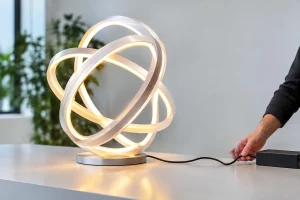
A static sculpture occupies space. Light art occupies space and unfolds through duration. The instant LEDs shift from a cool white plane to a saturated violet corridor, the piece is no longer experienced as one fixed object. It has a before, an after, and a rhythm.
This is where the physics meaning of the fourth dimension quietly returns. You do not need a lecture on relativity to feel time embedded in an artwork. A changing light program makes time visible. It turns viewing into an event rather than a glance.
Infinity mirrors heighten that effect. Mirrors face mirrors, creating repeated reflections that appear to travel beyond the physical depth of the sculpture. The visual field can suggest a tunnel, a chamber, a floating lattice, or an interior architecture that recedes far past the wall. The object remains finite, handcrafted, and materially present, yet perception reports an impossible abundance of space.
This is not an illusion in the dismissive sense. It is a designed perceptual condition. The viewer knows there is no endless corridor behind the glass, but the body still responds to the depth. That simultaneous awareness is part of the experience: reason says boundary; vision says infinity.
The Fourth Dimension Is a Matter of Viewpoint
Higher-dimensional geometry becomes easier to grasp when you stop expecting one perfect image. Consider a cube. From one angle it appears as a square. From another it appears as a hexagon-like arrangement of faces. Neither view is false, yet neither is the complete cube.
A tesseract demands the same humility at a higher level. Its projections can look dramatically different depending on orientation. Rotate it in four-dimensional space, then project it into ours, and edges can seem to pass through one another, interior and exterior can appear to exchange roles, and scale can feel unstable.
Immersive sculpture borrows this principle without pretending to be a textbook model. A collector walking past a mirrored hypercube sees one work from the entryway, another from the sofa, and another in the evening when the lighting program takes command. The piece is physically stable, but its perceptual identity is mobile.
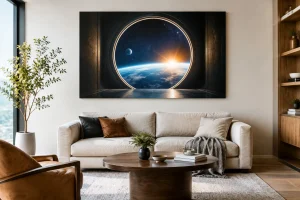
That makes placement consequential. In a quiet gallery, the work can hold attention as a precise object of contemplation. In a dramatic residential foyer, it can function as a threshold between ordinary space and a more cinematic interior. In a media room or private lounge, its color and animation may become part of the atmosphere. Scale, ambient light, viewing distance, and wall color all influence the result.
Sacred Geometry, Without the Shortcut
The language of sacred geometry often appears around dimensional art because geometric forms can produce a powerful sense of order, symmetry, and connectedness. A cube, sphere, lattice, or hypercube can feel archetypal before a viewer knows any mathematics behind it.
There is room for that emotional response, provided the distinction stays clear. Geometry is a real mathematical discipline. Spiritual meaning is personal, cultural, or philosophical. One does not prove the other. The more compelling position is to let both coexist: precision gives the form authority, while human interpretation gives it resonance.
A tesseract-inspired piece can evoke infinity, transcendence, portals, systems, or consciousness. Another viewer may see elegant engineering and spatial design. Neither response needs to cancel the other. Serious art often earns its staying power by allowing multiple readings without becoming vague.
When Dimensional Art Belongs in a Collection
Not every luxury interior needs a visual singularity. A hyper-dimensional infinity mirror sculpture is not background decor, and it should not be purchased as though it were. Its strength is its ability to command a room, reward repeat viewing, and begin conversations that move beyond color palettes and furniture brands.
For collectors, the most meaningful distinction is between an object that merely references futurism and one that is built with authorship. Material quality matters. So does the accuracy of the geometry, the depth of the mirror construction, the character of the illumination, and the control available over the lighting experience. A signed, numbered work with documented provenance carries a different cultural and personal weight than a mass-produced visual effect.
Customization also changes the relationship. A work scaled for a double-height entry, calibrated for a specific architectural niche, or programmed around a client’s preferred color language becomes part of the space’s identity. Nicky Alice approaches the tesseract not as a novelty shape, but as a sculptural framework for light, perception, and collector-level presence.
The fourth dimension may remain beyond direct human sight, but its invitation is close at hand: look longer, move around the form, and notice how quickly certainty gives way to wonder.