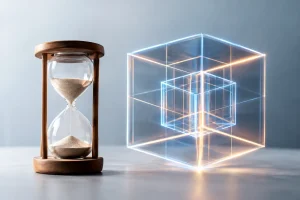

At 3:17 in the morning, a room can become an impossible machine. A hallway folds back into itself. A familiar face contains another landscape. Gravity changes its mind. The question, can dreams represent other dimensions, arrives naturally in that state, because dreams do not merely show images. They generate entire rules of space, time, identity, and causality, then make those rules feel completely convincing.
That feeling is not scientific proof that consciousness has traveled beyond the known universe. But it is not trivial, either. Dreams reveal a startling fact about human perception: the mind can construct coherent experiences of spaces that the waking body has never entered. For an artist working with hypercubes, mirrors, reflection, and recursive depth, that is fertile territory. A dream may not be a portal. It may be something just as fascinating, an internal laboratory for dimensions the senses cannot easily hold.
Can Dreams Represent Other Dimensions?
The precise answer depends on what “represent” and “dimensions” mean. In physics, a dimension is not automatically a hidden realm. It is usually an independent direction or coordinate needed to describe a system. Three spatial dimensions allow a location to be specified by length, width, and depth. Time is often treated as a fourth dimension in spacetime. Some theoretical models propose additional spatial dimensions, though none have been directly experienced as dream landscapes.
Dreams do not provide testable measurements of those possible dimensions. A dream cannot tell a physicist the size, geometry, or physical behavior of an unseen spatial direction. Its evidence is private, unstable, and altered every time it is remembered. Treating a dream as literal data about cosmology would confuse a powerful experience with a controlled observation.
Yet dreams can represent other dimensions in a different and meaningful sense. They can stage what it feels like to encounter spatial logic beyond ordinary intuition. They can create nested rooms, simultaneous viewpoints, shifting scale, and routes that return to their own beginnings. Those are not demonstrations of extra dimensions, but they are perceptual metaphors for the strangeness that higher dimensional geometry asks the mind to confront.
The Brain Is Already a Generator of Worlds
During sleep, particularly during rapid eye movement sleep, the brain is not simply playing random images like a damaged projector. It is actively constructing a world model from memory, emotion, sensation, expectation, and association. Brain regions involved in visual imagery and emotional significance can be intensely active, while systems responsible for logical checking and stable self monitoring may be less dominant.
That imbalance explains why impossibilities can feel ordinary. A dreamer can walk through a wall, speak with someone who is both absent and present, or move through a building whose interior is larger than its exterior. Waking perception constantly corrects itself against sensory input. Dream perception has no such obligation. It can revise the geometry midexperience and preserve the emotional truth of the scene.
This is why dream space is so compelling. It is not merely surreal decoration. It is a world built by a system that knows the grammar of space while being temporarily released from the physical constraints that usually discipline it.
A lucid dream intensifies the experiment. The lucid dreamer recognizes the dream as a dream while remaining inside it. That recognition can introduce intention, curiosity, and a degree of interactive control. Some people try to change a room’s scale or pass through a boundary. Others simply observe the instability of their own spatial assumptions. The result is not a map of another universe, but it can be an unusually direct encounter with the mind’s capacity to fabricate reality.
A Tesseract Makes the Problem Physical
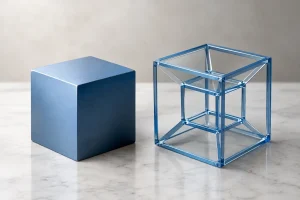
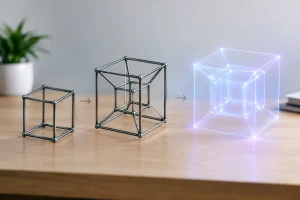
Higher dimensional geometry offers a cleaner way to understand why dreams can feel dimensional without proving anything supernatural. A square is the boundary of a two dimensional region. Move that square in a new direction, one unavailable inside its own flat plane, and its sweep creates a cube. Move a cube in a direction unavailable to three dimensional space, and the conceptual result is a tesseract, also called a four dimensional hypercube.
No one can place a complete tesseract in ordinary space, because any physical object made here has three spatial dimensions. What can be made is a projection. A cube casts a two dimensional shadow that distorts as its orientation changes. In the same way, a tesseract can be projected into three dimensions. The familiar image of a smaller cube nested inside a larger cube, connected at corresponding corners, is one such projection.
A projection is not a failure. It is the method. It gives a lower dimensional observer a partial but rigorous trace of a higher dimensional form. The cost is distortion. Relationships that are simple in four dimensions can look tangled, doubled, or impossible in three.
That is the conceptual engine inside my Tesseract sculptures. Mirrors and carefully organized light do not create an actual infinite volume. They construct repeated reflections that persuade the eye to read depth where physical space ends. Geometry supplies the structure. Reflection supplies the recursion. Perception completes the event.
Standing before an infinity mirror hypercube can produce an almost dreamlike uncertainty. Is the form a solid object, an opening, a corridor, or an endlessly multiplying diagram? The answer changes as the viewer moves. It is interactive in the most elemental sense, because a body in motion reorganizes the image. No belief in hidden worlds is required. The work begins with real optical behavior and lets the imagination carry the consequences.
Why Impossible Architecture Feels So Familiar in Dreams
Dreams and hyperdimensional art meet at the point where perception reaches its limit. Both ask the mind to reconcile incompatible views. A staircase may rise and return to its starting point. A chamber may feel vast while occupying a small footprint. A figure may appear on opposite sides of the scene without seeming duplicated.
In a dream, those contradictions often pass without alarm because the dreaming mind prioritizes narrative and emotion over measurement. In an installation, the contradiction becomes more conscious. The viewer knows the room has boundaries, yet sees depth extending beyond them. That tension is productive. It makes perception visible to itself.
Sacred and spatial geometry can deepen this response when it is treated as geometry first. Symmetry, repetition, proportion, and recursion have psychological force because the visual system is exquisitely sensitive to pattern. A lattice can feel ancient or cosmic without requiring mystical claims. The awe comes from witnessing simple relationships generate immense complexity.
At a festival, this threshold can become collective. Thousands of people may encounter a large scale hyperdimensional sculpture after dark, carrying different histories of mathematics, altered states, art, and wonder. Some see an elegant optical system. Some see a shrine to infinity. Some see the closest physical cousin to a recurring dream. None of those responses cancels the others.
What Dreams Can Teach a Maker About Dimensions
Dreams are useful to my practice not because they solve physics, but because they refuse lazy assumptions about perception. They remind me that a space does not need to be physically enormous to feel bottomless. A repeated pattern can create a sense of motion. A frame can become a threshold. A reflected body can turn the viewer from observer into material within the geometry.
That last point matters. A tesseract diagram on paper can be understood intellectually, but an immersive sculpture recruits balance, distance, peripheral vision, and self recognition. In an interactive augmented reality experience, a viewer can virtually step inside the form and examine the geometry from positions that physical construction cannot offer. The virtual encounter does not replace sculpture. It extends the question of projection, asking how a body understands a form when the form can reorganize around it.
There is also a useful discipline in keeping the language honest. Dreams may suggest other dimensions. They may resemble projections of impossible spaces. They may produce encounters that feel spiritually enormous. But feeling is not verification, and mystery does not need false certainty to remain profound.
The most interesting possibility is quieter. Perhaps dreams represent not another place, but another capacity, the capacity to inhabit models of reality that exceed the habits of waking vision. A hypercube does something similar. It does not demand that anyone abandon reason. It asks reason to stretch until imagination can meet it.
The next time a dream gives you a door that opens into a room larger than the world outside it, do not rush to name it evidence or illusion. Stay with the structure. Notice what repeats, what folds, what remains impossible but internally consistent. That is where the real question begins.