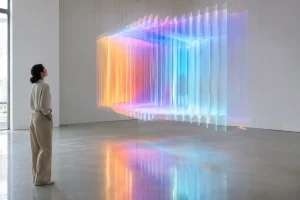

A guide to selecting custom dimensions begins with a strange fact about perception: size is never merely size. A cube can occupy a measured volume, yet mirrors can make it appear to recede beyond the horizon. A narrow corridor can become an infinite chamber. Light can cause a body to feel contained, expanded, disoriented, or briefly released from ordinary spatial logic.
When I develop an immersive sculpture, dimensions emerge from a conversation between mathematics, architecture, human movement, and the emotional temperature of the site. The question is not simply how much room an object occupies. It is what kind of encounter its geometry can produce.
Why scale changes the geometry of experience
A tesseract is a four dimensional hypercube. Just as a three dimensional cube may be understood as a sequence of two dimensional squares connected through a third direction, a tesseract can be understood as a sequence of cubes connected through a fourth direction. No human eye can observe that fourth direction directly. What can be built is a projection, an imperfect but potent shadow of higher dimensional structure.
Physical scale determines how that projection is read. A small hypercube can be held at arm’s length and understood as a precise object. A large one shifts the relationship entirely. The visitor no longer observes the geometry from outside. The body becomes a reference point inside the projection, moving through edges, reflections, and recursive planes.
This is why the five foot by five foot by five foot Tesseract is not simply a larger version of a tabletop sculpture. At that scale, the cube begins to act like architecture. A person can stand before it and sense an interior that seems to continue impossibly far beyond its actual depth. The mathematics remain consistent, but perception becomes interactive. Every small movement of the viewer changes the reflected field.
Guide to selecting custom dimensions through the body
The first measurement I consider is the human body. Not as a generic unit, but as a moving, sensing instrument. A standing visitor occupies roughly six feet of vertical attention. Their eyes scan at a comfortable level, their peripheral vision notices light beyond the point of focus, and their instinct for personal space changes when reflective surfaces suggest an opening or an abyss.
A sculpture intended to be encountered at close range needs enough visual density to reward stillness. Fine LED intervals, crisp mirror seams, and small geometric transitions can create a private encounter, almost like looking into the machinery of a lucid dream. A larger interactive installation must also speak to the body in motion. It needs a readable silhouette at a distance, an approach path, and an interior visual event powerful enough to hold attention once visitors arrive.
At a festival, these conditions become more complex. People arrive in groups, in costumes, after dark, sometimes through dust or fog. They may encounter the work from far across an open playa or from the compressed energy of a dance floor. A dimension that feels intimate in a gallery can disappear in an expansive outdoor field. Conversely, an enormous form can lose its force if it cannot create a moment of proximity and wonder.
The right scale depends on whether the work is designed for one person contemplating an infinite reflection, a small group gathering around a luminous form, or a stream of thousands moving through an immersive event. These are different spatial problems, not merely different measurements.
Reflection requires real depth and perceived depth
Infinity mirrors create their apparent depth through repeated partial reflections. A light source sits between reflective layers, and each reflection loses a portion of its intensity while traveling deeper into the visual field. The result is a chain of receding lights that appears to extend far beyond the actual physical cavity.
The cavity depth matters, but it is not the only variable. Mirror quality, reflective transmission, LED brightness, the angle of view, and ambient light all influence the illusion. A shallow structure can feel vast when the optical system is carefully balanced. A deeper structure can feel unexpectedly flat if outside illumination overwhelms the reflected layers.
This is where custom dimensions become a physics problem. Increasing the width of a mirrored plane expands the visitor’s field of view. Increasing height changes whether the work reads as a portal, a wall, or a vertical shaft. Increasing depth can strengthen parallax, the subtle change in reflected relationships as someone shifts position. Yet each increase also changes weight, structural demands, power distribution, transport, and the precision required to keep surfaces aligned.
Perfect geometry is not an abstract preference. A slight shift in a frame can interrupt an edge that should appear continuous. A mirror angle that is off by a fraction can change the perceived location of an entire luminous corridor. I treat the frame as an instrument, not a container. It holds the mathematics in a position where the eye can believe it.
Site is part of the sculpture
No immersive work arrives in an empty universe. It enters a site with ceiling heights, entry points, existing light, sound, traffic flow, weather, and power constraints. The dimensions must converse with all of them.
For an outdoor installation, sightline is often the first force at work. The piece should announce itself from a distance without explaining everything at once. A glowing hypercube in a dark landscape can operate as a beacon, then reveal complex recursion as visitors draw near. In daylight, reflective surfaces interact with the sky, ground, and passing bodies in a completely different way. The sculpture needs a presence when its light is not yet dominant.
Indoor environments place more emphasis on threshold and circulation. A work near an entrance can create immediate gravitational pull, while a work at the end of a passage can turn movement into anticipation. Ceiling height affects whether the geometry feels compressed or monumental. Sound can either sharpen the experience, through the hush created by concentrated attention, or compete with it when the setting is loud and kinetic.
Power is equally physical. Programmable LEDs need reliable distribution, controlled cable paths, and a system that remains safe under the actual conditions of the event. A large interactive light sculpture may require careful planning around circuits, heat, weather protection, and access for installation. These practical requirements do not diminish the dream. They are how the dream remains visible through a long night of human encounter.
The role of programmable light
Static light reveals geometry. Programmable light lets geometry behave like time.
A slow pulse can make a mirror field feel as though it is breathing. A sequence traveling along the edges of a hypercube can trace the logic of its construction, suggesting how one cube might transform into another across an unseen axis. Color transitions can establish emotional contrast, from the cool distance of deep blue recursion to a sudden warm flare that feels startlingly near.
The most effective patterns do not merely decorate the form. They clarify or complicate the spatial reading. A visitor may initially see a cube, then notice another cube nested within it, then realize that the apparent structure is repeating beyond sight. In an interactive setting, a change in light can encourage people to circle, pause, photograph, or look again from a new angle. The work becomes a perceptual experiment performed by many bodies.
Augmented reality adds another layer to this experiment. With an AR headset, viewers can virtually step inside the hyperdimensional environment and experience spatial relationships that cannot be physically constructed at full scale. The interactive transition between physical sculpture and virtual interior is meaningful because both forms begin with the same geometry. One is built from mirrors, light, and material limits. The other can extend the projection beyond those limits.
Let the unknown remain visible
The purpose of dimensional planning is not to eliminate mystery. It is to give mystery a precise stage. A tesseract cannot be fully placed inside three dimensional space, but its projections can make the limits of ordinary perception feel suddenly tangible.
When the scale, light, reflection, and site align, a visitor does not need a lecture in higher dimensional geometry to feel that something unusual has happened. They may simply stand before a luminous depth that cannot be there, then recognize that their own perception has been participating in its construction. That is the most useful measurement of all: the instant when a solid structure opens a door in the mind.