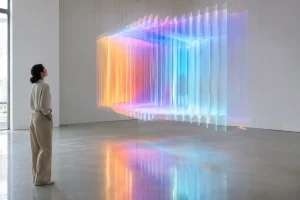
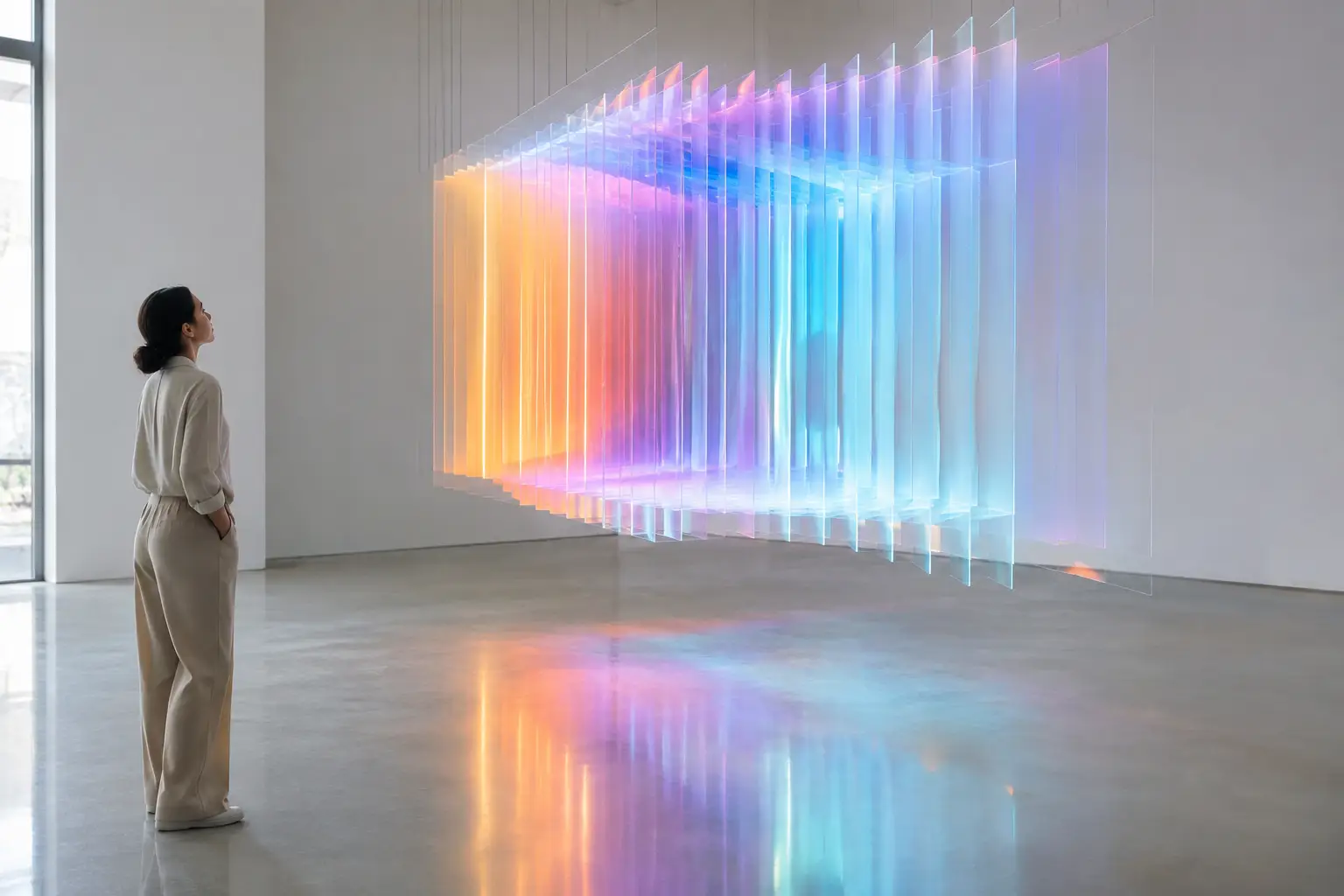
A serious light installation begins with a question that cannot be answered by a floor plan alone. How to commission light art is really a question of what kind of perception an environment can hold. Can a room become a threshold? Can reflection produce the sensation of impossible depth? Can a visitor stand before a physical structure and feel, briefly but unmistakably, that space has more dimensions than the senses normally report?
I approach commissions as experiments in embodied geometry. Light is not surface treatment. Mirrors are not merely reflective material. Together, they can become an interactive system that destabilizes ordinary spatial intuition, translating mathematics into an experience the body understands before language catches up.
Start With the Perceptual Question
The most compelling commission conversations do not begin with an object size or a material palette. They begin with the desired encounter. A festival organizer may want an interactive landmark that pulls people out of the noise and into a moment of lucid stillness. A curator may be building an exhibition around altered perception, cosmology, or the boundary between physical and virtual space. A collector may be drawn to the peculiar intimacy of standing before an apparent infinity that occupies only a few feet of real space.
Those intentions lead to different works, even when the underlying vocabulary is similar. A tesseract inspired installation asks visitors to confront the fourth dimension through projection and recursion. An infinity mirror sculpture asks a related question, how can a finite volume generate an apparent depth with no visible end? The physics is concrete. Repeated reflections carry light between partially reflective and fully reflective surfaces, producing diminishing copies that appear to recede. The perceptual result is less concrete. It feels like looking through matter into another spatial order.
At the beginning, I want to understand the emotional temperature of the setting, the expected movement of visitors, and the time each person is likely to spend with the work. A piece encountered in a crowded music festival operates differently from one encountered slowly in a quiet architectural setting. Neither context is secondary. The environment becomes part of the optical instrument.
How to Commission Light Art With Geometry at Its Core
A commission becomes specific when an abstract fascination takes on a mathematical structure. For my practice, that structure often begins with the hypercube, also called a tesseract. A cube is the three dimensional analogue of a square. A tesseract is the four dimensional analogue of a cube. Since human vision and movement are organized around three dimensions, a true tesseract cannot be placed intact in ordinary space. What can be built is a projection, a shadow, or a sequence of transformations that lets the mind infer something beyond direct perception.
That limitation is the source of the work’s force. Geometry is not illustrated from a distance. It is given scale, reflection, color, and duration. A five by five by five foot mirror hypercube can hold a visitor in front of an apparent corridor of repeating edges, where the cube seems to multiply and fold inward. The form remains physically measurable, yet perception refuses to settle on a single stable interpretation.
Early design conversations can establish whether the work should foreground the tesseract explicitly or allow its logic to remain latent. Some contexts benefit from a clear geometric language, where the nested cube structure is immediately legible. Others call for an encounter that begins as pure visual wonder and only later reveals its mathematical framework. There is no universal answer. The right balance depends on whether the installation needs to teach, provoke, gather a crowd, or create a more private altered state.
Sacred and spatial geometry can also be present without unsupported claims. Repeated forms, symmetry groups, and proportional relationships have long carried emotional weight because human perception is exceptionally sensitive to pattern. I treat that response as a perceptual fact worth investigating. The transcendence belongs to the encounter, grounded in real optics, real structure, and real mathematics.
Translate the Site Into Physical Constraints
Every installation lives inside a set of conditions. Ceiling height, entry paths, ambient light, power availability, weather exposure, sound, viewing distance, and crowd density all affect the final form. A work designed for a darkened interior can use subtle reflection and slow color movement. A work intended for a desert event must contend with daylight, dust, wind, transport, and thousands of moving bodies.
This is where imagination meets engineering. I consider the structure supporting the mirrors, the optical depth created by each reflective chamber, LED placement, heat management, cable routing, and access for assembly and maintenance. Programmable LEDs make it possible for a sculpture to shift through carefully timed states rather than simply remain illuminated. Light can pulse, recede, rotate through color relationships, or respond to an interactive trigger. Yet more animation is not always better. A quiet sequence can make the illusion feel deeper because the eye has time to enter it.
Power planning deserves attention early. Large scale work may need dedicated circuits, protected distribution, and a clear plan for safe cable management. Outdoor work requires materials and enclosures that can tolerate its conditions. Temporary festival installations also need a practical method of arriving, assembling, operating, and leaving without compromising the visual experience. These are not administrative details. They determine what kind of physics the sculpture can perform in public.
Build Interaction Into the Experience
Interactive art is strongest when participation changes a visitor’s relationship to space, rather than asking for attention through novelty alone. In an infinity mirror environment, a person already becomes part of the image. Their body appears among recursive reflections, repeated into apparent depth. That simple fact can be profoundly disorienting. The observer is no longer outside the system.
Interactive elements can extend this threshold. Programmable lighting may react to proximity, motion, or a shared sequence of viewers passing through the space. An Augmented Reality activation can allow visitors wearing a headset to step virtually inside a hyperdimensional structure, moving through forms that could not be physically occupied in the same way. The virtual extension should not replace the sculpture. It should reveal another layer of its logic, allowing the interactive experience to move from reflected depth into imagined four dimensional space.
For public events, interaction also needs to be intuitive. A visitor should sense where to stand, how close to approach, and what the work is asking without requiring a long explanation. The most successful moments often occur when someone notices that a geometric object has begun to behave unlike an object at all.
Define the Rhythm of the Collaboration
Commissioning a light installation is a sequence of decisions, not a single approval. The first phase establishes concept, scale, site, intended audience, and technical constraints. From there, I develop drawings, material studies, lighting behavior, and a fabrication plan. For complex work, prototypes are valuable because an optical effect can look different in a rendering than it does when mirrors, LEDs, and human eyes occupy the same physical space.
Feedback works best when it returns to the central question. Does this proposal create the desired perceptual shift? Does the geometry read at the intended distance? Is the work interactive in a way that feels essential? Small changes in mirror depth, frame proportion, LED density, or ambient conditions can significantly change the sensation of infinity.
The timeline depends on scale, fabrication complexity, installation access, and whether the work includes interactive or virtual components. A site with strict event schedules or unusual load in conditions requires earlier coordination. For festival work, testing before public opening is especially valuable. A sculpture can be mathematically precise and still need adjustment once it meets darkness, dust, ambient sound, and a living crowd.
Let the Work Keep Its Mystery
A commission should be clear in its purpose and exact in its construction, but it does not need to explain every feeling it produces. Light art can invite a person toward the same strange recognition found in lucid dreams, the sense that familiar reality has become internally inconsistent while remaining vividly real.
That is the possibility worth protecting throughout the process. Begin with the question that keeps returning to you. Give it a geometry, a physical body, and enough darkness for light to reveal what ordinary space has been concealing.