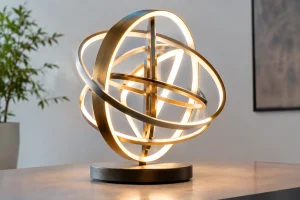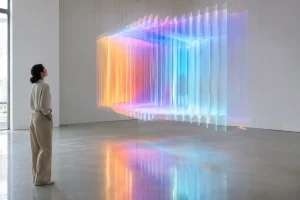
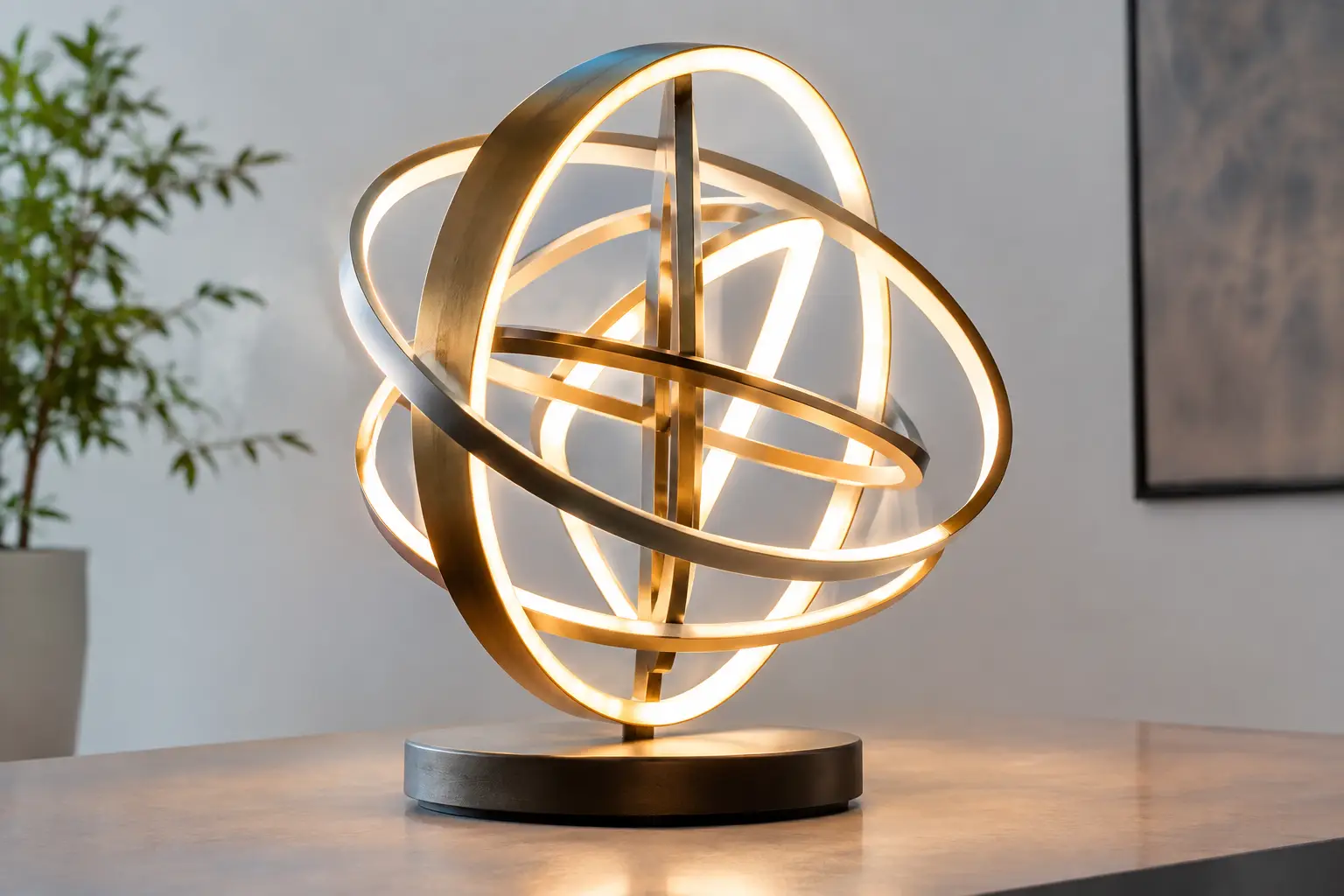
A room changes when its boundaries stop behaving like boundaries. A mirrored plane catches a line of light, repeats it, and suddenly the eye is no longer reading wall, object, and distance in the familiar order. It is trying to locate a space that appears to continue far beyond the physical structure in front of it. That is where illuminated art becomes more than illumination. It becomes an instrument for perception.
I build work around that moment of productive confusion. The sculptures begin with physics, geometry, and materials, then become an encounter with a question: what would a fourth spatial dimension feel like to a human body built to perceive only three?
Illuminated Art as a Perceptual Experiment
Light has no fixed appearance before it reaches an eye. It travels, reflects, scatters, enters the retina, and is assembled by the brain into color, depth, edge, movement, and form. Mirrors complicate that process because they produce images that appear behind their surfaces, even though the reflecting material is directly in front of us.
Place opposing mirrors around programmable LEDs and the effect can become startling. Every reflected light source is reflected again. The viewer sees a recession of luminous points and lines, a visual corridor whose apparent depth can feel infinite. It is not infinite, of course. Energy is lost at every reflection, and the light eventually fades. But perception does not measure the decay as a physicist would. For a few seconds, it accepts a depth that the object cannot physically contain.
That gap between measured space and felt space is central to my work. I am not interested in light as ornament. I am interested in light as evidence that the brain is constantly constructing reality from incomplete information.
Why the Hypercube Belongs in Physical Space
A cube is the three dimensional extension of a square. If a square has length and width, the cube adds height. A tesseract, also called a hypercube, is the four dimensional extension of a cube. It has an additional direction, one that cannot be pointed to inside ordinary three dimensional space.
This is not mystical language. It is geometry. A tesseract has sixteen vertices, thirty two edges, and twenty four square faces. Yet no physical object can display a complete tesseract in the same direct way that a wooden model can display a cube. To encounter it, a person must use projection, analogy, or mathematical description.
A familiar two dimensional analogy helps. Imagine a flat being living on a sheet of paper. A cube passing through that sheet might appear as a sequence of changing squares. The flat being could measure each square precisely, but would not see the entire cube at once. Human perception has a related limitation when it tries to imagine four dimensional form. A tesseract can be projected into three dimensions, but its full geometry exceeds the projection.
My infinity mirror hypercubes use this limitation as a material. They do not claim to be literal fourth dimensional objects. They stage the sensation of dimensional projection. Lines that appear to recede, multiply, and fold through reflective space invite the eye to experience a fragment of a geometry it cannot fully hold.
The Tesseract and Recursive Depth
The Tesseract is built as a five by five by five foot infinity mirror hypercube. Its physical dimensions are finite. Its experiential dimensions are not so obedient. The LED system produces a field of repeating light structures within the mirrored planes, while the cubic framework gives the body a stable reference point. The viewer knows where the edges are, then watches those edges dissolve into recursive depth.
That tension matters. Without the clear physical framework, infinity can become visual noise. Without the reflected light field, the structure remains only a cube. The work needs both conditions, an exact geometry that can be understood and an optical event that resists ordinary scale.
Programmable light also makes time part of the sculpture. A static pattern allows the eye to trace symmetry and repetition. A shifting pattern can cause the apparent volume to pulse, rotate, inhale, or collapse. The structure itself remains still, yet the visual system reports movement. This is an interactive encounter even before a viewer touches anything, because attention changes the experience. Shift your position by a few inches and the reflected architecture reorganizes.
Craft Is Where the Illusion Earns Its Power
An infinity mirror sculpture is not produced by placing lights between reflective surfaces and hoping for depth. The angles must be exact. The reflective materials need to preserve enough brightness across repeated bounces. The internal framework has to hold its geometry under its own weight, while leaving the optical field visually clean.
I work through these constraints as part of the concept. The engineering is visible in the result, even when it is not visible as hardware. A line that lands slightly out of alignment can rupture a mathematical rhythm. A light source that produces uneven color can make the mirrored field feel shallow. Power distribution, heat, cable paths, and the behavior of every LED channel shape whether the finished work reads as a convincing impossible space.
There are tradeoffs. Greater brightness can create an immediate impact, but it can also flatten subtle layers of reflection. Dense patterns can create exhilarating complexity, but a quieter sequence may better reveal the underlying hypercube structure. The right condition depends on viewing distance, ambient light, the scale of the installation, and whether the piece is meant to be encountered in passing or inhabited through sustained attention.
This is why mathematics and intuition must work together. Geometry establishes relationships that can be tested. Perception reveals whether those relationships generate wonder.
Interactive Art That Extends Beyond the Frame
The sculptures also have an interactive augmented reality activation. With an AR headset, viewers can virtually step inside the geometry rather than standing only outside its reflective threshold. This does not replace the physical work. It changes the question.
Standing before a mirror hypercube, the body sees itself at the edge of an impossible interior. Virtually inside it, the body becomes a moving coordinate within the structure. The viewer can look along illuminated axes, sense scale changing around them, and experience the hypercube as an environment rather than an object.
That interactive shift is especially compelling because it exposes how much spatial knowledge comes from movement. A mathematical diagram can communicate topology. An immersive environment can communicate orientation, disorientation, and bodily scale. These are different kinds of understanding, and both matter.
From Festival Night to Lucid Dream Logic
At Burning Man and other large scale immersive events, light sculptures meet an audience already prepared to question ordinary orientation. Darkness removes many of the visual cues that organize daytime space. Dust, music, movement, and open distance create a landscape where a bright geometric form can feel like a signal from another set of physical rules.
Thousands of people may approach the same work, but no two encounters are identical. One person studies the construction and sees optical engineering. Another sees sacred geometry. Another is reminded of the unstable architecture of a lucid dream, where a hallway extends after the body stops walking, or a room contains a horizon.
I value all of these responses, provided they remain connected to the actual mechanics of seeing. A dreamlike experience does not require abandoning physics. It can emerge precisely because physics, reflection, and neural interpretation are operating with exquisite complexity.
The most resonant illuminated art does not simply fill darkness. It gives darkness a structure, then asks the viewer to test that structure with their own eyes and movement. Stand still long enough before a recursive field of light. Notice where your certainty about inside, outside, near, and far begins to loosen. That moment of uncertainty may be the closest physical intuition we have for a dimension just beyond perception.