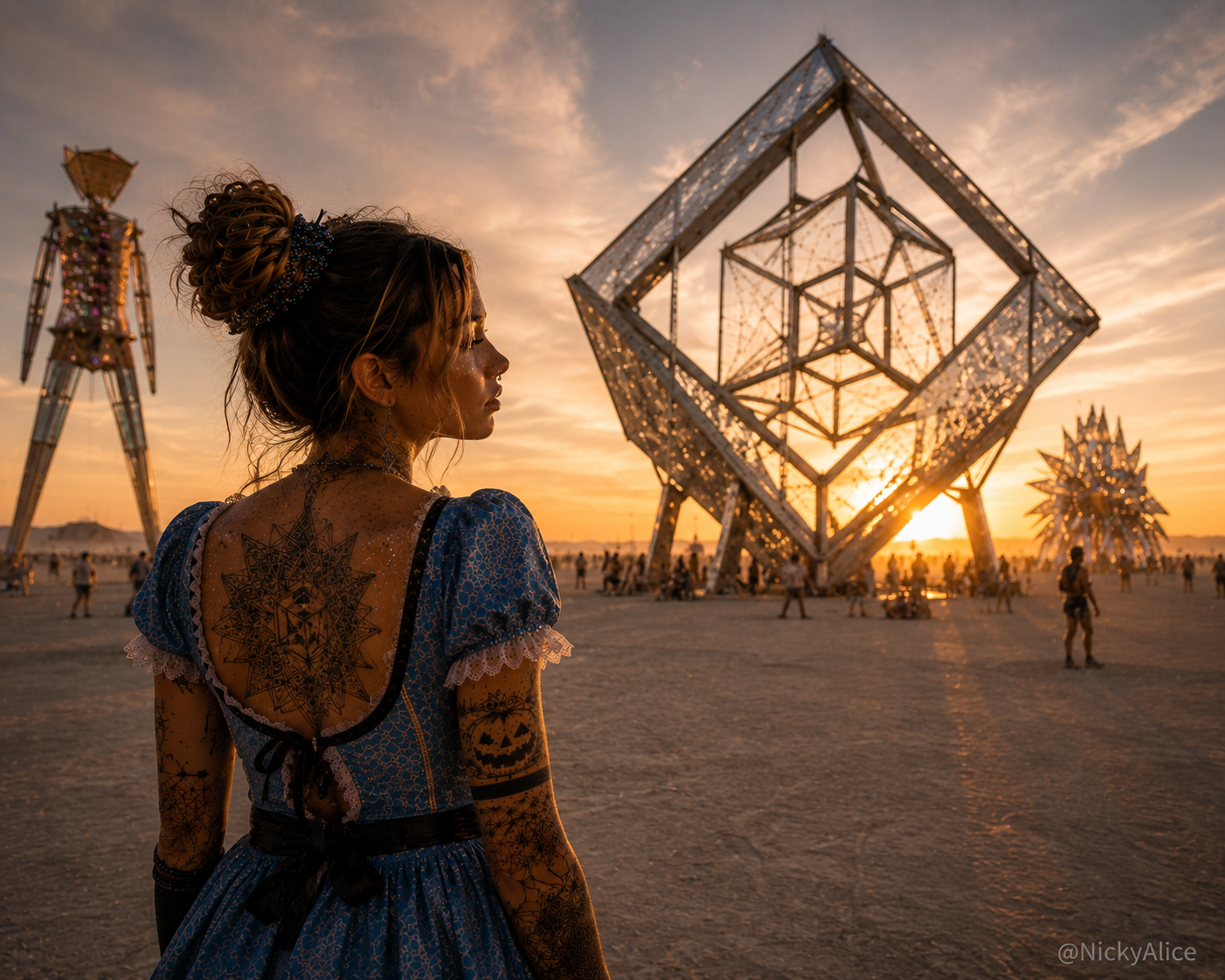
A sculpture rises from an empty expanse of alkaline dust. At night, its geometry becomes legible in light. By sunrise, it has become a meeting point, a landmark, a question, and perhaps a place where someone quietly changes their mind about what art can do. That is the art of Burning Man at its most potent: not an object placed in a setting, but a temporary world that asks its audience to enter.
For collectors and design patrons, Burning Man offers a provocative counterpoint to the familiar white-wall experience. Its most memorable works are often monumental, technologically demanding, and visually arresting. Yet their power does not come from spectacle alone. They are made to be encountered in motion, under an open sky, in the company of strangers, and with the full knowledge that the environment will disappear.
The Art of Burning Man Is Built to Disappear
The annual gathering in Nevada’s Black Rock Desert has become one of the most influential proving grounds for participatory, large-scale contemporary art in the United States. Its visual language is broad: fire sculpture, kinetic structures, immersive chambers, sound-responsive environments, temple architecture, vehicles transformed into moving fantasies, and works that use light to redraw the desert after dark.
But calling it a festival of installations misses the central idea. On the playa, a work is rarely complete when fabrication ends. Wind, dust, darkness, heat, human movement, and collective attention become part of its medium. A towering structure may look entirely different at noon than it does at 2 a.m., when LEDs, flame effects, or reflected light release its hidden architecture.
That relationship to time changes the stakes. In a gallery, permanence is usually a virtue. At Burning Man, impermanence can be the point. A work may be dismantled, burned, transformed by weather, or remembered more vividly than it was documented. The result is an art culture that prizes presence over passive viewing.
This is not a rejection of craft. Quite the opposite. Temporary work can demand extraordinary engineering, logistics, and material intelligence. Artists must account for wind load, public safety, transport, assembly, heat, dust, electrical systems, and the requirement to leave the desert without a trace. The romance of a glowing structure in the open desert rests on serious planning.
Why Participation Changes the Meaning of the Work
The strongest playa art does not merely provide a backdrop for photographs. It gives people something to do, feel, navigate, activate, or share. A visitor may climb a structure, trigger sound, contribute a message, sit inside a luminous chamber, or encounter a piece only because they chose to wander past the edges of the expected.
That distinction matters. Decorative objects are designed to complete a room. Experiential art can alter the behavior of everyone in it. It creates a temporary social contract: pause here, look closer, speak to the person beside you, become aware of scale, or notice how your body moves through space.
For a discerning collector, this is a useful lens for evaluating ambitious light sculpture at home. The question is not simply, “Will this fill the wall?” A more revealing question is, “What does this work ask a guest to experience?” A compelling piece can slow a room down. It can create a focal point that remains active as daylight changes, a dinner party unfolds, or programmable color shifts alter the emotional temperature of the space.
At Burning Man, the audience is also part of the composition. People in reflective garments, bicycles passing through darkness, voices, music from a distance, and the sheer unpredictability of the crowd all create conditions no studio can fully control. That is why documentation, however beautiful, often feels incomplete. The image captures form. It cannot fully capture encounter.
Light as Architecture, Tesseract by Nicky Alice
The Tesseract at Burning Man 2023: When Light Becomes Sculpture
The desert’s darkness has made Burning Man a serious laboratory for light based art. In an environment with almost no visual interruptions, illumination can establish scale, direction, and atmosphere with startling precision. A distant beacon becomes an invitation. A glowing corridor becomes architecture. A geometric field of LEDs can make a flat horizon feel dimensional.
In 2023, I brought my Tesseract to Burnign Man for the first time. The 5x5x5 foot infinity mirror sculpture made its debut on the playa, and the desert turned out to be the truest test a piece like this could face. No walls, no gallery lighting, no ceiling. Just a four dimensional hypercube rendered in architectural grade tempered mirrored panels and programmable LEDs, standing alone in the dark, asked to hold its own against the largest black canvas on earth.
Why the Playa Is the Ultimate Test for Light Art
This is where the influence of playa art extends far beyond the event itself. Artists, architects, and collectors have increasingly recognized that light is not an accessory applied at the end of a project. It can be a primary sculptural material. Not to mention all the people high on drugs trying to climb it on the first night.
The desert strips away every crutch. There is no soft interior lighting to flatter a weak form, no architecture to lend it borrowed structure. A work either generates its own presence or it vanishes into the dark. The Tesseract is built for exactly that condition. Its recursion does not depend on a room. The infinite reflections construct their own depth, so the sculpture reads as a corridor of light receding into space whether it sits on a collector’s wall or alone under a desert sky.
On the Playa: The Tesseract Debut
Watching thousands of people encounter the Tesseract for the first time, in the dark, at Burning Man, confirmed the thing I had believed since the design first came to me in a lucid dream years earlier. People do not just look at it. They lean in. They try to find where the physical object ends and the illusion begins, and they cannot, because that boundary is the entire point.
I captured the debut on video, and it says more than a paragraph can:
The most successful illuminated works use restraint as well as intensity. More brightness is not always more powerful. A subtle internal glow can create greater intrigue than a flood of color. Slow transitions feel more cinematic than rapid effects. A carefully programmed sequence reveals facets, voids, and reflections that would otherwise stay invisible. On the playa, where I could run the piece through its full range against total darkness, that programming became the difference between a light and a living thing.
From the Desert to the Collector’s Wall
That sensibility translates beautifully to collectible contemporary sculpture. An infinity mirror work does not simply emit light. It constructs the illusion of depth where the physical object ends. Repeated reflections pull the eye inward, turning a wall mounted piece into an apparent aperture, corridor, or impossible volume.
In a refined residential setting, that visual recursion creates the same pleasurable disorientation that makes a nocturnal desert installation unforgettable. The Tesseract that commanded the open playa is the same work that can anchor a dark hallway, a dim entry, or a low light living room after sunset. Interactive, programmable illumination lets a collector shift the piece from a quiet gallery glow to the full desert intensity, controlled virtually from a phone. The desert proved what the sculpture could do. A home is where it does it every night.
The geometry underneath all of it is real, not decorative. If you want to understand the four dimensional structure the Tesseract represents, I break it down in two short videos, building the Tesseract dimension by dimension and a closer look at how the hypercube unfolds.
Experience the Tesseract
See the Tesseract, the sculptures, and available works at nickyalice.com.
Follow the work in progress on Instagram, watch full installation videos on YouTube, and catch quick clips on TikTok.
Interested in bringing the Tesseract to your event, festival, or home? Reach out through nickyalice.com.
Nicky Alice approaches this territory through handcrafted hyper-dimensional forms that treat geometry as an experience rather than an academic reference. A Tesseract-inspired light sculpture can hold a room with a different kind of force than conventional art because it changes as the viewer changes position. It rewards return visits. It keeps the eye moving.
The Tension Between Ephemera and Collectibility
Burning Man art is often discussed as if its impermanence makes it the opposite of collectible art. That is too simple. The two worlds have different priorities, but they can inform each other.
A collector may want provenance, material quality, controlled installation, and a work that endures for decades. Those are reasonable expectations, particularly when acquiring a significant piece for a home, hospitality setting, office, or curated collection. A limited-edition, signed sculpture has a different relationship to authorship and stewardship than a desert installation designed for one brief encounter.
Still, Burning Man offers a challenge to collectors: do not confuse ownership with meaning. The most valuable works are not always those that occupy the most square footage or use the rarest materials. They are the ones that continue to generate perception. They create an atmosphere that cannot be reduced to a product category.
The trade-off is real. A highly interactive, programmable light sculpture asks more of its owner than a static canvas. It requires thoughtful placement, access to power, and decisions about mood, brightness, and programming. In return, it offers a living relationship with the space. The work can shift from contemplative to electric, architectural to intimate, depending on the moment.
This is particularly relevant in luxury interiors, where visual abundance can make rooms feel finished but emotionally flat. A single immersive statement piece can do more than a collection of agreeable objects. It can establish a point of view.
What the Desert Teaches Artists and Collectors
The deeper lesson of Burning Man is not that every work should be huge, illuminated, or built for a crowd. It is that art becomes more resonant when form, environment, and audience are considered together.
For artists, that can mean designing beyond the object itself. Think about shadow, reflection, sound, approach, sightlines, and the body of the viewer. Consider how a work changes from across the room to a few inches away. Build with enough conceptual clarity that technology serves the idea instead of obscuring it.
For collectors, it means buying with an eye toward encounter. Scale matters, but so does placement. A light sculpture at the end of a long hallway creates anticipation. The same work in a sitting room can become a quiet gravitational center. A programmable installation in an entry may announce a home’s identity before a guest hears a word.
The desert also reinforces the value of conviction. The works that remain in people’s memories are rarely timid. They make a clear visual proposition, whether that proposition is a cathedral of wood, a field of flame, a mirrored portal, or a luminous geometric impossibility.
A meaningful work of art should not merely occupy space. It should give space a new dimension – and leave the people who encounter it seeing their own surroundings with more curiosity than before.