A hypercube is never only an object. It is a question made visible: what would a fourth dimensional form feel like to a mind built to navigate three dimensions? The distinction between commissioned sculpture versus ready art matters because each path frames that question differently. One begins with a particular site, body, and encounter. The other carries a completed experiment into its next field of perception.
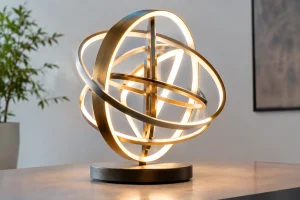
My work with infinity mirrors, programmable light, and spatial geometry is built around this tension. A sculpture can appear finite from the outside, then open into impossible recursive depth when someone approaches it. The physical frame remains present, but reflection loosens the viewer’s certainty about where the surface ends and space begins.
Commissioned Sculpture Versus Ready Art, A Difference in Time
A commissioned sculpture starts before the first material is cut. It begins with the dimensions of a space, the route through which people will encounter the work, the available power, ambient light, sightlines, and the desired intensity of interaction. At a festival, those variables can include dust, wind, darkness, thousands of moving bodies, and the strange clarity that arrives at three in the morning when a familiar world has become newly unreal.
Ready art begins from another kind of conviction. The geometry, scale, materials, and light behavior have already been resolved through the making process. It arrives with its own internal logic, asking the next setting to meet it rather than reshaping itself around that setting. This does not make it less alive. A finished infinity mirror remains variable because reflection is a conversation with its surroundings. Every person, angle, and change in light alters the image inside.
The real difference is not custom versus fixed in a superficial sense. It is whether the sculpture is designed as a response to a specific set of conditions, or whether it is a self contained transmission from a completed inquiry. Both can generate awe. Both can make an ordinary sense of scale collapse for a moment.
The Tesseract Is Not Just a Shape
The tesseract, or four dimensional hypercube, gives this distinction unusual force. Mathematically, a tesseract has eight cubic cells, twenty four square faces, thirty two edges, and sixteen vertices. No physical sculpture can contain that four dimensional object in the literal sense, because physical sculpture occupies three spatial dimensions. What it can do is construct a projection, analogous to the way a cube casts a two dimensional shadow.
A tesseract projection often looks like a cube nested inside another cube, joined at corresponding corners. That image is useful, but it is not the whole form. It is a three dimensional trace of a structure that extends along a direction human perception cannot directly occupy. Mirrors and LED light let me work in the gap between the mathematical model and the felt experience. Repeated reflections create depths that appear to continue beyond the frame, making the visible geometry feel less like a diagram and more like a threshold.
This is where sacred and spatial geometry become more than visual motifs. Symmetry gives the mind a pattern it can recognize. Recursive reflection then unsettles that recognition. The result can resemble a lucid dream, a place where architecture is precise but its scale cannot be trusted.
A Commission Starts With the Body in Space
When a work is made for a particular event or environment, geometry can be calibrated to the body. A five foot hypercube has a different psychological force from a smaller wall based work because the viewer does not merely look at it. The body measures itself against it. A large installation can feel architectural, even when its structure is open and transparent.
The viewer’s approach also becomes part of the design. A direct frontal encounter may reveal an apparent tunnel of light. A step to either side fractures the symmetry and introduces new layers of reflection. At Burning Man and other immersive festivals, this interactive behavior matters deeply. The work must hold attention at a distance, reward close observation, and remain compelling when a crowd turns the surrounding darkness into a moving field of silhouettes.
A commission can account for those behaviors from the beginning. Light programs can respond to an event’s atmosphere, from meditative slow transitions to high energy rhythmic sequences. Materials and structural engineering can be developed for the environment rather than treated as secondary considerations. The physics is practical: LEDs generate heat, mirror surfaces demand careful handling, power requires planning, and a large geometric form must remain stable under real conditions.
Ready Art Carries a Fixed Experiment Forward
Ready art has its own kind of integrity. It preserves a moment when an idea reached formal clarity. Its proportions are not provisional, and its light sequence has already been composed as part of the piece’s internal language. For people drawn to mathematics, this can be especially compelling. A completed structure offers a precise proposition that can be studied over time.
That precision does not prevent new experience. A mirror sculpture changes with the room’s illumination, with the viewer’s position, and with the people nearby. The work stays structurally consistent while its images remain unstable. This is one reason reflective art can feel interactive without requiring buttons, screens, or instructions. Perception is the mechanism.
Some ready works also include an interactive augmented reality activation. With an AR headset, viewers can virtually step inside the geometry and encounter the hypercube at a scale unavailable to the physical body. The virtual experience does not replace the sculpture. It clarifies the tension at its center: a bounded physical object can suggest a space with no obvious end.
Interaction Is a Form of Physics
Light does not simply sit on a mirror. It reflects according to angle, surface quality, and the position of the observer. In an infinity mirror, partially reflective glass allows some light to pass through while sending some back into the chamber. With repeated reflection, each image becomes dimmer, but the eye reads the sequence as receding depth.
That apparent infinity is not an illusion in the casual sense. It is a measurable optical process that produces an experience the nervous system interprets spatially. The mind is constantly building a model of the world from incomplete sensory information. Infinity mirror sculpture makes that model visible as it begins to fail, then rebuild.
For an event producer, this distinction is useful. An interactive installation does not need to demand attention with spectacle alone. The strongest encounters often give the audience agency through movement. Someone circles the work, sees an unexpected alignment, brings another person closer, then returns to the first angle because the space inside seemed to shift. The sculpture becomes a social instrument for curiosity.
The Most Useful Question Is About Encounter
The question is not whether commissioned sculpture or ready art is inherently more meaningful. It is what kind of encounter the work is meant to create. A site responsive hypercube can be tuned to the architecture, crowd flow, darkness, and energy of a particular gathering. A completed work can arrive as a concentrated statement, carrying years of mathematical and material investigation within a defined form.
Both paths can point toward the same larger mystery. Humans evolved to sense a world of length, width, height, and time, yet mathematics calmly describes spaces beyond that intuitive reach. When light, mirrors, and geometry make that fact visceral, the fourth dimension stops feeling like an abstract answer on a page. It becomes a sensation, brief but convincing, that reality may be larger than the senses that report it.