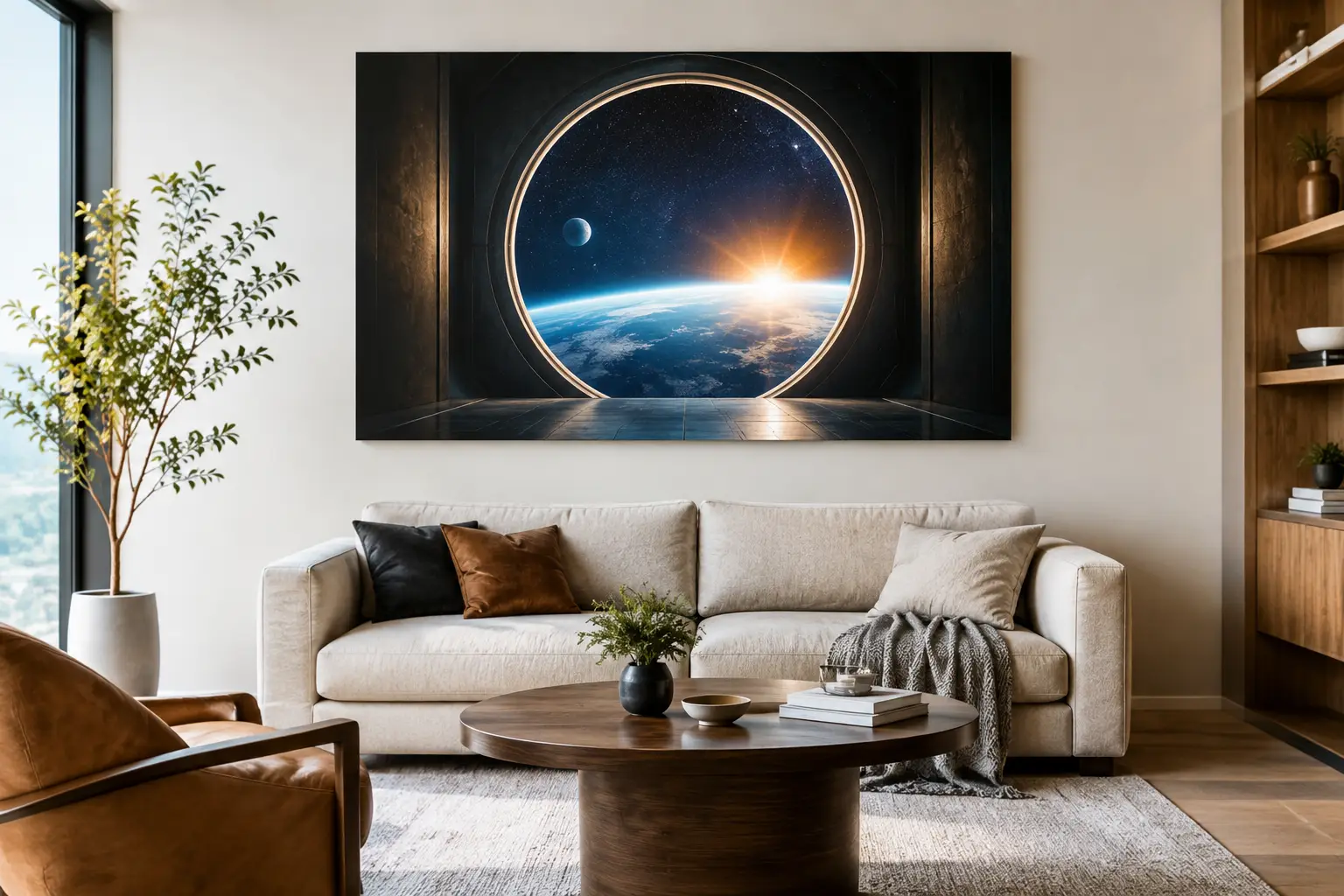
A wall can seem to stop at its surface until statement art for living room turns it into a question about perception. A field of mirrors and programmed light does not simply occupy space. It makes the eye search for a boundary, then removes the answer. The room remains physically finite, yet perception begins reporting impossible depth.
That tension is where a sculpture becomes more than an image. It can become a small experiment in consciousness, asking what human vision assumes about distance, reflection, volume, and reality itself. For people drawn to geometry, lucid dreams, physics, or the strange clarity of a night at Burning Man, this is not an abstract idea. It is a felt experience.
Statement Art for Living Room Can Alter Scale
Large immersive installations have a physical authority that is difficult to replicate. Standing before a five foot hypercube of reflective planes and light, the body becomes part of the measurement. A viewer can sense the structure extending beyond ordinary space, even while knowing its actual dimensions.
In a living room, the encounter changes scale but not ambition. The room becomes quieter, more intimate, and more attentive. Instead of passing through an installation among thousands of festival participants, a person can return to the same visual paradox at different hours, in different states of mind, and notice that the sculpture never offers exactly the same image twice.
Light depends on the viewer’s position. A slight movement of the head changes sightlines, reflected angles, apparent depth, and the geometry of the body within the piece. This makes the experience interactive without requiring a screen or a control panel. The observer is already inside the system.
That distinction matters. An artwork can be visually dramatic without changing the way someone inhabits a room. A spatial light sculpture changes the relationship between body and environment. It introduces an active uncertainty. Where does the surface end? Which lights are physically present? Is that distant point of color ten inches away or visually falling through a corridor with no end?
The Tesseract Is Not a Cube With Extra Drama
The tesseract is the four dimensional analogue of a cube. A point extends into a line. A line extends perpendicularly into a square. A square extends perpendicularly into a cube. If a cube could extend in a direction perpendicular to every familiar direction, the result would be a tesseract, also called a hypercube.
Mathematically, a tesseract has sixteen vertices, thirty two edges, twenty four square faces, and eight cubic cells. It cannot be physically built in four spatial dimensions because human experience is embedded in three. What can be built is a projection, much as a cube can be represented by a two dimensional drawing.
The familiar image of a cube inside another cube, with corresponding corners connected, is one projection of a tesseract. It is not the whole object, just as a shadow is not the thing casting it. Yet projections are powerful. They make a higher dimensional structure legible through the rules of a lower dimensional world.
I use this fact as both a mathematical foundation and a sculptural provocation. The outer frame gives the eye a stable reference. Reflection destabilizes it. Programmable LED light creates sequences that travel through the frame, illuminate spatial relationships, and suggest that the structure is rotating through an axis the body cannot access.
The effect is not a claim that a literal fourth dimensional object has appeared in the room. Physics deserves more precision than that. It is an encounter with the limits of the visual system, using a real geometric model and real optics to make higher dimensional intuition feel temporarily possible.
Mirrors Build Depth From Repeated Light
An infinity mirror works through partial reflection. A highly reflective rear surface faces a front surface that reflects some light while allowing some light to pass through. LEDs placed between them appear repeatedly in the receding reflections. Each pass loses some intensity, which is why the visual tunnel gradually falls into darkness rather than continuing with equal brightness forever.
This is physics doing theater. The depth is optically persuasive, but it is generated by a finite chamber. A carefully controlled angle, spacing, surface quality, and light level determine whether the chamber reads as shallow repetition or an opening into vastness.
For a hyperdimensional sculpture, mirror placement is not merely an effect added after the form is made. It is part of the geometry. Every reflective plane becomes an operator, transforming a single source of light into a recursive spatial event. A line becomes many lines. A frame becomes a corridor. A finite volume begins to suggest an interior larger than its exterior.
Programmable LEDs add a temporal dimension. A static arrangement may reveal the structure. A changing sequence can reveal relationships within it. Pulses can move from one vertex to another. Color can map a path through the frame. Gradual shifts can make the eye uncertain whether the form is moving, turning, expanding, or simply being reinterpreted by the brain.
This is why light art can feel unusually alive. The materials are fixed, but perception is not. The work has an interactive quality because each glance is an act of reconstruction.
A Room Becomes a Site for Dimensional Thought
Statement art for living room does not need to announce itself through size alone. Its real scale can be conceptual. A mirror sculpture can hold a question large enough to follow someone long after the lights are off: if vision can be so confidently misled by reflection, what else does the mind simplify in order to make reality manageable?
This question has a natural kinship with lucid dreams. In a lucid dream, familiar architecture can suddenly become unstable. A hallway lengthens. A door opens into a place with no geographic logic. The dreamer recognizes the impossibility and, for a moment, inhabits it anyway.
Infinity mirrors create a waking analogue. The room is still there. The materials are visible. The laws of optics remain intact. But the visual result interrupts the ordinary agreement between what is seen and what is expected. That interruption can feel dreamlike because the mind encounters a space it understands intellectually but cannot fully reconcile perceptually.
Sacred geometry is often discussed as though its power must be mysterious. Geometry needs no mystery to be profound. Symmetry, recursion, proportion, and dimensional projection are already extraordinary. They reveal that simple rules can produce forms of immense complexity, from crystalline structures to orbital patterns to the branching systems of living things.
A hypercube sculpture belongs to this lineage, not as an ornament for a room but as a physical meditation on structure. It asks the viewer to stand beside an equation, inside a projection, and before an image that refuses to be exhausted by a single angle.
From Festival Scale to Intimate Encounter
At Burning Man and other immersive art gatherings, light installations operate in a different sensory climate. Dust, music, movement, darkness, exhaustion, and collective curiosity make perception more porous. A glowing geometric form can become a landmark, a meeting point, a temporary temple, or a portal shared by strangers.
The Tesseract was made for that kind of encounter. People gather around it, photograph it, lean toward its apparent depths, and recognize themselves multiplied inside a structure that resembles both advanced mathematics and a lucid dream. The work is interactive because bodies continually alter the visual composition. It is also interactive through augmented reality, where viewers can virtually step inside the geometry with an AR headset and explore a perspective unavailable to the physical body.
Bringing that visual language into a living room does not reduce its intensity. It changes the rhythm. Festival art is often a flash of astonishment. A sculpture encountered every day can become a recurring calibration of attention. Morning light, evening darkness, conversation, solitude, and movement through the room all create different conditions for the same geometry.
For event producers, curators, and people building spaces around experience, that is a useful idea. Immersion is not only a matter of spectacle. It is the result of a work giving perception something active to do.
The Most Interesting Surface Is a Threshold
A mirror is commonly treated as a surface that returns an image. In an infinity structure, it becomes a threshold between physical space and visual space. The viewer sees an interior that does not exist in the ordinary architectural sense, yet the experience of looking into it is real.
That is the territory I want the work to occupy. Not fantasy detached from material fact, and not technical display without wonder. Light has a speed. Reflection follows measurable laws. A tesseract has a precise mathematical description. When those facts are built carefully into an interactive sculpture, they can produce an encounter that feels larger than explanation.
The room does not have to become another world. It only has to admit that this one is stranger, deeper, and more dimensional than the eye first assumes.