A lucid dream can begin with a small impossibility: a room has no ceiling, a staircase folds back into itself, or a mirror opens onto a space far deeper than the wall that holds it. In that instant, lucid dreaming and creativity become inseparable. The dreamer is no longer only receiving an image. The dreamer is observing the image system from within, testing its rules, and sometimes changing them.
For Alice, that threshold is familiar territory. I build physical structures that ask perception to question itself: mirror chambers, programmable light, recursive reflections, and the geometric logic of a hypercube translated into human scale. A lucid dream does something related without materials. It turns consciousness into an interactive environment, where space, identity, and causality can become fluid.
Why lucid dreams feel creatively charged
Ordinary dreaming is already a remarkable act of image generation. The brain composes faces, landscapes, sensations, and narratives while much of the sensory information from the waking world is reduced. Lucidity adds metacognition, the awareness that one is dreaming. That awareness can be unstable, sometimes lasting only seconds, yet it changes the relationship to the experience.
Creativity often depends on holding two apparently incompatible conditions at once: openness to surprise and enough attention to recognize what matters. A lucid dream offers both. The dream can deliver an image that no waking plan would predict, while the lucid dreamer can pause and investigate it. What happens if the impossible corridor is entered? What is on the other side of the shifting mirror? Can an object be rotated through a direction that does not exist in ordinary space?
The value is not that dreams provide perfect instructions. Most dream material is incomplete, emotionally exaggerated, or impossible to remember with precision. Their creative force is in disruption. A dream interrupts the efficient habits of waking thought and replaces familiar scale, gravity, and sequence with a more permissive physics.
Lucid dreaming and creativity as spatial research
Artists, mathematicians, and physicists face a related problem when thinking about higher dimensions. Human vision and touch evolved for three dimensions of space. A four dimensional object cannot simply be placed on a table and seen from the outside, because any view available to us is necessarily a three dimensional projection.
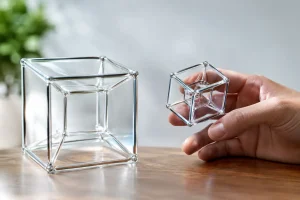
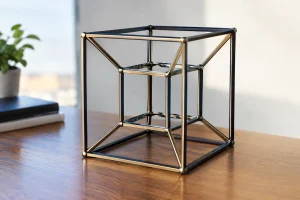
The tesseract, or four dimensional hypercube, is a clean example. A square relates to a cube through extension into a new spatial direction. A cube relates to a tesseract through the same conceptual move. The difficulty is not the mathematics. The equations can be written clearly. The difficulty is perceptual intuition.
Dreams occasionally supply a strange approximation of that missing intuition. A dream room may be larger inside than outside. Two distant places may touch. A person may walk around an object and return to the same position by a route that could not exist in waking architecture. These scenes are not evidence that the brain has literally accessed a fourth spatial dimension. They are evidence that the brain can construct spatial models that do not have to obey the constraints of the physical room around the sleeping body.
That distinction matters. I am interested in wonder grounded in real geometry, not claims that cannot be tested. Yet imagination is still a serious instrument. Before a structure can be engineered, it often has to be mentally inhabited. Lucid dreaming can become a rehearsal space for that act of inhabitation.
The dream is not the artwork
A powerful dream is raw material, not a finished form. Its intensity can make an idea seem complete when it is not. Bringing it into sculpture requires another kind of discipline: measurements, optical angles, materials that can carry light, wiring, power planning, structural tolerance, and repeated testing of what a body actually perceives while moving through space.
This is where creativity becomes craft. In an infinity mirror work, reflected light travels between partially reflective surfaces. Each reflection loses some intensity, but the sequence creates apparent depth. The installation does not contain an infinite tunnel in any literal sense. It creates a visual system that persuades the eye to accept recursive depth.
That perceptual persuasion resembles dreaming. In both cases, the observer encounters a constructed world and temporarily accepts its internal logic. The difference is that an installation makes the construction visible. It asks the viewer to feel the illusion while also recognizing the physics that produces it.
The creative advantage of impossible rules
Lucid dreamers often talk about flying, changing scenes, or summoning an object. Those experiences can be exhilarating, but the richer creative question is not, “What can I control?” It is, “What rules is this world using?”
A dream may resist direct commands. Ask for a door, and a window appears. Try to fly, and the ground rises instead. That resistance can be more useful than total control because it preserves surprise. Creative work becomes thin when every outcome is already known.
I think of interactive installations in a similar way. An interactive artwork should not merely obey. It should establish a relationship between structure and participant. As viewers move, reflections shift. As programmable LEDs change color and rhythm, the apparent geometry changes with them. The piece responds to perception because perception is part of the medium.
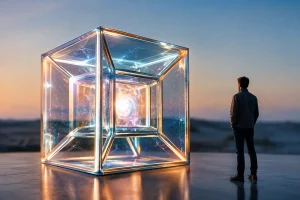
In an augmented reality activation, a viewer can virtually step inside a hyperdimensional mirror sculpture. The interactive experience does not replace the physical work. It offers another mode of encounter, one where the body can move through a geometry that is ordinarily closed by material boundaries. Virtual entry can make the question more immediate: if the inside seems to exceed the outer volume, what exactly is the mind using to judge space?
A practice for carrying dream images into waking work
The fragile point is waking. Dream memory fades rapidly because the brain is shifting states, attention is returning to the room, and language often arrives after the image has already begun dissolving. If lucid dreaming is part of a creative practice, capture should happen before interpretation.
Keep a notebook or voice recorder beside the bed. Record concrete details first: the direction of light, the surface of walls, the scale of objects, the sequence of movement, and any impossible geometry. “A beautiful strange place” is less useful than “a blue corridor reflected itself eight times, then turned into a cube viewed from inside.” Specificity gives the waking mind something to build from.
Later, translate the image through several lenses. Sketch its spatial logic. Ask whether it could be modeled as a projection, a reflection system, a nested volume, or a distortion of perspective. Then ask what emotional condition the geometry carried. Awe, vertigo, reunion, claustrophobia, and transcendence are not decorations applied after the fact. They inform how light should move, how long an observer should linger, and whether the work should feel stable or perpetually unresolved.
It also helps to accept that some dream images should remain impossible. Not every vision needs to be forced into fabrication. A failed translation can still reveal a useful boundary, showing precisely where available material or physics diverges from the mind’s private cinema.
From private dream to shared perception
At Burning Man and other immersive events, large scale light works create a social version of this threshold state. A person may arrive alone, late at night, tired, alert, disoriented by distance and darkness. Then light appears in the desert, structured enough to feel intentional and strange enough to suspend ordinary expectation.
The most memorable encounters are interactive because bodies complete them. One viewer sees a tunnel. Another sees a jewel box of reflections. Someone else stands still long enough to notice the exact moment a cube becomes a suggestion of a tesseract. The work remains physically consistent, but perception keeps generating new readings.
Lucid dreaming offers a useful ethic for that encounter. Notice the world while it is happening. Question its assumptions. Let the impossible image expand the range of what feels thinkable, then return to the real constraints with sharper eyes. Creativity does not require escaping reality. Sometimes it requires building a precise enough illusion that reality reveals how much more it contains.