
A mirror artist does not simply make reflective objects. At the highest level, the medium becomes a controlled illusion: light multiplied into apparent infinity, geometry made physical, and a familiar surface transformed into a threshold. The result is not wall decor. It is a sculptural event that changes the atmosphere of a room the moment it powers on.
For collectors drawn to contemporary art, advanced design, and the visual language of the future, mirror-based light sculpture offers a rare combination. It has the intellectual rigor of mathematics, the emotional pull of color and movement, and the physical authority of a handcrafted object. A well-conceived infinity mirror can command a gallery wall, alter the perceived scale of an entryway, or become the singular focal point of a private lounge.
Mirror Art Is Built on Perception
The visual force of an infinity sculpture begins with an optical system. Mirrors, partially reflective surfaces, precisely positioned LEDs, and a carefully constructed enclosure work together to create repeating planes of light. The eye reads those repetitions as depth, even when the sculpture has a relatively shallow physical profile.
That apparent contradiction is the point. A finite object suggests an endless interior. Light appears to recede beyond the wall, while a geometric form remains materially present in the room. The piece asks the viewer to hold two ideas at once: this is a fabricated sculpture, and this is an opening into somewhere impossible.
A mirror artist has to choreograph that experience with unusual precision. The placement of each light source affects the rhythm of the reflections. Material selection changes the clarity, warmth, and edge definition of the image. Even a small shift in proportion can determine whether a work feels architectural and commanding or visually cluttered.
This is why not every illuminated mirror earns the status of collectible art. The technology can be accessible. The authorship, fabrication discipline, compositional judgment, and conceptual intent are far less common.
Why Geometry Gives the Work Its Power
Geometry gives infinity mirror sculpture its structure and its mythology. Cubes, portals, concentric forms, and hypercube-inspired compositions are not arbitrary patterns. They provide a visual order that lets the eye travel through an otherwise overwhelming field of reflection.
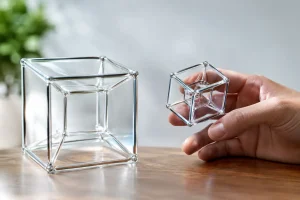
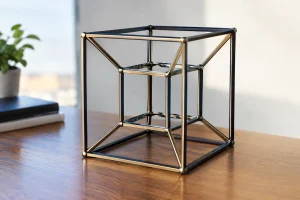
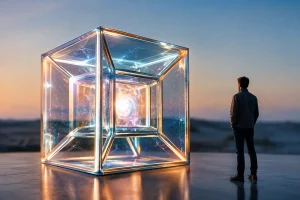
The Tesseract is especially compelling because it refers to a four-dimensional hypercube, an object that cannot be fully seen in ordinary three-dimensional space. When translated into sculpture, it becomes a powerful visual paradox. The form is recognizable yet impossible. It feels engineered, ancient, futuristic, and strangely familiar all at once.
For a collector, that complexity matters. A strong work rewards repeated viewing. In daylight, it may read as a refined sculptural object with crisp lines and a considered material presence. At night, the lighting system activates a second identity, introducing spatial drama, color, and dimensional movement. The piece does not become a different work. It reveals another layer of its own logic.
Sacred geometry carries a similar resonance. Repetition, symmetry, and proportion can create a meditative experience without becoming literal or ornamental. The best pieces leave room for interpretation. One viewer may see cosmology; another may see code, architecture, or pure abstraction.
Light Is a Material, Not an Accessory
In luxury interiors, lighting is often treated as a finishing layer. In hyper-dimensional mirror sculpture, it is a primary material. Its behavior determines the emotional temperature of the work.
A warm amber sequence can make an installation feel intimate and ceremonial. Deep blue can create a sense of distance and quiet. Saturated magenta, electric green, or rapid color transitions can push the work toward a more kinetic, nightlife-inflected energy. Programmable LEDs give the collector agency, but the range of effects should still feel intentional rather than gimmicky.
That distinction is critical. More colors do not automatically create more art. Sophisticated lighting design depends on pacing, contrast, brightness control, and the way a programmed scene interacts with the mirror chamber. A slow pulse may make depth feel immeasurable. A restrained gradient can reveal the geometry more clearly than a chaotic sequence ever could.
Smartphone-controlled lighting can be especially valuable in a residence or hospitality setting because the sculpture can respond to the occasion. A collector may choose a clean white architectural mode for a daytime gathering, then shift to a saturated custom palette after dark. The artwork remains authored, yet it can participate in the life of the space.
The Difference Between Decor and a Collector Piece
The market is full of objects designed to photograph well for a moment. A serious mirror sculpture is designed to endure attention. It should have a distinct visual language, disciplined construction, and an identity that cannot be reduced to a trend.
Collectors evaluating a piece should look beyond the initial spectacle. Ask whether the geometry feels resolved from multiple angles. Consider how the work performs when switched off as well as illuminated. Notice the depth of the reflections, the quality of the finish, the integration of the hardware, and the intentionality of the color programs.
Provenance also matters. Limited editions, signatures, edition numbers, and certificates of authenticity help establish the work as art rather than interchangeable decor. For commissioned work, documentation of the concept, dimensions, materials, and lighting configuration becomes part of the object’s story. It records why that specific sculpture exists in that specific form.
Exclusivity is not just a matter of scarcity. It is the confidence that the work was made with a singular point of view. A handcrafted Tesseract-inspired sculpture carries the imprint of the maker’s decisions: how the planes are joined, how the illusion is calibrated, how the light moves, and where the boundaries between sculpture and architecture begin to dissolve.
Choosing Scale for the Space
Scale changes everything. A smaller work can create an intimate, jewel-like portal in a study, dressing room, or private collection wall. A larger sculpture can establish the identity of a double-height foyer, media room, gallery corridor, or penthouse living space.
There is no universal correct dimension. It depends on viewing distance, surrounding materials, ceiling height, and whether the piece is meant to be discovered or immediately confronted. A work placed at the end of a long hallway can benefit from a stronger visual pull. A sculpture above a console may require proportionate restraint so it complements the furniture rather than visually consuming it.
Custom sizing is therefore more than a luxury option. It allows the geometry to meet the architecture on its own terms. Before commissioning, consider the intended wall, nearby art, ambient light, access to power, and the desired emotional effect. A quiet portal and a room-defining installation demand different decisions.
Power planning deserves attention early in the process. A clean installation protects the illusion. Depending on the artwork and location, that may mean planning for a discreet outlet, a concealed cable route, or a flexible power solution suited to the room. The finest visual experience is one where the viewer sees only form, light, and depth.
Commissioning a Work With Intent
A commission is an opportunity to collect something that cannot be replicated by choosing a finish from a catalog. The strongest conversations begin with the space, but they do not end there. They also consider the collector’s relationship with color, geometry, technology, and atmosphere.
Some clients want a sculpture that echoes the angular language of a modern residence. Others want deliberate contrast: a luminous mathematical object set against soft plaster, historic woodwork, or restrained natural stone. Both approaches can be striking. The question is whether the artwork should extend the room’s existing visual vocabulary or interrupt it with a new one.
It is also worth deciding how much control the owner wants. A programmed work can maintain a signature sequence selected by the artist, offer a curated set of moods, or provide broader control for changing environments. Greater customization can make a piece more personal, though too many options can dilute the clarity of the original artistic vision. The right balance depends on how the work will be lived with.
At Nicky Alice, hyper-dimensional mirror sculpture is approached as a meeting point between exacting fabrication and imaginative possibility. Each work is built to create more than a visual effect. It creates a presence: a concentrated field of light and form that gives a room its own gravitational center.
The most rewarding mirror art does not ask to be glanced at and forgotten. It invites the viewer to step closer, question the space in front of them, and recognize that a wall can hold far more than an image. It can hold a new dimension of the room itself.