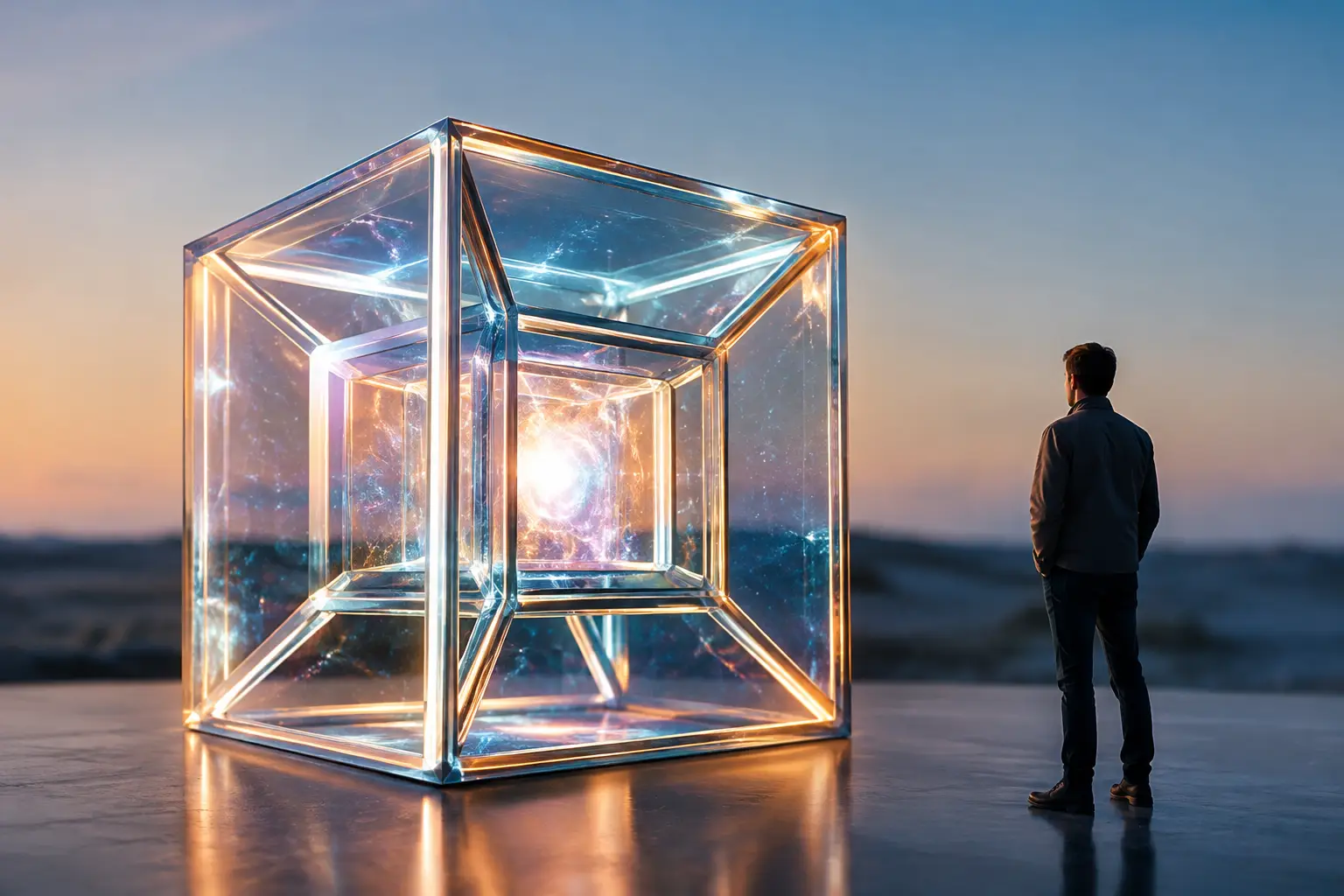
The phrase tessseracts as portals for time traveling sounds like science fiction until the mind pauses over a more interesting question: what would time look like if it were spatially accessible? A tesseract cannot transport a body into yesterday. Physics gives no evidence that a geometric sculpture opens a literal passage through time. Yet the hypercube offers something more immediate and, in its own way, stranger. It gives the imagination a rigorous structure for sensing a dimension beyond ordinary vision.
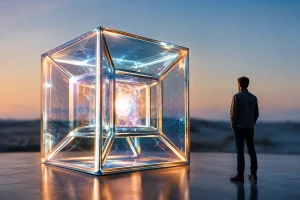
A person standing before an infinity mirror tesseract sees depth repeat beyond the reach of the room. Planes appear to fold inward. Edges multiply, then seem to recede into a place with no final wall. The experience can resemble a lucid dream, where the familiar rules of space still operate but no longer feel complete. That fracture in certainty is where the tesseract becomes portal like, not as a machine of physical transport, but as an instrument for altered perception.
Why a Tesseract Changes the Idea of a Room
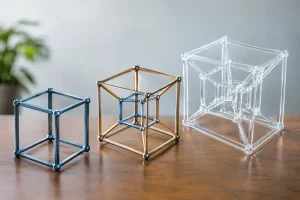
A cube is simple to hold in the mind because human perception evolved in three spatial dimensions. It has length, width, and height. A tesseract, also called a four dimensional hypercube, extends that pattern one dimension further. Where a square has four edges and a cube has twelve, a tesseract has thirty two edges, twenty four square faces, eight cubic cells, and one form that contains them all.
The difficulty is not that the mathematics is mystical. The difficulty is that a complete four dimensional object cannot be placed directly before three dimensional eyes. What can be shown is a projection, just as a cube can cast a two dimensional shadow. Draw a cube on paper and some edges overlap or distort. The drawing is not the cube itself. It is a translation between dimensions.
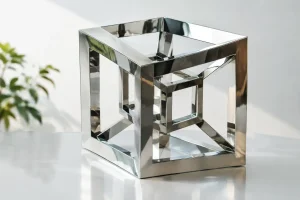
A tesseract projection works the same way. The familiar image of a small cube nested inside a larger cube, joined at corresponding corners, is a spatial translation of the hypercube. The inner cube is not simply sitting inside the outer cube. In the mathematics of the projection, it represents a related region of a shape extending along a fourth spatial axis that cannot be pointed toward in ordinary space.
That distinction matters. The tesseract does not ask anyone to abandon reason. It asks the mind to recognize that perception is not identical to reality. Human eyes are excellent at navigating a three dimensional environment. They are not built to intuit every geometry that mathematics can describe.
Can Tessseracts as Portals for Time Traveling Be Real?
If the claim is literal time travel, the honest answer is no. A tesseract, whether rendered in an equation or built as sculpture, does not override causality. General relativity does show that time is not universal in the naive sense. Motion and gravity affect the rate at which clocks pass. A clock traveling at extraordinary speed measures time differently from one at rest. A clock nearer a massive object also measures time differently from one farther away.
These are experimentally supported features of spacetime, not metaphors. But they do not make a hypercube an entrance to the past. The equations that permit speculative structures such as closed timelike curves come with profound physical problems. Some require conditions never observed in nature. Others threaten causality itself, raising the old paradox of an effect changing its own cause.
Still, there is a legitimate connection between higher dimensional geometry and time. In relativity, an event is specified by three coordinates of space and one coordinate of time. A person does not experience that four dimensional spacetime all at once. Consciousness receives a moving slice, an unfolding present. The past survives as memory, the future as possibility, while the body occupies one local moment.
A tesseract is not a model of spacetime, because its fourth direction is spatial rather than temporal. Conflating the two erases real mathematical differences. Yet placing a four dimensional spatial object before the senses can destabilize the assumption that the visible world exhausts the possible world. It becomes a compelling analogy for the limits of a creature that moves through time but cannot step sideways out of it.
The Portal Is a Projection Machine
My tesseract sculptures begin with geometry, not with an attempt to imitate a movie prop. The proportions, vertices, and connecting lines must hold together as a coherent hypercube projection. Then the physical problem begins: how can flat reflective surfaces, internal depth, and controlled color create an encounter that feels larger than the material volume?
Infinity mirror architecture provides one answer. Repeated reflection sends an image back and forth between surfaces, generating a visible recession that is physically finite but perceptually unstable. Each reflection loses a little intensity, so the apparent depth gradually dissolves rather than ending at a hard boundary. The eye reads recurrence as distance. The body knows it is standing before an object, but another part of the mind keeps searching for the end.
This is not an illusion in the trivial sense of a trick that disappears once understood. Knowing the optics can intensify the experience. Light follows describable paths. Reflective surfaces obey measurable angles. Yet a collection of exact physical behaviors produces a sensation of impossible extension. The gap between mechanism and feeling is where art becomes an experiment in perception.
Inside an interactive installation, changing position alters the projected geometry. A step to one side can make lines converge, separate, or appear to rotate through each other. No object has actually entered a higher dimension. The viewer has, however, become part of the system. Vision, motion, reflection, and spatial expectation are continuously calculating together.
Festival Space and the Shared Fourth Dimension
At Burning Man and other immersive gatherings, a tesseract enters a very different context from a quiet gallery wall. Dust, sound, darkness, movement, and thousands of distinct states of attention become part of the sculpture’s medium. Someone may encounter the work after hours of walking across open playa. Someone else may arrive with a background in topology, ready to interrogate every edge. Both can find a valid entrance.
The strongest festival art does not dictate one correct reaction. It establishes conditions for attention. A large hyperdimensional mirror form can become a meeting point, a place for conversations about physics, a site for stillness, or a threshold people cross together without fully agreeing on what they saw. That plurality is fitting for a tesseract. A projection changes with viewpoint, and so does its meaning.
Interactive augmented reality extends the question virtually. With a headset, a viewer can step inside the projected structure and experience relationships of scale that a physical body cannot occupy in the same way. This interactive layer does not replace the material sculpture. It offers another kind of projection, one that lets the visitor test the difference between looking at a hypercube and moving through an interpretation of it.
There is a tradeoff here. Virtual experience can make geometry feel immediate, but physical presence provides resistance: the scale of the structure, the pull of reflection, the awareness of other bodies nearby. The most resonant installations keep both facts alive. Mathematics can be exact, and experience can remain unresolved.
Time Travel as a Practice of Attention
The most useful version of time travel may be less about escaping chronology than changing the density of a moment. A powerful spatial encounter interrupts automatic seeing. For a few seconds, the mind stops labeling the environment and begins asking basic questions again. Where does this surface end? Which direction is forward? Is depth inside the object, behind it, or constructed by my own visual system?
Those questions are not a retreat from science. They are the beginning of it. Physics starts by noticing that the world behaves more strangely than intuition predicts. Geometry starts by granting form the right to exceed familiar space. Art can place that intellectual opening in the body, making an abstract dimension feel close enough to inhabit.
A tesseract will not carry anyone into another century. But when its recursive depths make a room feel briefly larger than the senses can map, it can return attention to a more radical fact: reality may contain structures that are perfectly real before they are fully imaginable.