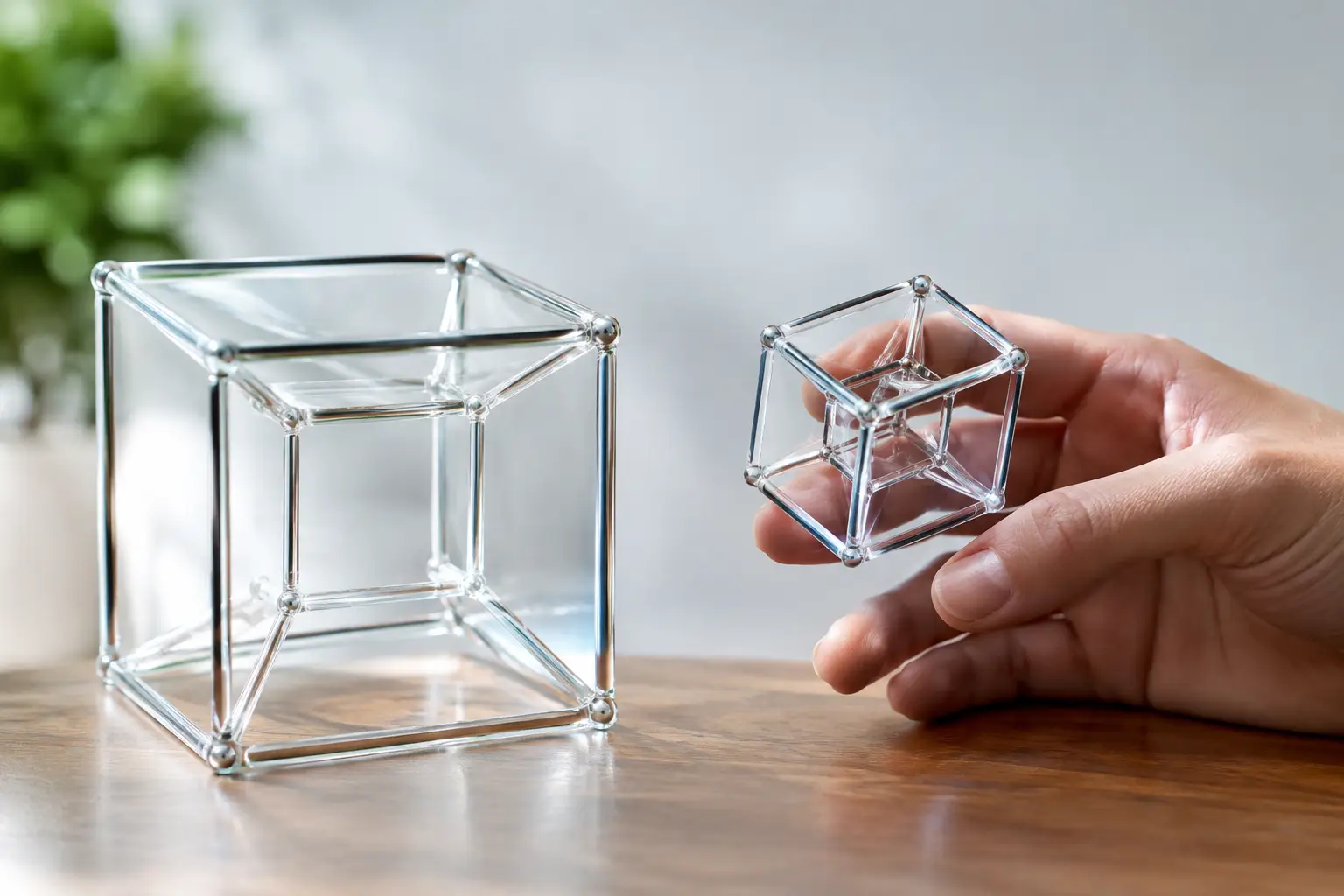
A cube is easy to trust. It has faces, edges, corners, and a scale the hand understands. Physics and tesseracts begin where that confidence breaks. A tesseract is the four dimensional analogue of a cube, a figure with eight cubic cells that cannot be fully held inside the three dimensions of ordinary space. Yet it can be projected, reflected, calculated, and made emotionally immediate.
That tension is the source of its power. The tesseract is not merely an exotic shape from mathematics. It is a precise challenge to perception. It asks whether the limits of sight are also the limits of reality, and whether an object can feel present even when its complete form can never appear before us.
Physics and tesseracts begin with projection
The easiest way to approach a tesseract is to start with a sequence of dimensions. A point has no length. Pull it through space and it becomes a line. Move the line in a new perpendicular direction and it sweeps out a square. Move that square in another perpendicular direction and it creates a cube.
The same operation, carried one step further, generates a tesseract. A cube moves through a fourth spatial direction, perpendicular to the familiar three. The result contains eight cubes, just as a cube contains six squares and a square contains four lines.
No one can point toward that fourth spatial direction in a room. Human bodies and instruments are built within three extended spatial dimensions, so a complete tesseract cannot simply arrive as an ordinary object. What can arrive is a projection.
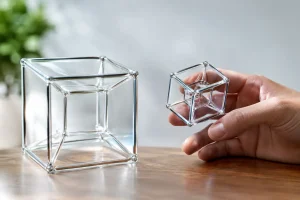
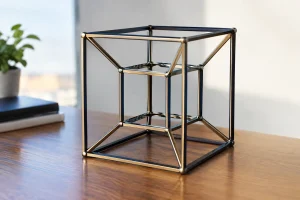
A shadow is a projection. A three dimensional hand can cast a two dimensional silhouette on a wall, but that silhouette does not contain the hand in full. It contains selected information about the hand from one angle. In the same way, the familiar wireframe tesseract, a small cube apparently nested inside a larger cube with connecting edges, is a three dimensional projection of a four dimensional structure.
This is why it can look unstable. Rotate a cube in ordinary space and its projected outline changes. Rotate a tesseract through four dimensions and its three dimensional projection changes in ways intuition has not practiced. Cubes seem to pass through one another, interior and exterior exchange roles, and a stable object appears to breathe.
A tesseract is geometry, not proof of extra space
There is a necessary distinction here. Mathematics can define a four dimensional Euclidean space with complete rigor. Physics does not automatically claim that a large, accessible fourth spatial dimension exists beside left, right, forward, back, up, and down.
Relativity treats time as part of spacetime, often described with four coordinates. But time is not simply another direction that behaves like width. Its role in the geometry of spacetime has a different metric signature, and causality gives it a character that a spatial axis does not share. Calling time the fourth dimension is useful in some contexts, but it does not make a tesseract into a cube moving through time.
Some physical theories do consider additional spatial dimensions. In certain models, those dimensions may be compactified, meaning curled into scales far beyond direct perception. These ideas are serious areas of mathematical physics, but they remain distinct from evidence that a walkable fourth spatial direction is available in everyday life.
For me, that distinction sharpens the artwork rather than reducing it. The tesseract does not need to be a secret scientific artifact to produce awe. It is already a real mathematical object, and its projections reveal a profound fact about human perception: seeing an object is never the same as possessing the whole object.
Reflection makes depth behave strangely
Mirrors provide a physical language for this problem. A mirror does not create an actual second room behind its surface. It redirects rays of light so the eye traces them backward and locates an apparent image in a place that is not materially occupied. The image is virtual, but the visual experience is persuasive because the geometry of reflection is exact.
When reflective surfaces face one another, each surface receives an image that already contains another reflection. The result is recursive depth. Every apparent chamber contains another chamber, reduced in brightness and shifted by the geometry of its path. The eye reads this sequence as extension, repetition, and distance, even when the sculpture has a finite physical boundary.
That is the physics I work with when building hyperdimensional mirror sculpture. The structure is finite. The experience can feel unbounded. A viewer sees edges that multiply beyond reach, faces that appear to fold into themselves, and a center that becomes difficult to locate.
The illusion depends on craft as much as imagination. Angles must align. Materials must hold their geometry. Reflective planes must be positioned to create a legible recursive field rather than visual noise. The mathematics determines the skeleton, while optical behavior determines whether the skeleton becomes a convincing perceptual event.
The body is part of the equation
A tesseract projection on a screen can be understood intellectually. An immersive tesseract changes when the viewer changes. A step to the side shifts the reflected paths. A turn of the head rearranges apparent depth. A raised hand enters the field and becomes part of an unfolding spatial experiment.
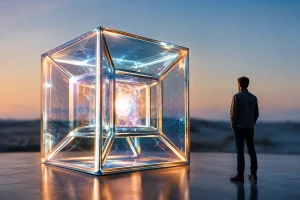
This is why scale matters. In a 5 by 5 by 5 foot hypercube, the body is no longer outside the geometry looking in. It becomes the moving reference frame through which the geometry is interpreted. The work is interactive without requiring a button or a lesson. Perception itself is the interaction.
That experience has a close relationship to lucid dreams. In a dream, a corridor may become longer after it has been crossed. A room can contain an ocean, a childhood memory, or an impossible number of doors without triggering the ordinary alarm of logic. Lucidity introduces a second awareness: the dream is convincing, but its rules are negotiable.
Immersive geometry can produce a gentler waking version of that recognition. The eye reports infinity. The reasoning mind knows the object is bounded. Neither response needs to defeat the other. The space becomes interesting precisely because both are active at once.
Sacred geometry earns its force through structure
Sacred geometry is often discussed as if a pattern becomes meaningful simply by being old, symmetrical, or visually pleasing. I find the deeper fascination elsewhere. Geometry earns its emotional charge because symmetry lets the mind encounter order at multiple scales.
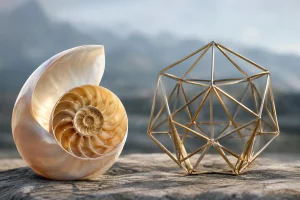
A cube has exceptional economy. Its faces are congruent, its angles repeat, and its symmetries can be described as transformations that leave the form unchanged. The tesseract extends this logic into a dimension that cannot be directly seen. It makes symmetry feel like an invitation toward a larger order, without requiring unsupported claims about hidden forces.
At a festival, this quality is palpable. Amid sound, dust, movement, costume, and heat, a disciplined geometric form can become a point of orientation. People gather around it, circle it, photograph it, and then return alone. The installation becomes interactive social architecture, a shared place for asking what is real and what merely appears real.
Burning Man has made room for this kind of encounter because the culture understands that art can be an experiment rather than an object to consume quickly. Thousands of people can meet the same sculpture and leave with radically different accounts. One person sees optics. Another sees a portal. Another recognizes a mathematical projection. The work does not demand a single interpretation, but it does insist on attention.
Virtually stepping inside the hypercube
Augmented reality extends the question of scale and entry. With an AR headset, viewers can virtually step inside an interactive hyperdimensional environment that would be impossible to build as a conventional room. The body remains in physical space, while the visible geometry can expand, transform, and surround it.
This is not an escape from physics. It is a new perceptual arrangement governed by optics, spatial tracking, rendering, and the brain’s relentless effort to reconcile vision with motion. The interactive potential is especially compelling because a tesseract is fundamentally about viewpoint. What it reveals depends on where the observer stands and how the form is projected.
A virtual encounter can make that dependency explicit. Walk forward and the apparent cells shift. Turn and the edges reorganize. Reach toward a vanishing point and discover that the vanishing point was never a destination, but a consequence of perspective.
The fourth dimension may remain beyond direct human intuition, but intuition is not fixed. It can be trained by movement, reflection, mathematics, and wonder. Stand before a tesseract long enough, and the useful question changes. Not, can I see all of it, but what new kind of attention does this impossible object ask of me?