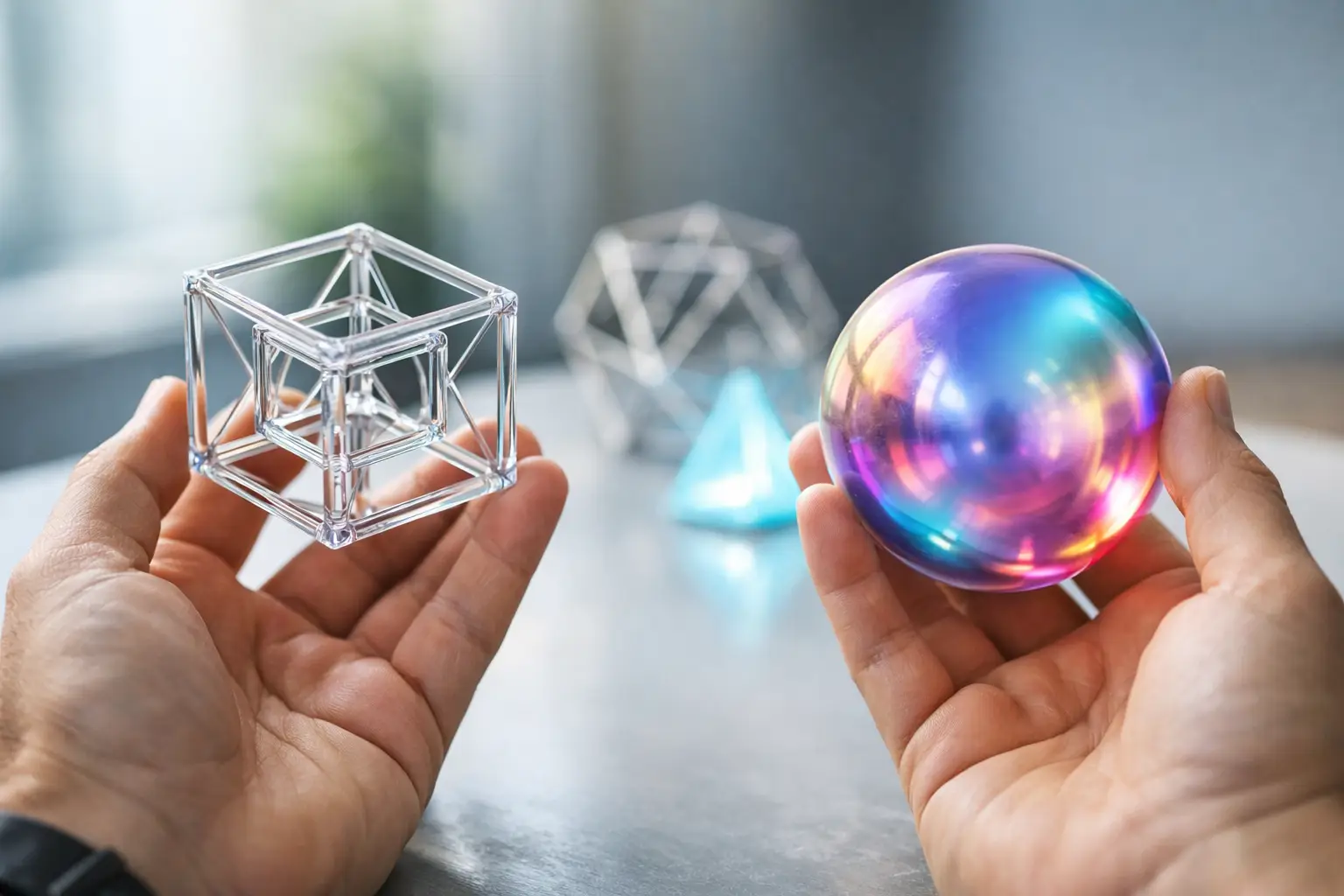
A cube feels settled because human perception evolved inside three dimensions. Height, width, and depth arrive together, so completely familiar that they almost disappear. Higher dimensional geometry interrupts that comfort. It asks what happens when a spatial direction exists that the body cannot point toward, walk along, or hold in the mind all at once.
I build sculptures for that interruption. Light, mirrors, programmable LEDs, and precise frames turn an abstract mathematical question into an encounter: not a claim that a fourth spatial dimension has been captured, but an invitation to feel what its projection might do to perception. A tesseract becomes less like a diagram on a page and more like a room that keeps refusing to end.
Higher Dimensional Geometry Begins With a Simple Pattern
The leap from a point to a tesseract is orderly, even if the result is difficult to imagine. A point has no extent. Move that point in one new direction and it traces a line. Move a line in a direction perpendicular to itself and it sweeps out a square. Move a square in a new perpendicular direction and it becomes a cube.
The next step follows the same rule. Move a cube in a direction perpendicular to all three directions already available, and the result is a four dimensional hypercube, more commonly called a tesseract.
The difficulty is not the mathematics. It is the body. A cube has three mutually perpendicular axes, usually written as x, y, and z. A tesseract requires a fourth axis. Mathematicians can write that axis cleanly and calculate with it without trouble. Human vision, however, is organized around three dimensional space. The fourth direction has no ordinary visual counterpart.
That gap between what can be calculated and what can be sensed is where the artwork begins.
The tesseract is not two cubes connected by lines
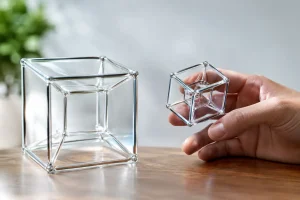
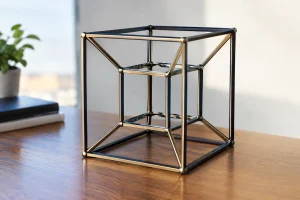
The familiar image of a small cube nested inside a larger cube, with corresponding corners joined, is a three dimensional projection of a tesseract. It is useful, but it can also mislead. The inner cube is not literally sitting inside the outer cube in four dimensional space. It is the shadowlike result of translating a four dimensional object into fewer dimensions.
A useful analogy begins with a three dimensional cube. Its two dimensional projection can look like a square within a square, connected at the corners. Nobody would conclude that a cube is actually two flat squares living one inside another. The drawing is a reduction, shaped by the angle of projection. The tesseract image works the same way, only one dimension higher.
A tesseract has 16 vertices, 32 edges, 24 square faces, and 8 cubic cells. Those numbers are not ornamental facts. They reveal a structure of remarkable consistency. Each vertex meets four edges, because four independent directions are available. Each cubic cell is a boundary component of the whole, much as a square is a boundary face of an ordinary cube.
Projection Is the Bridge Between Dimensions
Every attempt to experience a higher dimensional object depends on projection. A shadow is a projection. A map is a projection. A photograph turns a spatial scene into a flat image. None is the object itself, yet each preserves enough relationships to let the mind reconstruct something real.
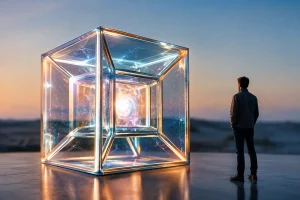
My tesseract sculptures use this principle deliberately. The frame establishes a physical three dimensional projection, while mirrors produce repeated images of that structure. As the eye looks inward, the cube appears again and again at changing scales. The mind is forced to negotiate multiple apparent interiors, multiple boundaries, and a depth that is visibly finite yet experientially unstable.
That instability matters. An infinity mirror does not create literal infinity. It creates a sequence of reflections that loses brightness with every pass, eventually falling beneath visibility. The perceived corridor has a physical limit governed by reflectivity, glass transmission, ambient light, LED intensity, viewing angle, and the eye’s own sensitivity. Yet before that limit arrives, the recursive geometry can feel bottomless.
This is not a failure of physics. It is exactly the point. Perception does not passively record the world. It builds a model from incomplete evidence, contrast, motion, expectation, and light.
Light makes mathematics temporal
A static tesseract drawing gives the viewer a single fixed projection. Programmable light adds time. Color sequences can establish rhythms across edges and vertices, drawing attention to pathways that would otherwise remain hidden. A slow pulse can make the structure seem to breathe inward. A shifting pattern can cause one cube to emerge while another recedes.
The geometry remains exact, but the reading of it changes. This is why interactive light is more than spectacle. It allows visitors to discover that spatial understanding is active. A few steps to the side, a change in eye height, or a new light sequence can reorganize the entire form.
At large scale, that shift becomes bodily. A five foot tesseract does not sit quietly at the edge of vision. It establishes a field around itself. Reflections catch movement, faces, dust, night air, and nearby bodies, then multiply them into the apparent depth. The visitor is not outside the experiment. The visitor becomes part of the projection.
Sacred Geometry Without the Shortcut
Sacred geometry has enduring power because geometric forms appear in architecture, crystals, plants, orbital systems, craft, and visual culture across centuries. Symmetry can feel meaningful before language catches up. A circle, spiral, cube, or lattice can produce a precise emotional response through proportion and repetition alone.
But geometry does not require vague claims to be wondrous. A tesseract is compelling because its properties can be derived, tested, modeled, and built. Its strangeness survives explanation. In fact, explanation makes the strangeness sharper. The more clearly a person understands that a tesseract is a valid four dimensional analogue of a cube, the more uncanny its three dimensional projections become.
I am interested in sacred and spatial geometry at that threshold, where rigor and awe reinforce each other. Mathematics provides the grammar. Light gives that grammar an atmosphere. The viewer supplies the moment of recognition.
Why Mirrors Confuse the Spatial Mind
A mirror reverses neither left nor right in the strict physical sense. It reverses the direction perpendicular to its surface, front to back. The left right feeling arises because the observer mentally rotates into the reflected position. This small fact is already a lesson in perception: what feels obvious can conceal a more subtle transformation.
Place mirrors in opposing relationships and the transformations compound. Each reflection contains a reflection of a reflection, with altered scale, viewpoint, brightness, and delay of visual interpretation. A precise frame prevents the experience from becoming random. Repetition needs an underlying rule, just as a fractal needs an iterative equation.
In an interactive mirror sculpture, the eye searches for a stable orientation and repeatedly fails to find one. A corner seems near, then far. A luminous line seems to enter the structure, then return from another direction. This is not virtual space. It is physical optical behavior, staged so that the senses encounter their own assumptions.
Festival Night Is a Laboratory for Altered Perception
At Burning Man and other immersive events, darkness turns light sculpture into an instrument of orientation. A distant glow becomes a landmark. Up close, it becomes architecture for attention. Thousands of visitors arrive with different levels of mathematical knowledge, yet many recognize the same feeling when standing before an illuminated hypercube: the sensation that ordinary depth has become unreliable.
Festival conditions intensify the encounter. There is movement everywhere, music at a distance, dust in the air, fatigue, exhilaration, conversation, and the temporary suspension of routine. Under those conditions, an interactive installation can feel less like an object and more like a portal with engineering behind it.
That word should be used carefully. The sculpture does not transport anyone to another dimension. It does something more honest and, to me, more interesting. It reveals how quickly the ordinary visual system can be persuaded to question its model of space.
Interactive augmented reality extends that inquiry virtually. With an AR headset, a viewer can step inside the geometric logic of the piece and examine relationships that physical scale, glass surfaces, and safety boundaries may conceal. The virtual experience does not replace the sculpture. It offers another projection, another angle from which to test the same question.
The Fourth Dimension and the Dreaming Mind
Lucid dreams often contain impossible architecture: rooms larger within than without, hallways that loop, stairways that arrive somewhere unexpected. Dreams do not prove hidden dimensions. They do demonstrate that the mind can construct spatial experiences that exceed the rules of waking orientation.
Higher dimensional geometry gives language to some of that feeling without confusing imagination for evidence. A four dimensional object could appear in three dimensional space through changing cross sections, much as a three dimensional sphere passing through a two dimensional plane would appear to a flat observer as a point, then expanding circles, then shrinking circles, then nothing. The observer would see transformation without access to the full object.
This thought experiment has a dreamlike charge because it exposes a limit. There may be structures that cannot be perceived whole from within a given dimensional frame. The proper response is not certainty. It is curiosity, supported by mathematics, experiment, and the willingness to let perception become strange for a moment.
When a visitor stands before an illuminated tesseract, follows its reflections, and loses track of where the edge truly ends, that moment can become a small practice in intellectual humility. The senses are extraordinary instruments, but they are not the final boundary of what can be imagined, calculated, or built.