Why Is the Fourth Dimension So Hard to Imagine?
Your brain is built for three-dimensional life.
You understand left and right.
You understand forward and backward.
You understand up and down.
But a fourth spatial direction would have to point somewhere that is perpendicular to all three of those directions at once.
There is no familiar word for that direction because we do not experience it.
So instead of trying to picture the fourth dimension directly, it helps to approach it indirectly.
Start With Flatland
Imagine a two-dimensional creature living on a perfectly flat surface.
It understands two directions but has no concept of height.
Now imagine a three-dimensional sphere passing through its world.
The creature would not see the full sphere.
It might first see a tiny circle appear.
The circle would grow larger.
Then it would shrink.
Finally, it would disappear.
The 2D creature experiences only cross-sections of the 3D object.
The same idea helps us think about a 4D object passing through our 3D world.
We might not see the entire object at once. We could experience changing three-dimensional cross-sections.
Use Shadows and Projections
A 3D object can cast a 2D shadow.
A cube may cast a square-like or distorted polygonal shadow depending on its angle.
By analogy, a 4D object can be represented through a 3D projection.
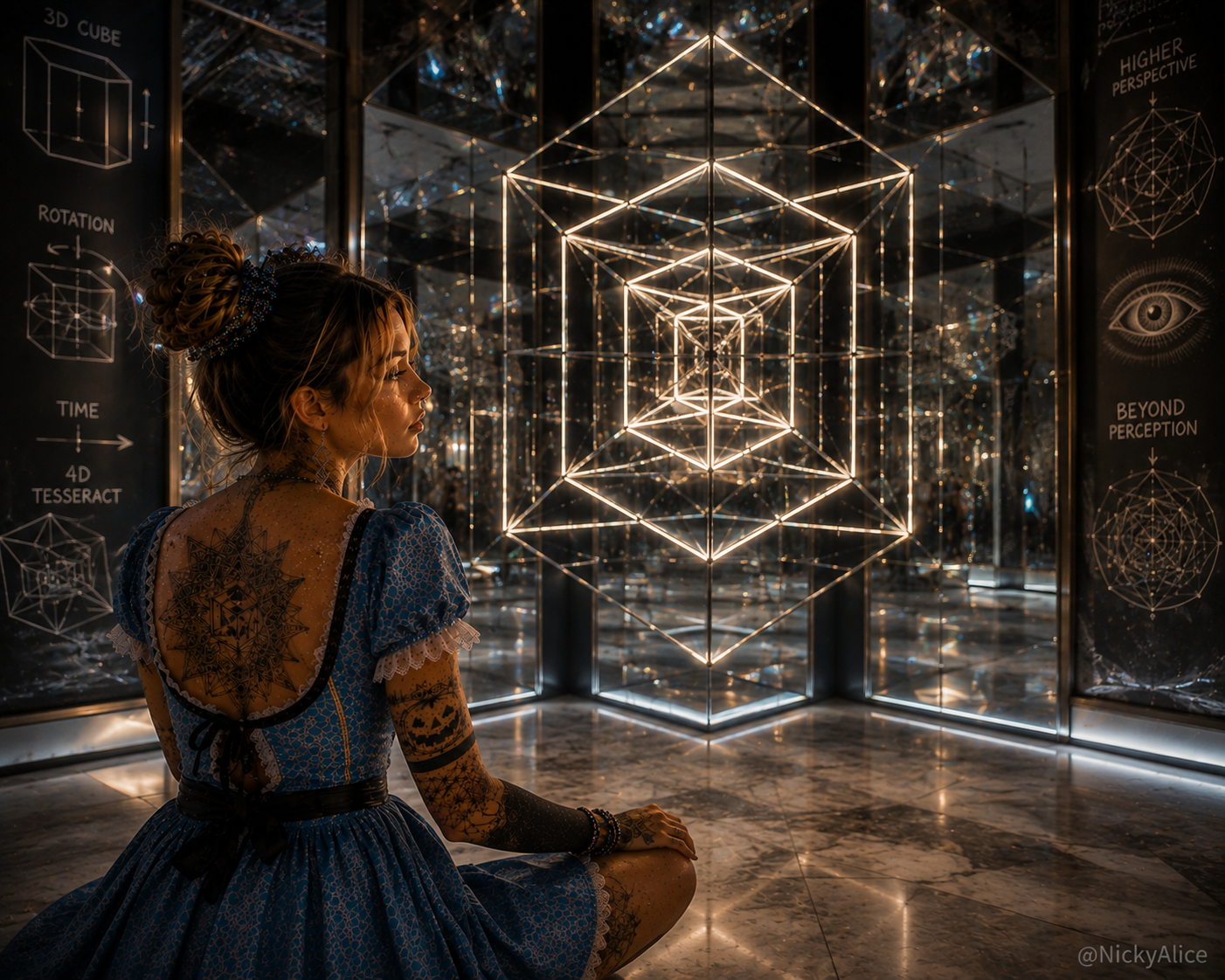
That is why a tesseract is often shown as a cube inside another cube with connecting edges.
The image is not the complete object. It is a projection designed for a lower-dimensional observer.
Think About Cross-Sections
Cut a sphere into slices and you get circles of different sizes.
Cut a cube and you can produce squares, rectangles, triangles, and other shapes depending on the angle.
A 4D object could similarly produce changing 3D cross-sections.
This means a strange object appearing to change shape in front of us could, in principle, be understood as different slices of something higher-dimensional.
Rotation Makes Everything Stranger
In three dimensions, rotation can occur around different axes.
In four dimensions, there are additional planes of rotation unavailable in ordinary 3D space.
A rotating 4D object therefore produces projections that appear to fold, invert, and pass through themselves.
This is why rotating tesseract animations seem so unsettling.
The object is not necessarily changing its structure.
Our projection of it is changing.
Mirrors as a Visualization Tool
My own work explores this gap between what exists physically and what appears visually.
Infinity mirrors create corridors of apparent space that extend beyond the physical depth of the sculpture.
The viewer sees somewhere they cannot physically go.
That contradiction provides a useful artistic analogy for higher dimensions.
You do not have to perfectly picture the fourth dimension to engage with it.
Instead, you can study its shadows, projections, cross-sections, rotations, and visual consequences.
Sometimes understanding begins not with seeing the whole object, but with learning how to read its traces.