A guide to buying signed sculpture begins somewhere more interesting than a certificate or a name etched into metal. It begins with a question of presence. Does the work carry an idea that continues to unfold as light changes, as a viewer moves, or as perception starts to doubt the boundaries of the room? For sculpture concerned with infinity, reflection, and higher dimensional geometry, a signature marks a physical object, but the real work may extend far beyond its edges.
A signed sculpture is not simply an authored form. It is evidence of a particular set of decisions, materials, calculations, experiments, failures, and revisions. In my own practice, those decisions can include mirror alignment measured to fractions of an inch, LED programming, structural geometry, reflected light paths, and the strange perceptual threshold where a finite object appears to open into impossible depth.
Why a Signature Matters in Experiential Sculpture
A signature traditionally identifies authorship. That function still matters. It establishes a direct connection between an artist and a work, especially when a sculpture is one of a numbered edition or exists alongside related studies. Yet for experiential and light based sculpture, the signature also points toward a larger system.
An infinity mirror sculpture is not static in the usual sense. Its visual field depends on the angle of approach, ambient illumination, the intensity and timing of its internal light, and the position of the human body in front of it. A signed work records who designed that system and who determined how its physical structure produces its perceptual effect.
This distinction is especially meaningful with forms inspired by the tesseract. A tesseract is the four dimensional analogue of a cube. Just as a cube can be understood as an extension of a square into a third spatial direction, a tesseract extends the cube into a fourth direction that cannot be directly inhabited by ordinary three dimensional vision. Any physical sculpture of a tesseract is therefore a translation, a projection, or an invitation to imagine beyond the available senses.
The signature identifies the person responsible for that translation. It connects the visible construction to an invisible conceptual architecture.
A Guide to Buying Signed Sculpture With Provenance
Provenance is the history that stays with a work. It can include the date of creation, edition information, materials, dimensions, exhibition history, installation photographs, technical documentation, and records of restoration or modification. For a conventional bronze, these details establish context. For a sculpture containing mirrors, lighting, electronics, or interactive components, they also clarify how the piece is meant to live over time.
A work with programmable LEDs, for example, has both a sculptural body and a temporal behavior. The code or controller settings may determine color sequences, brightness, rhythm, and duration. Those elements are not peripheral. They are part of the authored experience, just as the placement of a cast figure or the finish of a stone surface is part of a more traditional sculpture.
Documentation can reveal whether the work has a fixed light program, adjustable settings, or an interactive response. It can explain power needs, access points for service, mounting requirements, and the intended relationship between the piece and its surrounding environment. None of this reduces the work to equipment. It honors the fact that contemporary sculpture can be an engineered encounter with physics.
For editions, clarity is equally valuable. A notation such as 2 of 8 identifies a defined sequence, while an artist proof or unique variation has a different relationship to the larger body of work. Small variations can matter substantially when mirrors, hand built structures, and light are involved. Two related sculptures may share a geometric premise while creating entirely different perceptual worlds.
Material Is Part of the Mathematics
It is tempting to encounter an illuminated mirror sculpture as pure illusion. The apparent tunnel of light seems immaterial, almost dreamlike. But the illusion is carried by specific physical conditions.
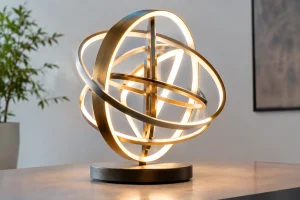
An infinity mirror generally relies on a reflective rear surface, a partially reflective front surface, and a light source positioned between them. Light reflects repeatedly between the surfaces. At each reflection, some light passes through the front plane and some continues inward. The repeated losses create the visual recession that reads as a luminous corridor or an endless chamber.
This is real optics, not a special effect. The perceived infinity arises because the eye receives a sequence of diminishing reflections that suggest depth beyond the sculpture’s actual dimensions. Geometry organizes the structure, reflection multiplies the signal, and human perception completes the impossible space.
The materials determine the quality of that experience. Mirror clarity affects the sharpness of the recursion. Frame construction controls alignment. Diffusers alter the way individual LEDs resolve into lines or fields. Acrylic, glass, aluminum, steel, wood, and composite materials each carry different optical, structural, and emotional qualities. A single millimeter of misalignment can interrupt a precise geometric projection.
This is why surface condition deserves thoughtful attention. Minor marks may be part of a work’s history, particularly if it has been installed at a festival or public event. But deep scratches, damaged coatings, broken seals, or altered electronics can affect not only appearance but the underlying physics of reflection. The question is not whether an object is untouched. It is whether its current state remains faithful to the experience the artist built.
Scale Changes the Experience of Space
Scale is never just a measurement. A palm sized hypercube offers intimate concentration. It asks the viewer to peer into a contained anomaly, like a portal discovered on a desk or shelf. A five foot Tesseract changes the body itself. Its geometry becomes architectural, and the viewer feels less like an observer than a participant standing before an opening in ordinary space.
At festivals, this distinction becomes intense. A large installation must compete with darkness, music, dust, movement, distant light, and thousands of people arriving with radically different states of attention. It needs structural endurance, electrical planning, and enough visual force to gather a crowd. Yet the strongest installations also preserve a private moment, that instant when someone recognizes an impossible depth and falls quiet.
A smaller signed sculpture can retain this logic in another register. It may not contain a walk through environment, but it can still create a shifting relationship between body, light, and geometry. The viewer moves, the reflection reorganizes, and the work continues to offer new spatial readings.
Interactive Works and Their Continuing Life
Interactive sculpture introduces a further dimension of authorship. A sensor, controller, headset, or responsive light sequence can make the work change according to proximity, gesture, sound, or user input. The experience is not random. It exists within designed parameters, which is precisely why technical records and artist direction matter.
Some hyperdimensional works also have an augmented reality activation that allows viewers to step inside the sculpture virtually with an AR headset. This interactive layer can make a geometric premise physically legible in a new way. Instead of only seeing the projection of a tesseract, a viewer can virtually inhabit an expanded interpretation of its recursive interior.
Technology evolves, and that creates a practical question. Components may eventually need servicing or replacement. Thoughtful maintenance does not diminish the work when it preserves the original visual behavior, materials, and interactive intention. In many cases, it is closer to maintaining a musical instrument than preserving a sealed artifact. The physical body remains, but its capacity to perform is part of its identity.
The Difference Between a Name and an Encounter
The market can treat a signature as a shortcut, a way to compress an artist’s life and ideas into a mark of authorship. But the best signed sculpture resists that compression. It asks for duration. It rewards repeated viewing. It may lead from a reflection to a question about dimensional projection, then from mathematics to a memory of a lucid dream where a room seemed larger inside than outside.
That is the deeper promise of work built around light and higher dimensional form. It does not merely represent the unknown. It constructs conditions in which the unknown feels briefly present.
Spend time with the geometry before assigning it a fixed meaning. Let the reflections alter as you move, let the apparent depth remain unresolved, and let the artist’s signature point back to the patient human act of making an impossible space visible.