
Cooper does not simply fall into a black hole in Interstellar. He arrives in an architecture built from a human life, where a child’s bedroom repeats beyond sight and time becomes something he can cross with his hands. This interstellar tesseract scene analysis begins there, with the film’s most daring proposition, that a fourth dimensional intelligence might make time spatial enough for a three dimensional being to navigate.
The scene is not a physics lecture, nor is it empty fantasy. It is a carefully constructed translation problem. How can cinema give the audience an intuition for dimensions it cannot directly perceive? Christopher Nolan’s answer is emotional and geometric at once. He turns memory into a place, gravity into a language, and a bedroom into an impossible lattice.
What the Interstellar Tesseract Scene Is Showing
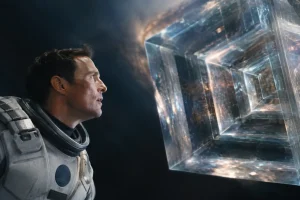
The tesseract appears after Cooper crosses the event horizon of Gargantua. From the outside, this should be a final boundary. In the film’s imagined cosmology, beings from the far future have created a structure inside that extreme environment, one that lets Cooper perceive different moments in Murph’s room simultaneously.
Every version of the room corresponds to a different instant in its history. Cooper can see Murph as a child, then as an adult, and can reach across years through the gravitational effects on objects in the room. The watch becomes the crucial receiver. Its moving hand carries a coded message that Murph later reads as quantum data.
That explanation asks the viewer to accept several imaginative leaps. Human beings could not survive the journey as shown, and contemporary physics does not provide a method for sending usable information backward through time. Yet the visual logic is remarkably disciplined. The film treats time not as a glowing tunnel or a mystical fog, but as a dimension with structure, recurrence, adjacency, and distance.
A Tesseract Is Not Just an Infinite Cube
Mathematically, a tesseract is the four dimensional analogue of a cube. A point extended in one direction becomes a line. A line extended perpendicular to itself becomes a square. A square extended perpendicular to its plane becomes a cube. Extend a cube in a direction perpendicular to all three familiar spatial directions, and the result is a tesseract, also called a hypercube.
The difficulty is immediate. No one can point in the fourth spatial direction, because human perception and the space around the body provide only three. A tesseract can be described exactly through coordinates, equations, and combinatorics, but it cannot be held in the hand as a complete four dimensional object.
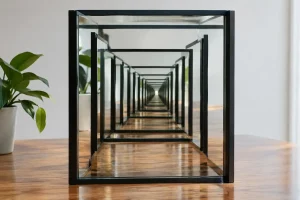
What can be seen is a projection. A cube projected onto a flat surface often appears as a smaller square nested inside a larger one, connected by lines. In the same way, a tesseract projected into three dimensions can look like a cube within a cube, joined at corresponding vertices. The familiar image is useful, but it is not the object itself. It is a shadow of a higher dimensional relation.
The Interstellar construction is not a literal tesseract in the strict geometric sense. Its cells are rooms and moments, rather than the cubic cells of a formal hypercube. Calling it a tesseract is poetic shorthand for something more specific: a constructed environment in which a higher dimensional perspective makes an inaccessible axis available. In this story, that axis is time.
Why the bedroom repeats
The repeated bedroom is the scene’s essential visual invention. A room is familiar enough to orient us, but its endless recurrence breaks ordinary spatial expectation. Cooper stands inside a volume where the same shelves, bed, books, and window persist in countless variations. Each variation is close in the architecture, yet remote in lived time.
This is what a dimensional projection can feel like. A higher dimensional object often presents multiple related faces at once when forced into a lower dimensional frame. The tesseract scene turns that abstract condition into a human experience. Instead of encountering sixteen vertices and thirty two edges, Cooper encounters his daughter at different ages, all nearby and all unreachable.
The emotional force comes from that contradiction. He is finally close to Murph, but not present in the way a father wants to be present. Geometry does not repair regret. It gives regret a structure.
Time Becomes a Place
Physics already invites language that sounds almost surreal. In relativity, space and time are not fully separate containers. They form spacetime, and gravity is described as curvature in that geometry. Massive objects alter the paths that matter and light follow. Near Gargantua, the film uses extreme gravitational time dilation to establish that time is radically different for Cooper than for people far from the black hole.
The tesseract scene makes a more speculative move. It treats the entire timeline of Murph’s room as something that can be viewed from outside, much as a person looking down at a map sees streets that a walker experiences one turn at a time. This is close to the idea often called the block universe, where past, present, and future are all parts of a four dimensional spacetime whole.
That does not mean time is proven to be an illusion, or that future events are settled in the simple fatalistic way movies sometimes suggest. Physics can model spacetime as a complete geometry while people still experience anticipation, decision, memory, and change. Interstellar keeps this tension alive. Cooper can access many moments, but he can only act through constrained physical channels. He cannot step into the room, speak normally, or rewrite every outcome.
This limitation matters. If the tesseract gave unlimited control, it would be dramatically empty and geometrically vague. Instead, it gives Cooper a narrow interface. Gravity moves dust, topples books, and alters the watch. The fourth dimensional vision is immense, but the communication bandwidth is almost painfully small.
Gravity Is the Scene’s Material Language
The film chooses gravity because it needs a force capable of crossing the barrier between Cooper’s strange position and Murph’s familiar world. Within the story, gravity is unusual because it can reach across dimensions. Outside the story, it is also visually legible. A book falls. Dust forms a pattern. A watch hand shifts.
There is an elegance in using such ordinary signals. The universe’s most exotic setting does not communicate through a grand speech. It communicates through a disturbance in a bedroom. Murph’s early belief that a ghost is trying to tell her something is not discarded as childish misunderstanding. It becomes the correct interpretation, reframed through spacetime and family.
The science here is intentionally stretched. The film draws from real relativistic concepts and consultation with physicist Kip Thorne, but the transmission of information across this temporal divide remains fictional. That tradeoff is not a flaw when understood clearly. The scene uses scientific language to build rules for wonder, then follows those rules closely enough that the emotional stakes hold.
Why This Geometry Feels So Convincing
A good dimensional illusion does not merely show more space. It changes the viewer’s sense of orientation. The Interstellar tesseract works because it offers recognizable repetition, an implied infinity, and a rule for movement. Cooper drifts through a framework of rooms, and the audience gradually learns that moving through the framework is equivalent to moving among moments.
I return to this question whenever I build a mirrored hypercube. How can a physical structure produce the sensation that the visible volume is not the whole volume? Repetition is one answer. Reflection makes a bounded form appear to continue beyond its material edges. Geometry supplies the discipline, because the illusion becomes far stronger when every plane, interval, and alignment is intentional.
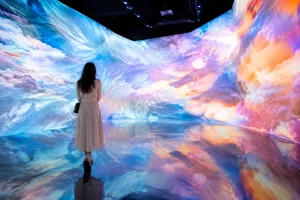
An interactive installation can make this bodily. At festival scale, a person does not just observe recursive depth, they locate themselves inside it. Their movements shift the reflections, and the mind starts testing whether there is an edge, a center, or another chamber beyond the one it can see. With an augmented reality headset, a viewer can virtually step inside an interactive hyperdimensional environment and encounter projection as inhabitable space rather than a diagram.
That experience is not evidence that people have discovered a hidden fourth spatial direction. It is more interesting than a false claim. It reveals how quickly perception relies on stable boundaries, and how strange reality feels when those boundaries are mathematically disturbed.
The Sacred Feeling of Precise Structure
People often describe tesseracts, recursive mirrors, and geometric chambers as sacred. That response deserves respect, but it does not require vague mysticism. Symmetry, scale, repetition, and proportion can produce awe because the brain is exquisitely sensitive to pattern. A form that is simple enough to recognize yet impossible to fully resolve creates productive tension.
The tesseract scene holds that tension with rare clarity. It is an image of cosmic physics, but also of lucid dreaming. In a lucid dream, a familiar room may remain recognizable while its causal rules change. Doors open into the wrong place. A hallway extends too far. A person senses that the environment is responding to attention. The tesseract gives that dream logic a rigorous spatial premise.
For anyone making immersive work, the lesson is not to imitate a science fiction set. It is to let the mathematics carry the atmosphere. Start with the question of what relation is being projected, what axis is hidden, and what the body can infer without being told. Then allow material, reflection, color, scale, and interaction to make the equation felt.
The final power of Interstellar is that its tesseract does not ask the audience to escape human feeling in favor of abstraction. It asks whether abstraction can become intimate. A dimension beyond ordinary sight becomes visible through a father trying, with almost no power at all, to tell his daughter that love and knowledge can still travel across the impossible.