
A tesseract cannot be placed in a room any more than a whole cube can be pressed flat onto a sheet of paper without changing its appearance. That tension is the beginning of how tesseract projection works. A projection does not deliver the fourth dimension intact. It translates it, preserving some relationships while sacrificing others, then asks the eye and mind to reconstruct what has been lost.
My work begins in that gap between mathematical fact and human perception. A tesseract is not a mystical symbol with vaguely cosmic properties. It is a precise geometric object, a four dimensional hypercube. Yet when its structure is projected into three dimensions, and then encountered through reflection, depth, motion, and an interactive body moving through space, it can feel startlingly close to a lucid dream.
What a Tesseract Actually Is
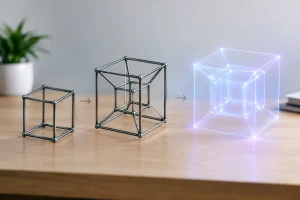
A point has zero dimensions. Move that point in a new direction and it traces a line. Move the line in another perpendicular direction and it creates a square. Move the square perpendicular to its two existing directions and it creates a cube.
The next step follows the same rule. Move a cube in a direction perpendicular to all three of its existing axes. The result is a tesseract, also called a four dimensional hypercube.
This is easy to state and difficult to picture because human spatial intuition is tuned to three dimensions. A cube has six square faces, twelve edges, and eight vertices. A tesseract has eight cubical cells, twenty four square faces, thirty two edges, and sixteen vertices. Its cells are cubes in the same way that a cube’s faces are squares.
The key word is perpendicular. In ordinary space, three mutually perpendicular directions can be named left and right, forward and back, up and down. A tesseract requires a fourth direction that is perpendicular to every one of those. That direction is not hidden somewhere above the ceiling or beyond the horizon. It is outside the full set of directions available to physical movement in three dimensional space.
How Tesseract Projection Works
Projection is the disciplined art of reducing dimensions. A shadow is the simplest familiar example. A three dimensional hand placed between a light source and a wall creates a two dimensional image. The shadow retains an outline, but it discards depth. Depending on the angle, fingers overlap, proportions change, and distinct points can collapse into one.
A tesseract projection performs the analogous operation from four dimensions into three. Mathematicians assign coordinates to each vertex of the tesseract, then map those four coordinates into three. The fourth coordinate must be represented indirectly, often by shifting points, changing scale, or creating the impression of one cube extending through another.
The classic image looks like a small cube inside a larger cube, with corresponding corners connected by diagonal edges. This is not literally a cube trapped inside another cube. It is a three dimensional projection of the eight cubical cells of a tesseract, arranged so that the fourth directional movement becomes visible as separation and connection within familiar space.
There is no single correct appearance. The projected form changes according to the chosen viewpoint, just as a cube can cast a square shadow, a rectangle, or a more complex polygon. Orthographic projection treats parallel directions consistently, making structural relationships easier to inspect. Perspective projection allows apparent size to change with depth, making the form feel more spatial and unstable.
That instability is not an error. It is evidence of the translation. The projection asks the brain to hold two truths at once: every visible edge belongs to a rigorously ordered object, and no arrangement of visible edges can reveal the original four dimensional form in full.
Rotation Reveals What Still Images Conceal
A rotating tesseract projection is more revealing than a static diagram. Rotation in four dimensions occurs in planes that have no direct equivalent in ordinary experience. In three dimensions, an object can rotate around an axis. In four dimensions, it can rotate through combinations of coordinate planes, producing transformations that make the projected inner and outer cubes appear to pass through, exchange scale, or invert their relationship.
Nothing supernatural is required. The apparent transformation comes from viewing a higher dimensional rotation through a lower dimensional projection. A useful comparison is a square rotating in three dimensional space. Its flat shadow can shrink to a line and then expand again, even though the square itself never loses a side. The shadow changes because the viewpoint hides and compresses information.
With a tesseract, the same principle becomes more profound. A projected cell can seem to emerge from the center, fold through the boundary, or become the surrounding structure. The eye searches for a stable object and finds a system whose identity changes with orientation. That productive confusion is part of the experience.
From Geometry to an Immersive Sculpture
A mathematical projection on a screen is clean, but it is not yet embodied. Building a tesseract sculpture means deciding which geometric relationships must remain exact, which can be intensified for perception, and where physical materials can carry the missing dimension.
I begin with the hypercube’s combinatorial structure, its vertices, edges, square faces, and cubical cells. The geometry establishes a grammar. Repeated frames and carefully aligned planes create an external structure the body can measure. Then reflection introduces recursive depth. A finite volume begins to imply a corridor that continues beyond the surface, not because the object has become infinite, but because the eye reads repeated images as receding space.
Reflection is particularly powerful because it makes projection interactive. As a viewer shifts position, the reflected geometry shifts too. Edges align, split apart, vanish, and return. The viewer is no longer looking at a fixed illustration of four dimensional space. Their movement becomes part of the optical calculation.
This is where the sculpture can exceed a diagram without abandoning mathematics. A diagram offers one privileged view. An installation gives each body a different path through the projection. From one angle, the structure may feel architectural and legible. From another, it can become a fractured field of repeated cubes, faces, and apparent voids.
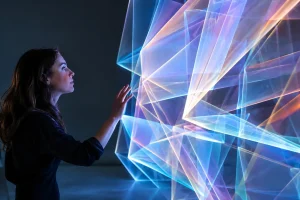
At a festival, that shift is amplified by time and crowd movement. A person approaches with a friend, pauses at the threshold, circles the work, then watches another person become folded into the reflected geometry. The tesseract is not merely represented. It becomes a shared perceptual event, an interactive encounter with the limits of spatial certainty.
Why Infinite Depth Feels Like Another Dimension
Infinity mirror effects do not produce actual infinity. They produce a sequence of diminishing reflections, each one carrying the image farther into apparent depth. The physical distances are finite, and each reflection loses some intensity. But perception is generous. It accepts the repeated recession as a space that may continue beyond reach.
That sensation resonates with tesseract geometry because higher dimensions challenge the boundaries of containment. In the familiar projection, an inner cube is connected to an outer cube. With recursive reflection, neither cube feels entirely inside or outside. The relation becomes unstable, almost breathing. What looked like an object becomes a threshold.
The effect depends on precision. Small errors in alignment can break the continuity of repeated lines. Surface quality changes contrast and depth. The spacing of frames determines whether the geometry reads as a coherent hypercube or as visual noise. Craft matters because the perceptual illusion is not arbitrary. It is built from controlled angles, repeated distances, and the physics of reflected rays.
The Fourth Dimension Is Not Just a Visual Puzzle
The enduring power of tesseract projection is not that it proves another physical dimension is nearby. Mathematics allows spaces of many dimensions, while physics asks separate questions about which dimensions shape the universe and how they might be detected. A sculpture should not collapse those questions into a claim it cannot support.
What it can do is make a real cognitive limit palpable. Human vision is already an act of projection. Each eye receives a two dimensional image, and the brain infers depth, distance, surfaces, motion, and solid objects. The certainty of a three dimensional world is, in part, an extraordinary construction of perception.
A tesseract disrupts that construction elegantly. It shows that a coherent object may exceed the available viewpoint, and that a projection can be accurate while remaining incomplete. This is why the form belongs naturally beside dreams, altered perception, and the strange clarity of a desert night at Burning Man. Each can make the ordinary coordinates of self and space feel briefly negotiable.
Augmented reality extends the question further. When a viewer virtually steps inside an interactive hyperdimensional environment, scale and orientation can change without the body physically crossing a wall. The experience does not create a fourth dimension, but it can stage the perceptual paradox: being inside a form that also appears to contain itself.
The value of a tesseract projection is not an answer to what reality secretly contains. It is a beautifully rigorous invitation to notice that reality, as experienced, is always larger than the frame through which it is seen.