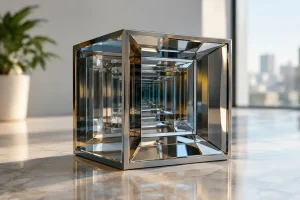

Stand between two mirrors and the room appears to continue past its own walls. Step toward an infinity sculpture and that continuation becomes stranger, sharper, almost architectural. Why do mirrors seem infinite? The short answer is repeated reflection. The more compelling answer is that a carefully built mirror system makes your visual system accept a finite object as a corridor through impossible space.
When I build a Tesseract or another hyperdimensional mirror sculpture, I am not trying to make a simple visual trick. I am building a physical experiment in perception. The sculpture has real edges, real depth, and a fixed volume. Yet the eye reads a receding sequence of luminous frames that seems to outrun the object that contains it. For a moment, a five foot cube can feel less like a cube and more like a portal into a spatial rule that has escaped ordinary three dimensional life.
Why Do Mirrors Seem Infinite?
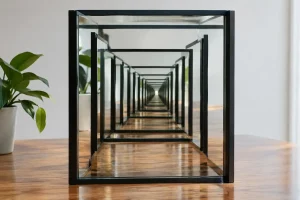
Two ordinary mirrors facing one another create an image of an image, then an image of that image, and so on. Light from an object reflects off one surface, crosses the gap, reflects from the opposite surface, and returns toward your eyes. Each trip creates another visible copy farther along the apparent axis of the reflections.
The copies are not physically located deep behind the glass. They are virtual images, positions the brain infers because reflected rays arrive at the eye as though they came from behind a mirror. A single plane mirror places one virtual version of the room behind its surface. A second mirror repeats that version. The system generates a chain of inferred spaces, each one displaced farther from the viewer.
This process is not truly infinite in a physical sense. Every reflection loses some light. Even excellent reflective surfaces absorb or transmit a fraction at every encounter. Dust, surface imperfections, the angle of viewing, and the brightness of the source all limit how many receding layers remain visible. What feels boundless is a fading geometric series, not an endless supply of energy.
That distinction makes the effect more interesting, not less. Infinity is suggested through a process that gets smaller but never suddenly declares an end. The last visible reflection dissolves into darkness or a dim haze, leaving the mind to continue the pattern beyond what the eye can resolve.
The Crucial Role of Partial Reflection
A classic infinity mirror uses two different kinds of surfaces. One is highly reflective. The other both reflects and transmits light. The front surface lets you see inward while also returning some of the interior image to you. The rear surface sends much of that interior image back into the chamber.
Light bounces between these surfaces. On every pass, part of it remains trapped in the visual conversation between the mirrors, and part of it reaches the viewer. This is why the depth contains many copies rather than a single reflection. The eye receives a nested sequence of diminishing signals, each associated with a farther apparent location.
The balance matters. If the front surface transmits too much, the internal recursion lacks force. If it reflects too much, the viewer cannot clearly enter the visual field. Material choice, surface quality, and the distance between planes all affect the final experience. Physics is not decoration here. It is the medium.
Color and programmed sequences can intensify the illusion because the eye uses changing brightness and motion as depth cues. A pulse traveling through repeated frames can look as though it is moving into an immense tunnel. In fact, it is traversing a finite set of physical distances while its reflections generate a second, apparent choreography. The sculpture becomes interactive with perception even when the viewer remains still.
Depth Is a Negotiation Between Light and the Brain
Human vision does not measure space like a ruler. It estimates depth from converging lines, relative size, overlap, focus, binocular disparity, motion, and learned expectations. Mirror recursion recruits several of these systems at once.
Repeated squares or cubes become smaller with apparent distance, which resembles perspective. Parallel edges converge toward a vanishing point. Bright forms overlap dimmer copies. As you shift position, reflections shift too, producing parallax that makes the apparent volume feel present rather than painted. The brain recognizes the grammar of a long corridor and supplies the sense of distance.
But the grammar has a deliberate error. In a real corridor, each opening leads to new physical space. In an infinity mirror, each opening is a transformed view of the same bounded chamber. The mind encounters a familiar depth signal attached to an impossible cause. That tension is where awe begins.
This is also why photographs can document these sculptures without fully replacing them. A photograph chooses one eye position and freezes the reflected geometry. In person, your body tests the illusion. You lean, circle, pause, and watch the chamber reorganize around your viewpoint. At a festival, surrounded by movement, sound, dust, and night, that small act of testing can become a lucid moment. You know the object is finite. Your senses offer another proposition.
From Recursive Cubes to the Fourth Dimension
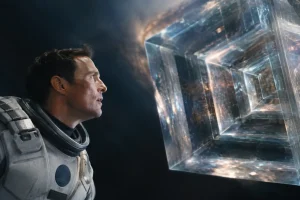
A cube is a three dimensional form bounded by square faces. A tesseract is the four dimensional analogue of a cube, bounded by cubic cells. No human eye can look directly into four dimensional space in the ordinary way, because the eye and brain evolved to navigate three spatial dimensions. Yet mathematics gives a precise way to understand the tesseract through projection.
A common three dimensional projection of a tesseract appears as a cube within a cube, connected at corresponding corners. It resembles a smaller cube suspended inside a larger one, though that image can mislead. The inner and outer cubes are not simply nested objects in four dimensional space. They are the projected traces of a single higher dimensional structure.
Mirror recursion offers a powerful physical analogy. A frame repeats into depth, then repeats again. The visible system contains related copies that feel connected across a direction the hand cannot reach. It does not prove a fourth spatial dimension, and I do not present it as proof. It gives the body an encounter with projection, recursion, and dimensional ambiguity, concepts that are easy to write as equations and difficult to feel.
In my Tesseract sculptures, the geometry is designed so that apparent corridors, cubes, and intersections echo the logic of a hypercube projection. The goal is not to illustrate a textbook diagram. It is to construct a place where the diagram becomes spatially persuasive. You stand outside a finite structure and perceive an interior that seems to have more room than its exterior permits.
Sacred Geometry Without Escaping the Mathematics
Geometric forms have long carried emotional weight. Squares suggest stability. Cubes suggest enclosure and order. Repetition can suggest ritual, continuity, and the scale of systems larger than an individual human life. These responses are real, but they do not require vague claims about hidden forces. Geometry is already profound.
A repeated cube can evoke sacred geometry because it reveals order across scale. One frame resembles the next, and the next, creating a self similar procession. The effect resembles patterns found in crystals, architecture, cellular structures, and mathematical models. It reminds us that a simple rule, applied repeatedly, can generate a world that feels inexhaustible.
There is a useful tradeoff here. Perfect symmetry creates clarity, but too much regularity can become visually static. Small shifts in timing, color, or viewpoint restore uncertainty. The most memorable immersive works often sit at that boundary, precise enough to reveal structure and unstable enough to make the viewer wonder whether the structure is changing them in return.
A Finite Object Can Still Open an Infinite Question
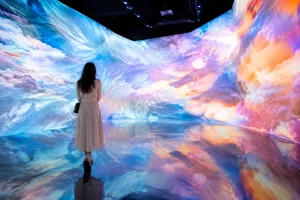
At Burning Man and other large experiential gatherings, people often approach an infinity sculpture first as a spectacle. Then the pace changes. Someone notices their own reflection multiplied into distance. Someone else sees a companion framed inside receding cubes. The object turns observation into participation, because every body near it becomes part of the reflected system.
That is the deeper answer to why mirrors seem infinite. The effect is optical, mathematical, and psychological at once. Reflections repeat, each pass grows dimmer, and the brain converts that sequence into depth. But the feeling of infinity arrives because the pattern is legible enough for the mind to continue after the visible image fades.
A mirror chamber does not contain endless space. It offers something more personal, a bounded space that teaches perception to imagine beyond its boundary. Stand before it long enough, move a few inches, and let the geometry answer back.