A cube has six visible faces. A hypercube asks the eye to imagine more than it can directly see. That tension is where hyperdimensional spatial geometry becomes more than mathematics: it becomes an artistic language for creating awe. In a handcrafted infinity mirror sculpture, illuminated lines repeat into apparent distance, turning a finite object into a visual proposition with no obvious edge.
For collectors, this is not about decorating a wall with a pattern. It is about placing a perceptual event in the room. A Tesseract-inspired light sculpture holds the disciplined clarity of geometry while behaving like an impossible architectural opening: precise, luminous, and continuously altered by the position of the viewer.
What Hyperdimensional Spatial Geometry Makes Possible
Hyperdimensional spatial geometry studies forms that extend beyond the three spatial dimensions we navigate every day. The most familiar example is the tesseract, often described as a four-dimensional analogue of a cube. No physical sculpture can literally occupy a fourth spatial dimension in the mathematical sense. What it can do, with extraordinary force, is present a three-dimensional projection of that idea.
That distinction matters. The power of a hypercube-inspired work does not come from pretending that physics has been overturned. It comes from making the mind feel the limits of ordinary perception. A carefully constructed framework, paired with mirrored depth and programmed light, lets the viewer experience a form that appears to continue far beyond its material boundaries.
The effect has roots in rigorous geometry, but its emotional impact is immediate. You may recognize the logic of a cube, then lose confidence in where its interior ends. Parallel lines seem to pull away from one another. Reflections become corridors. The object feels simultaneously engineered and otherworldly.
In a luxury interior, that contradiction gives the work its authority. It can hold its own against stone, glass, museum-grade finishes, and confident architecture because it is not trying to imitate its surroundings. It introduces a new spatial condition.
The Tesseract as a Collector’s Form
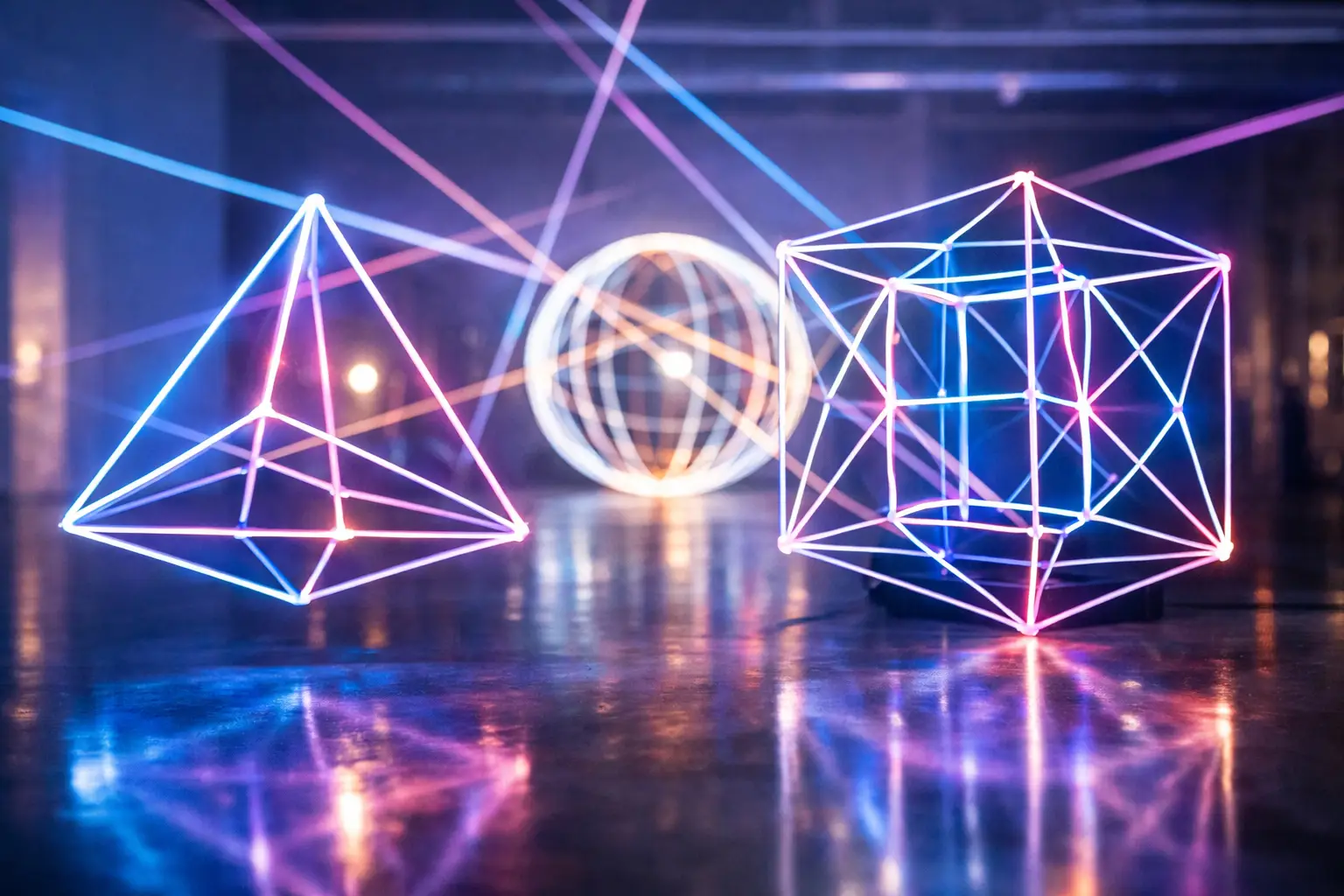
The tesseract is compelling because it is both recognizable and unresolved. Its projected structure contains cubes within cubes, joined by connecting edges. It reads as a familiar architectural diagram at first glance, yet the more closely one studies it, the more it resists being mentally completed.
For a collector drawn to sacred geometry, futurism, or conceptual design, that resistance is the point. A strong work of art should not surrender all of itself in a single look. It should reward return. Morning daylight may reveal the formal structure and fabrication. At night, the activated lighting can shift the work into a portal-like field of color and apparent infinity.
A hypercube is also unusually suited to sculptural light. Its network of edges gives illumination a clear path to travel, while its symmetry prevents the visual experience from becoming chaotic. The light is expressive, but the geometry holds it in discipline. This balance is essential in refined spaces, where spectacle without structure can feel temporary or loud.
Nicky Alice approaches this form as an artist and fabricator rather than as a producer of novelty lighting. Each handcrafted Tesseract work is designed to carry the visual exactness collectors expect from a statement sculpture, while advanced programmable LEDs make the piece responsive to atmosphere, mood, and occasion.
Projection Is Not a Compromise
A common misunderstanding is that a projection of a higher-dimensional object is somehow less meaningful than the object itself. In fact, projection is how we encounter much of the invisible world. A blueprint projects a building onto a page. A shadow projects a body onto a surface. Data visualization projects complex relationships into something the eye can interpret.
Hyperdimensional art uses that same principle with intention. The sculpture is a translation device. It gives a physical presence to an idea that cannot be held in the hand, then asks the viewer to complete the experience through attention and imagination.
Infinity mirror construction intensifies this translation. Repeated reflections create the impression of receding planes and endless illuminated edges. The physical enclosure remains finite, but the perceived space seems to expand. This is precisely the productive friction at the center of the work: certainty in the materials, uncertainty in the vision.
Light Turns Geometry Into an Environment
Without light, a geometric sculpture can be elegant, architectural, even severe. With light, it becomes temporal. Color, brightness, movement, and rhythm can change how the form occupies a room from one hour to the next.
Programmable LED lighting makes this possible without sacrificing the integrity of the underlying structure. A restrained single-color setting can emphasize the sculpture’s lines and depth. Slow transitions can create a meditative presence in a private lounge, primary suite, or gallery corridor. More kinetic color programs can transform the same work into a focal point for an evening gathering.
The best setting depends on the room and the collector. A monochromatic white or cool blue program can feel precise and celestial against minimal interiors. Amber, magenta, and saturated gradients can amplify a more expressive collection or a nightlife-forward entertaining space. The ability to control lighting from a smartphone gives the owner authorship over the experience, but the geometry ensures that even the most dramatic setting remains legible as art.
There is a trade-off worth respecting. Brighter, faster programs produce immediate impact, especially in larger social spaces. They can also compete with quieter artworks, reflective surfaces, or a room intended for restoration. For that reason, a considered lighting design often includes both theatrical scenes and low-intensity modes. A collectible sculpture should be able to command attention when asked and live beautifully with its owner when not.
Scale Changes the Perception of Depth
Scale is not merely a practical specification. It changes the psychological effect of hyperdimensional spatial geometry. A smaller piece can operate like a concentrated visual artifact, ideal for a curated shelf, office, bedroom, or intimate entry. It invites close viewing and makes the viewer feel as though they are looking into a contained anomaly.
A larger custom installation becomes more architectural. It can anchor a double-height wall, gallery-like corridor, listening room, or hospitality setting, where the illusion of depth has enough physical presence to alter the atmosphere of the entire space. As scale increases, sightlines become especially important. The work should be positioned where viewers can approach it head-on, then encounter its changing reflections from the side.
Power planning belongs in the conversation early. Flexible power options allow a sculpture to serve the realities of a residential installation, a design project, or a curated commercial environment. The cleanest result often comes from considering outlet placement, cable routing, wall conditions, and lighting control before the piece arrives. This is not an afterthought in high-end art placement. It is part of the composition.
Why Craftsmanship Cannot Be Separated From the Illusion
Infinity is a demanding visual claim. Small inconsistencies in alignment, reflective planes, structural joins, or light distribution can break the spell. When the subject is impossible space, precision is not simply a technical virtue. It is the foundation of belief.
That is why handcrafted fabrication has a distinct place in this category. The work must resolve conceptual geometry, material behavior, optical reflection, and electronic performance at once. A computer can model a tesseract, but it cannot replace the judgment involved in translating that model into a physical object that feels exact from across the room and compelling at arm’s length.
For collectors, limited-edition, signed, and numbered work adds another dimension of value: provenance. A certificate of authenticity and a clearly defined edition establish that the sculpture belongs to an artistic practice, not a production line. Custom commissions deepen that relationship further, allowing scale, lighting behavior, and power considerations to be shaped around a specific environment.
The result is an object that operates on several levels at once. It is a sculpture because of its form. It is a light work because its appearance is activated over time. It is a conceptual work because it turns advanced geometry into a direct encounter. And it is a conversation piece because no one passes it without trying to understand what they are seeing.
Living With an Impossible Object
The lasting appeal of a hyperdimensional sculpture is not that it provides a single, perfect illusion. It is that it refuses to become visually exhausted. Guests may see a portal. A mathematician may see projection and symmetry. A designer may see a luminous architectural intervention. The owner may simply see a work that makes an ordinary evening feel less ordinary.
Choose the placement, scale, and light program with the same care you would give any significant artwork. Then let the piece do what exceptional art does best: keep creating new space for thought long after the room goes quiet.