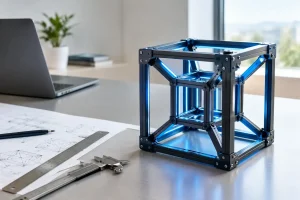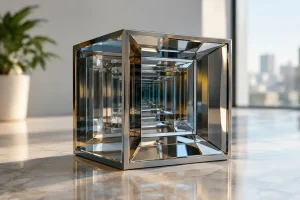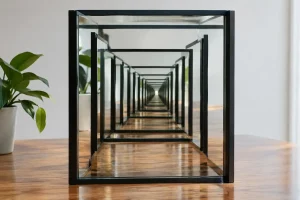

A tesseract installation engineering example begins with an impossible request: make a four dimensional object legible to a body that lives in three dimensions. On the playa, inside a darkened festival field, that request becomes physical. I build a form that appears to continue beyond its own boundaries, then let a viewer’s motion, attention, and curiosity complete the geometry.
The point is not to claim that a sculpture literally contains a fourth spatial dimension. It does something more interesting. It uses projection, reflection, scale, and programmable color to give the mind evidence that its ordinary map of space may be incomplete. A visitor sees an interior receding beyond reach, encounters their reflection multiplied into a strange population, and begins to feel the difference between an object and its higher dimensional shadow.
The Geometry Behind a Tesseract Installation
A tesseract is the four dimensional analogue of a cube. A point has no length. Extend it in one perpendicular direction and it becomes a line segment. Extend that segment in a new perpendicular direction and it becomes a square. Extend the square once more and it becomes a cube. One further perpendicular extension produces a tesseract.
That final movement is where intuition fails, not because the mathematics is vague, but because human vision and touch evolved within three spatial axes. The tesseract remains precisely describable. It has 16 vertices, 32 edges, 24 square faces, and 8 cubic cells. A cube has six square faces, while a tesseract has eight cubes as its boundary cells.
No physical sculpture can place those eight cubes into a literal fourth spatial direction. Instead, I work with a three dimensional projection. The familiar image of a smaller cube nested inside a larger cube, connected at corresponding corners, is one such projection. It is not the tesseract itself, just as a drawing of a cube is not a cube. Yet the projection preserves enough relationships to let the mind reconstruct the larger idea.
This is why tesseract sculpture is not merely an exercise in making a geometric frame. The engineering must protect the mathematical relationships while giving perception something richer than a static diagram. If the proportions drift, if the repeated lines lose correspondence, or if the inner and outer forms fail to read as one system, the sensation collapses into ordinary architecture.
A Tesseract Installation Engineering Example in Physical Space
My five foot cubic Tesseract begins with coordinates, not ornament. Every visible edge belongs to a larger spatial argument. I establish a consistent outer cube, a corresponding inner cube, and connectors that identify which vertices relate across the projection. The frame must carry its own visual weight while remaining open enough for reflection to perform the impossible extension.
Mirrors change the engineering problem. A single reflective plane gives an image. Opposing reflective surfaces create repeated images, and repeated images create apparent depth. The apparent corridor is finite in physical distance, but each reflection returns the structure to itself at a smaller intensity. The eye reads that sequence as recession, often far beyond the actual dimensions of the piece.
The result depends on angle with unusual sensitivity. Parallel planes create the cleanest recursive depth, but the smallest misalignment can make edges double, wander, or break apart. I account for the thickness of each material, the positions of joints, the tension between structural accuracy and optical clarity, and the viewing angles created by a crowd moving around the work.
Programmable color is another geometric instrument. Color can mark a path through the projected cells, pulse across corresponding edges, or create a temporal sequence that suggests rotation through a dimension unavailable to the body. A static projection shows a relationship. An interactive sequence can reveal transformation. When color migrates from one linked edge to another, the viewer can follow a rule rather than merely admire an effect.
That distinction matters. The most convincing moments are not produced by visual excess. They occur when an interactive pattern gives the brain a coherent clue, then reflection expands that clue into an apparent infinity. The structure feels alive because it is behaving according to a legible system.
Why Reflection Can Feel Like Another Dimension
Infinity mirrors are often described as portals, and the word is emotionally accurate, but physics gives the experience its force. Light reflects because electromagnetic fields interact with the electrons in a reflective surface. A partially transmitting front surface lets some light reach the viewer while returning some back into the chamber. Each return produces another visible iteration, weaker than the previous one, but still ordered.
The brain is remarkably willing to infer depth from ordered repetition. Linear perspective, shrinking scale, occlusion, motion, and reflection all participate. In a tesseract installation, these cues overlap. A visitor sees known cubic geometry, then sees it copied repeatedly into a space that the body cannot enter. The room remains finite, but perception receives the vocabulary of vastness.
There is a productive tension here. Binocular vision may report that the object is close, while the reflected geometry suggests that it is immeasurably deep. The eye shifts focus, the body adjusts position, and the mind revises its model. That small cognitive instability is part of the artwork. It resembles the feeling of a lucid dream, where a scene is perfectly detailed yet governed by a different physics.
Sacred Geometry Without Escaping Mathematics
Sacred geometry becomes meaningful when it is treated as a human response to pattern, proportion, symmetry, and recurrence. It does not need inflated claims to be powerful. Cubes, lattices, nested forms, and radial symmetries have appeared across cultures because geometry is both practical and psychologically charged. It offers visible order in a reality that often feels discontinuous.
The tesseract adds a compelling complication. Its projection looks familiar enough to approach, then refuses complete visual possession. It presents an architecture of correspondences that no viewer can fully inhabit. That makes it a potent form for questions about consciousness, dreams, and dimensions beyond direct sensory access.
I am interested in the moment when a viewer recognizes the rule and still cannot resolve the image. That is not a failure of explanation. It is the actual encounter with higher dimensional thinking. Mathematics says the object is consistent. Perception says the object is strange. Both statements can be true at once.
Engineering for a Festival Encounter
A large scale interactive installation at Burning Man or another outdoor festival must survive more than an ideal viewing condition. It meets wind, dust, changing temperatures, long nights, accidental touches, and thousands of different approaches. Structural decisions must anticipate all of it without making the form visually heavy.
Crowd flow is part of the composition. A person standing directly in front sees one kind of recursion. A person circling a corner sees another. Several people gathered around the sculpture become reflections within the geometry, turning the audience into a temporary population of parallel selves. The work becomes interactive not only through programmed behavior, but through the way bodies alter the image for one another.
Augmented reality extends that encounter virtually. With an interactive headset experience, a viewer can step inside a hyperdimensional interpretation that physical materials cannot fully contain. The virtual interior does not replace the sculpture. It reveals another layer of the same proposition: a tesseract is most vivid when it moves between calculation, object, image, and imagination.
The next time a recursive mirror field seems to open beneath your feet, resist the urge to solve it immediately. Move slowly. Find a corner, trace an edge, watch a reflection become a corridor. The fourth dimension may not be waiting behind the glass, but the mind’s ability to imagine it is already there.