
At night, a festival field becomes a temporary instrument. Bass travels through the ground, bodies alter the pathways through space, and interactive art at music festivals gives that collective energy a physical form. The strongest works do not simply fill an empty corner between stages. They interrupt ordinary perception, asking a person who has been dancing for hours to reconsider where a surface ends, how deep a room can be, or whether the architecture before them is behaving according to familiar rules.
For me, that interruption begins with a question from geometry. What would a fourth dimensional object feel like if it entered a world built for three dimensional senses? A tesseract, also called a hypercube, cannot be held in the hand as a complete four dimensional object. But its projections can be built, illuminated, reflected, and encountered. At a festival, where the boundaries between sound, movement, sleep, dream, and waking perception are already more fluid, that encounter can become remarkably direct.
Interactive Art at Music Festivals Is a Spatial Event
A painting asks for sustained attention. A large scale interactive installation asks for navigation. A person approaches it from one angle, sees another person framed in reflection, hears music arriving from an adjacent stage, then discovers that a small movement shifts the entire visible structure. The viewer is no longer outside the work. They become one of its variables.
This is why scale matters. A small optical illusion can be exquisite, but a structure large enough to enter changes the body’s relationship to geometry. The body measures space before language catches up. When someone walks toward an infinity mirror sculpture and the apparent interior continues far beyond the physical depth of the object, the nervous system registers a contradiction. The eye reports distance. The body knows there is a boundary. The mind must hold both claims at once.
That tension is the beginning of interactive experience. Interactivity does not always require a screen, a button, or a sensor that triggers an effect. Light, reflection, proximity, and the changing position of the viewer are already interactive materials. A festival amplifies this because no encounter repeats precisely. Weather changes the air. Dust softens the edges of light. A crowd creates choreography that no artist can fully script.
The Tesseract as a Machine for Perception
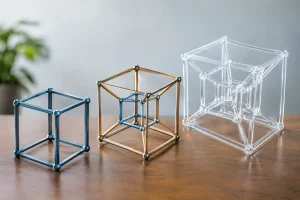
The tesseract is the four dimensional analogue of a cube. A point extended in one direction becomes a line. A line extended in a new perpendicular direction becomes a square. A square extended in another perpendicular direction becomes a cube. Extend the cube along a direction perpendicular to all three familiar axes and, mathematically, the result is a tesseract.
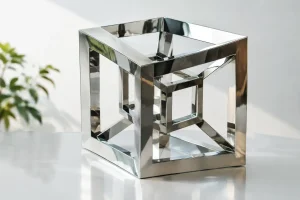
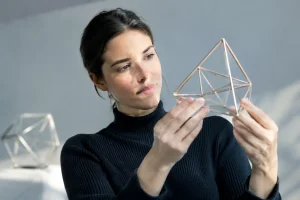
Human vision cannot directly see that final direction. Still, mathematics gives the form a rigorous structure. A tesseract has 16 vertices, 32 edges, 24 square faces, and eight cubic cells. Its familiar three dimensional projection often appears as one cube nested inside another, with corresponding vertices connected by lines. That image is not the tesseract itself. It is a shadow of a higher dimensional relationship, much as a square can be understood as a shadow or slice of a cube.
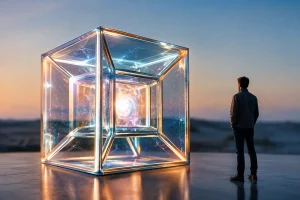
I use this logic as a sculptural framework. The Tesseract is a five foot infinity mirror hypercube whose visible depth is generated through carefully placed reflective surfaces and programmable LED light. The apparent space reaches inward through repeated reflections, creating a recursive corridor that feels much larger than its physical enclosure. It is not literally infinite. Each reflection loses a small amount of light, and the geometry is finite. But the perceptual effect is powerful precisely because the eye keeps attempting to resolve a space that refuses to settle.
At a music festival, the tesseract becomes interactive in several ways at once. Viewers change the angle of reflection. Groups appear inside the same visual field at different depths. Color sequences alter the perceived scale and velocity of the structure. A person may walk around it repeatedly and never encounter the same composition twice. The object is stable, yet experience keeps moving.
Physics Makes the Illusion Convincing
Infinity mirrors are not magic, although they can create the emotional conditions for magic. Their operation depends on controlled reflection. A partially reflective front surface allows some light to pass through while reflecting some of it back. Behind it, a highly reflective surface returns the light again. LEDs placed within the chamber appear in a sequence of diminishing reflections, each one deeper and dimmer than the last.
The engineering challenge is to make the physics serve the imagination. Mirror alignment matters. Frame tolerances matter. LED density, diffusion, heat management, cable routing, power distribution, and control programming all affect whether the illusion reads as expansive rather than cluttered. At an outdoor festival, the design must also account for wind, dust, transport, grounding, public safety, and the relentless reality of continuous use.
Programmable light adds another layer of interactive possibility. Color is not merely visual ornament. Saturated blue can make a chamber feel cool and distant. Red compresses attention and changes the emotional pressure of a space. Slow gradients can suggest breathing or vast atmospheric movement. Rapid sequences can turn a geometric structure into a perceptual engine, especially when nearby music gives the body a second rhythm to follow.
The goal is not to make light imitate the music in an obvious way. Sometimes synchronization is effective. Sometimes it reduces the work to a visual accessory for the stage. A more interesting installation retains its own internal logic while still participating in the larger sensory ecology of the festival.
Why Festival Context Changes the Work
A gallery offers concentration, controlled lighting, and time. A music festival offers intensity, chance, and a public that has arrived ready to move beyond routine perception. Neither context is superior. They produce different kinds of attention.
Festival art has to earn its encounter. Someone may arrive exhausted, ecstatic, distracted, curious, or looking for shade and water. The work must be legible enough to draw a person near, then complex enough to reward the pause. It must also welcome an audience with radically different levels of technical knowledge. A physicist may recognize a projection problem. A child may simply feel that the space is impossible. Both responses are valid, and both can lead toward deeper inquiry.
Burning Man has been especially significant to this kind of practice because it treats temporary architecture, sculpture, ritual, engineering, and radical public participation as parts of one landscape. Large interactive installations are not background scenery there. They become landmarks, meeting places, and shared memories. The work can be encountered at midnight, at sunrise, alone, or amid hundreds of people. Its meaning is partly composed by those conditions.
For festival producers and curators, that means interactive art should be considered early, not added after stages and walkways have already determined every possibility. Site lines, night visibility, sound bleed, crowd circulation, accessibility, power, and dwell time shape the experience. An installation that invites a long, contemplative encounter needs a different placement from one designed to act as a kinetic beacon across an open field.
Virtual Entry and the Question of Inside
Augmented reality can extend an interactive sculpture without replacing the physical object. With an AR headset, viewers can virtually step inside a hyperdimensional mirror structure and experience its spatial logic from an impossible interior position. This matters because a sculpture can reveal only certain projections from the outside. Virtual entry can shift the point of view through the geometry itself.
The distinction is essential. A virtual experience has tremendous freedom, but physical sculpture gives the mind resistance. There is weight, reflection, proximity, and a crowd sharing the same phenomenon. The most compelling interactive work lets these modes speak to each other. One makes the abstract model navigable. The other makes it consequential.
There is also a kinship between this experience and lucid dreaming. In a lucid dream, the dreamer notices that reality has acquired a different rule set, then begins to test it. An infinity mirror hypercube can provoke a gentler version of that recognition. The viewer sees a room that appears to contain impossible depth, realizes the effect is constructed, and still feels the pull of the impossible. Knowledge does not diminish wonder. It gives wonder more dimensions.
The next time an interactive installation catches attention at a festival, stay with it for another minute. Walk around it. Watch how other bodies enter its geometry. Ask what physical rule is producing the sensation, then let the sensation remain larger than the explanation.