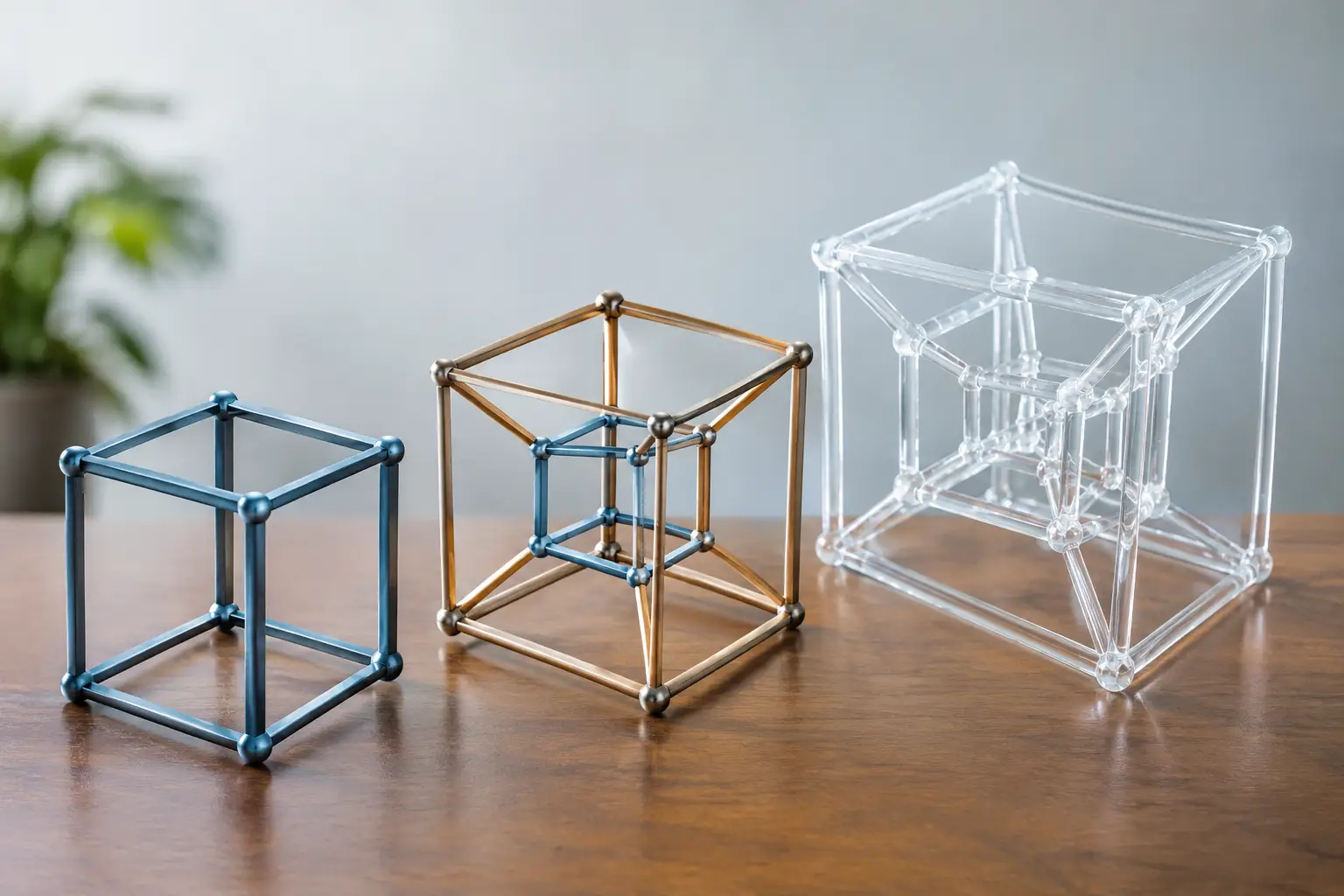
A hypercube is not merely an unusual geometric object. It is a pressure point in the imagination. The moment a mind tries to picture a four dimensional cube, ordinary spatial intuition begins to bend, split, and reassemble. That rupture is precisely where the work becomes interesting. A tesseract asks a direct question: if reality contains directions human bodies cannot move through, what traces might those directions leave in the world we can see?
What a Hypercube Actually Is
A square is the two dimensional version of a cube. Move every point of a square through a new direction perpendicular to its plane, and the path creates a cube. The same operation can be performed once more in mathematics. Move every point of a cube through a direction perpendicular to all three familiar spatial directions, and the result is a four dimensional hypercube, more commonly called a tesseract.
The phrase “perpendicular to all three directions” is where intuition objects. In a room, there is no spare direction to point toward. There is left and right, forward and back, up and down. A fourth spatial axis cannot be located by turning the head farther or climbing higher. It is not hidden behind the sky. It is an additional degree of freedom, defined mathematically even though human perception has no direct sensory organ for it.
The mathematics remains remarkably precise. A tesseract has sixteen vertices, thirty two edges, twenty four square faces, and eight cubic cells. A cube has six square faces. A tesseract has eight cubes as its boundary. That statement can feel impossible until it is compared with a simpler case: a square has four line segments as its boundary, while a cube has six squares. Each new dimension changes the kind of shape that can enclose a space.
This is why a hypercube is more compelling than a clever diagram. It exposes the limits of visual instinct while remaining fully rigorous. The mind cannot picture the entire object at once, yet it can understand its structure.
The Tesseract We Can See Is a Projection
Any tesseract encountered in a drawing, sculpture, or screen based experience is a projection. It is not the four dimensional object itself, just as a shadow on a wall is not the three dimensional hand that cast it. Projection translates information from a higher dimensional space into a lower dimensional one. Something is preserved, something is distorted, and that distortion carries meaning.
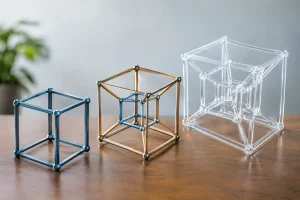
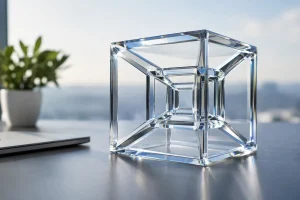
A familiar wireframe tesseract often appears as a small cube nested inside a larger cube, joined at corresponding corners. The image can seem like two boxes connected by diagonal struts. But this is a visual translation, not a literal arrangement of cubes floating one inside another. The nested form records how a four dimensional object may appear when projected into three dimensions.
Rotation makes this even stranger. A three dimensional cube rotating in front of a lamp produces changing two dimensional shadows. Likewise, a four dimensional tesseract rotating through its own space would produce a changing three dimensional projection. Edges may appear to pass through one another. Interior and exterior may exchange roles. A cell can seem to emerge from nowhere, not because the geometry has broken its rules, but because the observer is seeing only a reduced image of the motion.
That is the conceptual engine behind much hyperdimensional art. The goal is not to pretend that a room contains a literal fourth direction. The goal is to make projection felt, rather than merely calculated.
Building a Hypercube as an Experience
I build tesseract sculptures from explicit mathematical relationships, then use reflection, transparent planes, and programmable color sequences to extend their spatial logic beyond the material frame. The sculpture has a measurable outer boundary, but the perceived geometry can recede far past that boundary. Repeated reflections create a recursive field of cubes, cells, and vanishing points that appears to continue through the viewer’s position.
Mirrors are especially potent because they turn a finite construction into an argument about infinity. Two facing mirrors can generate an apparently endless corridor of repeated images. Introduce a hypercube structure into that system and the repetitions are not random. Every reflected edge becomes part of a spatial rhythm, one that can suggest the multiplication of cells in a tesseract or the impossible return of a shape into itself.
The physics matters. Reflection preserves angles according to a strict geometric law. A ray arrives at a mirror and leaves at an equal angle on the opposite side of the normal. Multiply those relationships through several reflective surfaces, and small changes in viewing position produce major changes in apparent depth. What feels supernatural is often a carefully engineered consequence of optics, material placement, and the limits of binocular vision.
That limit is not a defect. It is the medium. Human vision estimates depth through motion, convergence, focus, occlusion, and differences between the images received by each eye. An interactive sculpture can destabilize those cues without abandoning physical law. Step sideways, and the recursive geometry shifts. Lean closer, and a plane that seemed distant becomes a surface. The body starts testing the space because the eyes can no longer settle the question alone.
Why a Hypercube Feels Like a Dream
Lucid dreams often possess a geometry that is convincing while it is happening and impossible when described later. A hallway leads back to itself. A room gains another side. A familiar building expands into a place that could never fit inside its exterior. Dream architecture does not necessarily obey Euclidean space, but it often obeys emotional and perceptual continuity.
A hypercube offers a mathematical counterpart to that sensation. It is not dream logic, and it should not be reduced to mysticism. Its equations are exact. Yet its projections evoke the experience of encountering space that behaves coherently while exceeding the categories a waking mind usually relies on.
Sacred and spatial geometry meet here with care. Repetition, symmetry, and proportion have long been used to induce attention and contemplation. Their power does not require unsupported claims about hidden forces. A repeated form can affect consciousness because perception is always searching for pattern, scale, and orientation. When those patterns continue farther than expected, the nervous system pauses. Awe can emerge in that pause.
The Festival Scale of Higher Dimensional Space
At Burning Man and other immersive gatherings, a tesseract becomes more than an object viewed from a polite distance. It becomes a destination, a meeting point, an interactive threshold. Thousands of people can approach the same form with entirely different perceptual histories: a mathematician tracking its cells, a maker studying the construction, a dancer watching color migrate through reflections, or someone arriving after midnight and feeling that space has suddenly become porous.
This range of response is part of the work. Higher dimensional geometry does not need to be simplified into a vague symbol in order to be communal. The structure can remain mathematically serious while the encounter remains open. One person may see an elegant projection. Another may feel a lucid dream rendered at architectural scale. Both are responding to the same underlying system.
Interactive augmented reality can push this encounter further by allowing viewers to step virtually inside a hyperdimensional environment. The physical sculpture establishes trust through scale, material, and reflection. The virtual experience then lets impossible viewpoints become temporarily available. A viewer can occupy the apparent interior of a recursive form, where a cube may contain another cube without behaving like an ordinary box.
A Question Worth Keeping Open
The fourth dimension may never become visible in the direct, ordinary sense that a tree or a doorway is visible. But a hypercube gives perception a disciplined way to reach toward it. It makes the impossible neither vague nor decorative. It gives the imagination edges, vertices, angles, and consequences.
Stand before a tesseract long enough and the valuable question is not whether the sculpture proves that another spatial direction exists. It is whether the certainty of familiar space can survive an encounter with geometry that is both impossible to picture and impossible to dismiss.