
A mirror can make a room appear larger. Place mirrors in precise opposition, introduce a field of colored light, and that familiar effect becomes something stranger: a corridor with no visible end, a volume that seems to contain more space than its physical frame permits. The science of light art begins in that productive contradiction. I use real optics, measured geometry, and the limits of human perception to build encounters with spaces that feel impossible, yet remain entirely physical.
The aim is not to illustrate an abstract equation from a safe distance. It is to let someone stand before a hypercube and feel the question in their body: if a fourth spatial dimension existed beyond the directions available to human movement, what kind of structure might it cast into this world?
The science of light art is a study of perception
Light does not simply reveal an object. It carries information about surface, distance, angle, motion, and color to the eye. The brain then makes a best estimate of the world from that information. Most of the time, that estimate is astonishingly useful. It lets a person catch a falling object, recognize a face, and move through a crowded festival after dark.
An infinity mirror sculpture gives the visual system a problem it was not built to solve. Two partially reflective surfaces face one another. Light within that chamber reflects back and forth, and a portion of each reflection reaches the viewer. Each successive image is dimmer because no real surface reflects perfectly. The result is not literal infinity. It is a finite physical system producing a long, tapering sequence of virtual images.
That distinction matters. The apparent depth is an optical construction, not a hole cut through ordinary space. Yet the experience can still feel like an abyss. Vision reads repeated reflections as receding distance, while the body knows the sculpture has an edge. This disagreement between sight and embodied knowledge is where the work becomes charged.
In my Tesseract, the geometry gives that optical recursion a disciplined form. The reflections are not merely decorative repetition. They extend the logic of a cube into a field that suggests a larger dimensional order. The viewer sees a structure multiplying inward, then begins to wonder whether the visible object is a projection of something that cannot be held all at once.
Why the tesseract unsettles the eye
A tesseract is the four dimensional analogue of a cube. A point can extend into a line. A line can extend perpendicular to itself into a square. A square can extend perpendicular to its plane into a cube. Continue the pattern in a direction perpendicular to every direction in three dimensional space, and mathematics gives a hypercube, commonly called a tesseract.
No one can point toward that additional spatial direction in a room. Human senses operate within three dimensions of space, so a tesseract cannot be directly presented as a complete object. What can be presented is a projection.
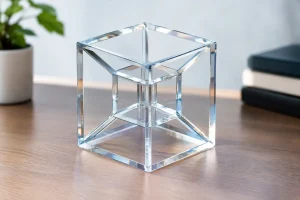
The familiar wireframe image of a tesseract, a smaller cube connected to a larger cube, is one such projection. It is not the tesseract itself, just as a square drawn on paper is not a cube. The drawing compresses higher dimensional relationships into fewer dimensions, preserving some structural information while distorting other relationships.
This is where sculpture becomes a way of thinking. A physical hypercube sculpture is not a claim that four dimensional space has been captured in metal and mirrors. It is a three dimensional interpretation of a mathematical object, designed to make projection emotionally legible. The geometry offers rigor. The optical depth offers sensation. Together, they let an idea arrive as an experience rather than a diagram.
There is a useful tension here. Mathematical space is exact. Perception is interpretive. The tesseract sits at their boundary, cleanly defined by coordinates and yet impossible to picture without translation. That impossibility is not a failure of imagination. It is the central material.
Projection is not illusion alone
Calling the work an illusion can be accurate, but incomplete. An illusion suggests a trick that disappears once its mechanism is understood. In this case, understanding the mechanism often deepens the effect.
A viewer may know that the depth comes from repeated reflection, that the color sequences are programmed, and that the frame has a fixed physical volume. None of that removes the visceral sense of standing before an opening into another order of space. Knowledge and wonder can occupy the same moment.
This is also why interactive installation matters. As a person changes position, angles shift, reflections reorganize, and the body becomes part of the measurement. The experience cannot be fully replaced by a photograph because a photograph fixes a single viewpoint. Walking around the sculpture reveals that perception is active, constantly testing the world from new coordinates.
Sacred geometry, without abandoning physics
Sacred geometry is often used as a broad name for recurring forms that carry spiritual, symbolic, or cultural meaning: circles, grids, polyhedra, radial symmetries, and proportional systems. Those meanings are real as human history and experience. They are not, by themselves, proof of hidden physical laws.
What interests me is the point at which symbolic resonance meets spatial fact. A cube has powerful cultural associations, but it is also a rigorous object with equal edges, right angles, six faces, twelve edges, and eight vertices. A hypercube extends that combinatorial logic. Its strange beauty is not arbitrary. It comes from a pattern that remains coherent as dimension increases.
Spatial geometry can produce a feeling often described as sacred because symmetry and repetition give the mind a foothold in complexity. But the work does not require mysticism to be meaningful. Reflection, angle, material, and geometry are enough to generate awe. If an encounter also opens a contemplative or dreamlike state, that response belongs to the viewer’s own imagination.
Lucid dreams offer a useful parallel. In a lucid dream, a person may recognize that the environment is constructed while still moving through it with intense emotional reality. An infinity mirror environment can create a waking version of that split awareness. The mind sees the construction and also feels the impossible scale of the space. It becomes an invitation to question how much of ordinary reality is assembled through perception.
Building a fourth dimensional encounter
The sculptures begin with mathematics, but building them requires continuous negotiation with material reality. A diagram may describe an ideal hypercube. A physical installation must account for alignment, surface behavior, structural tolerance, viewing angle, transport, and the unpredictable movement of a crowd.
Small errors become visible quickly. If a reflective plane is out of alignment, the recursive structure loses its clarity. If the internal geometry is not precise, the repetition becomes visual noise rather than an intelligible extension of form. The craft is not separate from the concept. Precision is what allows the concept to hold under close looking.
Color is equally structural. A changing chromatic field can mark depth, direct attention through the recursive chamber, or make the same geometry feel radically different from one moment to the next. In an interactive setting, color can create rhythm around a viewer’s movement and make time as present as space.
Augmented reality extends this inquiry in another direction. With an interactive headset activation, viewers can virtually step inside the geometry rather than only stand before it. The physical sculpture remains the anchor, while the virtual experience shifts scale and point of view. That change is significant. A tesseract projection viewed from outside asks the eye to infer another dimension. Entering an interactive virtual interpretation asks the body to imagine inhabiting it.
At Burning Man and other art festivals, this question gains an extra charge. A large installation does not exist in silence or isolation. It lives among dust, music, distance, weather, exhausted bodies, night walks, and chance encounters. Someone may arrive with an understanding of higher dimensional geometry. Someone else may arrive with no vocabulary for it at all. Both can meet the same structure through curiosity.
That shared encounter is one reason immersive art belongs in public space. Physics becomes social. A mathematical object becomes a gathering point. People circle it, photograph it, speak about what they think they are seeing, then realize that no single image contains the whole experience.
The most useful way to approach a hyperdimensional sculpture is not to demand a final answer from it. Stand still long enough for the recursion to disrupt your sense of scale, then move and watch the structure answer differently. The fourth dimension may remain beyond direct perception, but the mind can still feel the edge of the question.