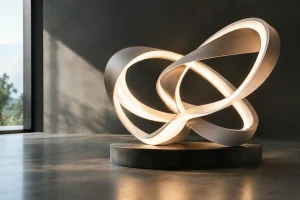
A festival can make a field feel like a temporary city, but large scale festival art can make that city feel like it has slipped outside ordinary space. A person walks toward a glowing geometric form, sees their reflection repeat into a depth that should not fit inside the object, and suddenly the body becomes uncertain of its own position. Is the surface near, or impossibly far away? Is there an interior, or only the suggestion of one?
That uncertainty is not a special effect added after the idea. It is the idea. I build interactive sculptures that use reflection, geometry, and programmed color to make the familiar rules of space feel porous. At a festival, where sleep, sound, dust, movement, and collective attention already alter perception, a hypercube can become more than a form to observe. It becomes an experiment that thousands of people enter together.
Large Scale Festival Art Is a Spatial Question
Scale matters because perception is embodied. A tiny reflective object can imply infinity, but a structure large enough to stand beside changes the equation. The viewer does not merely look at the geometry. They compare it to their own height, reach, motion, and breath. The artwork establishes a physical fact, then reflection begins to contradict that fact.
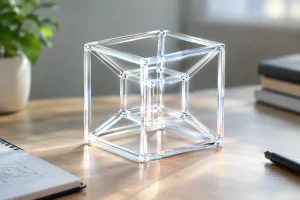
My five by five by five foot Tesseract begins with a simple mathematical provocation. A cube is the three dimensional analogue of a square. A tesseract, also called a hypercube, is the four dimensional analogue of a cube. Human vision cannot directly see four spatial dimensions in the same way it sees height, width, and depth. But mathematics can describe a tesseract precisely, and projection can translate aspects of it into three dimensional space.
A familiar drawing of a cube contains two offset squares joined by connecting edges. It is not a cube itself. It is a projection, a lower dimensional image carrying information about a higher dimensional form. The tesseract follows the same logic. Its common three dimensional projection appears as a cube within a cube, connected at corresponding vertices. The result feels both lucid and impossible because it asks the eye to hold several spatial readings at once.
At festival scale, this mathematical diagram stops behaving like a diagram. It becomes a threshold. People circle it. They place a hand near its edge. They photograph another person through it. Each action produces a new relationship between body and structure. That is why large scale festival art is not simply enlarged studio work. It is an interactive system shaped by movement, crowd behavior, weather, darkness, sound, and attention.
Reflection Makes an Impossible Depth Feel Present
The physics is direct, even when the experience feels uncanny. Mirrors reflect light according to a consistent rule: the angle at which light arrives matches the angle at which it leaves. Place reflective surfaces in relation to one another, however, and repeated reflections create a chain of virtual images. The eye reads those images as recession into space.
An infinity mirror uses partial reflection to create this effect. Some light is reflected back toward the viewer, while some passes through the front surface. Behind it, mirrored planes return the light repeatedly. Each recurrence loses intensity, so the visible tunnel gradually falls into darkness. The fading is crucial. It gives the apparent depth atmosphere, a horizon, and a sense that the image continues beyond what the eye can resolve.
The structure itself remains finite. No actual corridor opens inside the sculpture. Yet the visual evidence tells another story, and the nervous system is remarkably willing to entertain it. This tension between material fact and perceptual fact is where the work becomes alive. A viewer can understand the mechanism and still feel the pull of the impossible space.
The geometry intensifies the effect. A rectangular infinity mirror suggests a tunnel. A hypercube form suggests a recursive architecture with no obvious beginning or end. Faces repeat inside faces. Edges seem to fold through one another. The sculpture can resemble an object from a lucid dream, where every detail is sharply rendered but the logic binding those details has changed.
A crowd completes the equation
At a gallery, one person may spend ten quiet minutes watching a reflection shift. At Burning Man or an art festival, the work is continually recomposed by other bodies. A dancer appears in the apparent distance. A stranger pauses at an edge and becomes part of someone else’s photograph. A group gathers, then disperses, leaving the geometry momentarily empty.
This is not interference with the artwork. It is the artwork functioning at its fullest capacity. Large scale festival art must hold up under quick encounters and prolonged attention. It needs a strong silhouette from afar, an intimate visual reward up close, and enough depth that returning viewers find something different. The best encounters often happen at the edge of intention, when someone is walking elsewhere and suddenly realizes that space has become strange.
The Festival Is an Altered Perception Laboratory
Festivals create a rare condition: permission to suspend certainty. Daily life trains perception toward efficiency. A door is a door, a path is a path, a reflected image is recognized and dismissed. In an immersive event, the senses are already primed for surprise. A geometric sculpture can use that openness without asking anyone to abandon reason.
In fact, the stronger work is grounded in reason. The mathematics must be coherent. The reflective planes must align with precision. The programmed color sequences must support the form rather than bury it in spectacle. Installation engineering matters because a piece facing thousands of people must remain physically clear and psychologically legible amid visual abundance.
That is also where sacred and spatial geometry deserve careful distinction. Geometric forms have carried symbolic force across cultures because symmetry, repetition, and proportion are deeply compelling to human perception. A cube, circle, spiral, or lattice can evoke order and mystery without requiring an untestable claim. I am interested in that emotional resonance, but I begin with structure. Wonder becomes more durable when it has an actual physical basis.
For event producers, this distinction matters. An interactive installation should not merely fill an open area or serve as a backdrop. It can give a gathering a center of gravity. People orient themselves around it, meet beside it, return to it at another hour, and create stories that travel beyond the event. The work becomes memorable because it offers an experience difficult to compress into a single image.
Virtually Stepping Inside the Hypercube
Physical sculpture establishes the encounter, but interactive augmented reality can extend its central question. What would it mean to step inside a tesseract rather than look at its projection from outside? An augmented reality activation allows viewers to virtually enter the hyperdimensional space through a headset, moving from observer to participant.
This is not a replacement for the sculpture. It is a second register of perception. The physical form gives the body scale, surface, and shared presence. The virtual experience lets the viewer test the impossible interior suggested by the mirrors. Together, they expose a useful contradiction. The mind can navigate a representation of a fourth dimensional idea, even when the senses cannot directly inhabit four dimensions.
That contradiction has a kinship with lucid dreaming. In a lucid dream, awareness can arrive inside an environment that has its own strange consistency. A hallway stretches too far. A room changes shape when revisited. The dreamer knows something is impossible, yet the experience remains immediate. Hyperdimensional art occupies a related territory while staying anchored in engineered materials, reflection, and measurable geometry.
The goal is not to convince anyone that a tesseract has literally appeared in a festival field. The goal is more interesting: to let the viewer feel how much of reality is assembled by expectation. If a finite object can produce an intuition of infinite depth, what other assumptions about space are the senses making automatically?
A powerful festival encounter does not end when someone walks away. It leaves a small fracture in the ordinary map of the world. Later, a window reflection, a nested set of boxes, or the corners of a room may suddenly recall the hypercube. The question returns quietly: perhaps reality is not less strange than imagined, only more familiar than it deserves to be.