What does a tesseract look like? It does not look like a box, a star, or a glowing sci fi prop suspended in space. The honest answer is stranger and more interesting: a true tesseract cannot be fully seen by human eyes, because it extends through a fourth spatial dimension that human vision does not directly access.
What can be seen is evidence of it. A projection. A slice. A changing shadow. A three dimensional structure arranged so the mind begins to feel the pressure of an impossible direction. That tension, between what the eyes report and what the brain suspects, is where the tesseract becomes an experience rather than merely a diagram.
What Does a Tesseract Look Like in Three Dimensions?
A tesseract is the four dimensional analogue of a cube. A point has no dimensions. Move that point in a new direction and it becomes a line. Move a line in a direction perpendicular to itself and it becomes a square. Move a square through a third perpendicular direction and it becomes a cube. Move a cube through a fourth perpendicular direction and mathematics gives us a tesseract.
The sequence is clean, but the final step is where intuition breaks. A cube has eight corners, twelve edges, and six square faces. A tesseract has sixteen corners, thirty two edges, twenty four square faces, and eight cubic cells. Those cells are not faces in the usual sense. Each is a complete cube, joined to the others in a direction unavailable to ordinary movement.
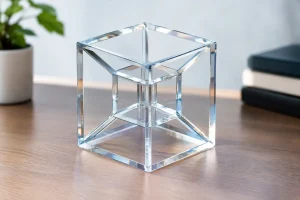
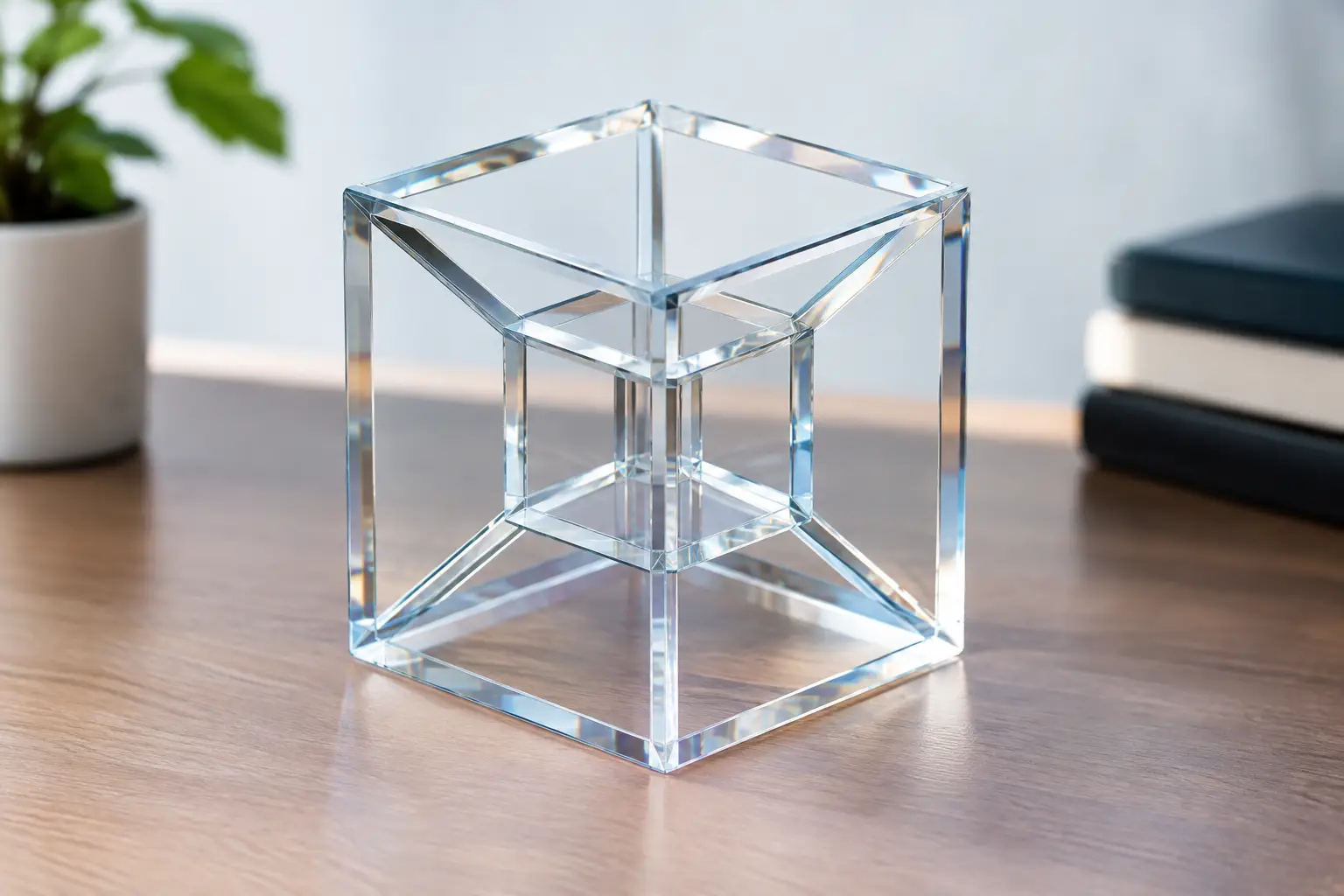
The most familiar image of a tesseract is two cubes, one apparently nested inside the other, with corresponding corners connected by lines. It is useful, but it is not a literal portrait. It is a perspective projection, much like a cube can be drawn as a skewed square inside another skewed square on a flat page. The drawing gives a two dimensional trace of a three dimensional object. Likewise, the nested cube image gives a three dimensional trace of a four dimensional one.
A tesseract does not have a single fixed appearance in our space. Its appearance depends on how it is projected, just as a cube can cast a square shadow, a rectangle, or a more distorted polygon depending on its orientation. Change the projection, and the tesseract seems to change shape. Nothing about the mathematical object has changed. Only the information available to the viewer has.
The Nested Cubes Are a Shadow, Not the Object
The nested cube form has power because it makes a hard idea visible at once. One cube can be read as the near boundary and the other as the far boundary, even though that interpretation is incomplete. The connecting edges imply a route the eye can follow, then lose.
In an ordinary cube, every edge travels through one of three spatial directions. A tesseract adds a fourth. Since no physical rod can point along that fourth direction in a gallery, desert, or city street, artists and mathematicians translate it into the directions available here. Depth, scale, overlap, reflection, and motion become stand ins for an axis that cannot be built directly.
This is why some tesseract images look like a cube turning inside out. In four dimensions, rotations have possibilities that are unavailable in three. A four dimensional rotation can exchange what appears interior and exterior when projected into our world. The projected form may pass through itself, invert, or seem to violate solidity. It is not actually breaking geometry. It is exposing the limits of the projection.
There is a tradeoff in every representation. A clean wireframe makes the structure legible, but it can feel static. A dense reflective sculpture can produce a more visceral sense of endless space, but it can obscure the simple combinatorial logic of sixteen corners and eight cubic cells. I am interested in holding both truths together, precision first, then perceptual disorientation.
A Tesseract Can Also Be Seen as a Sequence of Slices
Projection is not the only way to imagine higher dimensions. Slicing offers another route. Imagine a flat being living on a sheet of paper as a sphere passes through its world. That being would not see a sphere. It would see a point appear, expand into a circle, shrink, and vanish.
A three dimensional observer encountering a tesseract by slices would face a similar event. The slices are three dimensional shapes. Depending on the orientation and path, a cube might appear, grow, transform through connected volumes, then contract and disappear. The full tesseract would never be present in a single slice, just as the whole sphere never appears in one planar cross section.
This matters because it replaces the question, “What does it look like all at once?” with a better one: “What pattern of appearances would a higher dimensional object produce in my world?” Physics often works this way. Many things are understood through traces, measurements, interactions, and consequences rather than through direct visual access.
A tesseract is therefore not a claim that a hidden cube is floating just beyond the wall. It is a rigorous geometric object and an invitation to think clearly about perception. The fourth spatial dimension is a mathematical extension of space. It should not be casually confused with time, even though physics can describe spacetime using four dimensions, three spatial and one temporal.
Why Reflection Makes the Geometry Feel Larger Than It Is
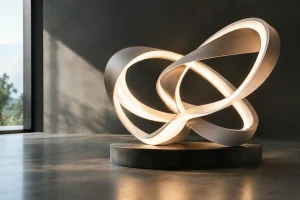
My Tesseract sculptures use reflective planes, programmed color, and carefully structured depth to create a recursive field. The physical object remains firmly three dimensional. Yet each reflection produces another apparent chamber, then another, until the eye cannot easily locate a final boundary.
That recursive depth is not a simulation of the fourth dimension. It is an analogy built from real optics. Light reflects between surfaces. Each reflected image travels a longer visual path, loses intensity, and appears farther away. The result can feel like a corridor extending far beyond the sculpture’s actual dimensions.
The effect becomes more potent when it is interactive. As a viewer moves, the angles change, reflections reorganize, and geometric relationships seem to open and close. A stationary image gives the brain time to classify an object. Movement denies that certainty. The body becomes part of the measurement system.
In my five by five by five foot Tesseract, scale changes the stakes. A small model can be understood from outside. A room scale hypercube asks for another kind of encounter. It asks the viewer to stand at the threshold of a form that seems to have more interior than its outer boundary should permit. At festivals, where darkness, movement, sound, and crowds already loosen ordinary perception, that encounter can feel almost dreamlike.
The Tesseract, Lucid Dreams, and Altered Perception
Lucid dreams often contain a peculiar spatial logic. A hallway can return to itself. A door can open into a place that does not fit inside the building. Distance can collapse without travel. None of this proves that dreams reveal higher dimensions. But dreams demonstrate that the mind does not passively record space. It actively constructs it.
A tesseract sculpture works on that same faculty, while remaining anchored in mathematics and material behavior. It presents a real object, then gives the perceptual system too much depth, too many repeated boundaries, and too many plausible routes for the eye to resolve immediately. The resulting awe is not mysticism for its own sake. It is the feeling of a model of reality becoming insufficient.
Sacred geometry enters the conversation here with care. Symmetry, recursion, and proportion have moved people across cultures because they make order visible. The tesseract belongs to that lineage of spatial fascination, but it is also exact mathematics. Its strangeness does not require vague language. Its structure is beautiful precisely because it can be counted, projected, rotated, and engineered.
Making an Impossible Direction Felt
At Burning Man and other immersive events, a tesseract becomes a social instrument as much as a sculpture. Someone approaches it for the color and reflection. Someone else recognizes the hypercube projection. A child reaches toward an apparent void. A physicist starts explaining cross sections. Strangers compare what they think they saw.
That shared uncertainty is valuable. An interactive installation does not demand that everyone arrive with the same vocabulary. It rewards attention at multiple depths. A visitor can simply be astonished, or can trace edges, test symmetries, and ask what kind of space would make the visible pattern ordinary.
Augmented Reality can extend that question. With an interactive headset experience, a viewer can virtually step inside a hyperdimensional environment and observe how a tesseract changes under projection and rotation. The virtual encounter does not replace the physical sculpture. It gives the mind another angle from which to return to it.
The most useful way to look at a tesseract is not to force it into a familiar object. Let it remain partially ungraspable. Follow its edges. Notice where your intuition insists on an inside and outside. Then move around it, and allow the geometry to suggest that reality may contain patterns the senses were never built to picture whole.