
A mirror can make a five foot sculpture feel like a corridor without end. A pane of glass can make a straight line appear to turn. Those are not competing magic tricks. Reflection versus refraction physics describes two radically different fates for the same ray of light, and the distinction matters whenever I build an environment meant to destabilize the eye’s confidence in space.
My work begins with a simple provocation: what would a fourth dimensional object feel like if it could only enter human perception as projection, recursion, and light? Reflection gives me depth that is not physically there. Refraction gives me a world in which straight paths appear to bend. Together, they reveal how much of reality is assembled by the brain rather than simply received by the eye.
Reflection Versus Refraction Physics, One Ray, Two Fates
Reflection occurs when light encounters a boundary and returns into the medium it came from. The law is precise: the angle of incidence equals the angle of reflection. If a ray arrives at a mirror at 30 degrees from the normal, an imaginary line perpendicular to the mirror surface, it leaves at 30 degrees on the opposite side of that normal.
This dependable symmetry is why mirrors are so powerful architecturally and sculpturally. They preserve the geometry of a scene while relocating it. Your reflection appears behind the mirror plane, at the same apparent distance as you stand in front of it. Nothing has traveled into that apparent room. Your visual system has extended the ray backward and constructed a virtual image.
Refraction is different. Here, light crosses from one transparent medium into another, such as air into glass or water. Its speed changes, and so does its direction, unless it strikes the surface exactly perpendicular. The relationship is described by Snell’s law: n₁ sin θ₁ equals n₂ sin θ₂. The symbol n represents refractive index, a measure of how strongly a material slows light relative to vacuum.
When light enters a material with a higher refractive index, it bends toward the normal. When it leaves, it bends away. A straw in water looks broken not because the straw has changed, but because rays from its submerged portion take a new route before reaching the eye.
Reflection preserves an angular relationship. Refraction transforms one. Both alter what appears to be present, but they do it through distinct physical mechanisms.
Why Mirrors Produce Impossible Depth
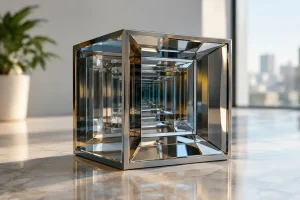
An infinity mirror is an argument between two surfaces. One is highly reflective. The other is partially reflective and partially transmissive. Light inside the narrow interval between them is repeatedly reflected, while a fraction escapes toward the viewer at every encounter.
The eye reads each successive escape as another copy farther away. In physical terms, the path is finite and the intensity diminishes with each bounce. In perceptual terms, the copies can seem to continue beyond the structure’s actual dimensions. The installation becomes a machine for generating visual recursion.
That distinction is essential. An infinity mirror does not contain literal infinity. It produces an ordered sequence of virtual images whose brightness decays. Yet the experience can still feel boundless because the viewer cannot easily locate a final spatial reference. The body knows it is standing before a surface. Vision reports an opening.
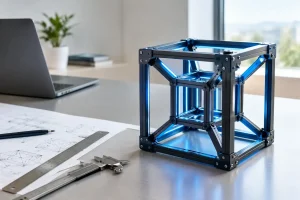
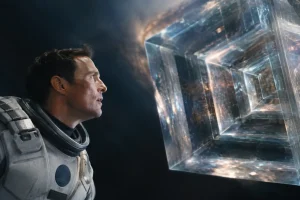
In the Tesseract, that contradiction is the medium. A tesseract is the four dimensional analogue of a cube. Just as a cube can be understood as a sequence of connected squares, a tesseract can be understood as a sequence of connected cubes. Since a four dimensional object cannot be placed whole into ordinary three dimensional space, it must be represented through projection, cross section, motion, or analogy.
Recursive mirror depth offers an analogy with emotional force. It does not prove that a tesseract is an endless mirrored chamber. It gives the nervous system a felt encounter with a structure that exceeds immediate spatial intuition. The geometry is real. The apparent interior is virtual. The sensation of dimensional excess emerges from their collision.
Refraction Makes Space Feel Unstable
Refraction creates a different kind of strangeness. A refractive object does not usually make a convincing duplicate chamber behind its surface. Instead, it shifts, magnifies, compresses, disperses, or distorts what lies beyond it.
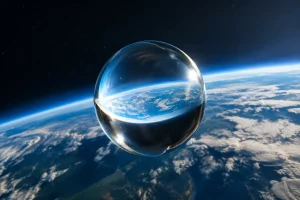
A curved transparent form can act as a lens. Its surface normals vary from point to point, so neighboring rays bend by different amounts. That variation can focus an image, spread it out, or turn a recognizable scene into a fluid spatial field. The effect depends on the material’s refractive index, the curvature of its surfaces, and the location of the viewer.
Color can enter the picture because refractive index is not identical for every wavelength. Shorter wavelengths often bend somewhat more than longer ones. This phenomenon, dispersion, separates a beam into a spectrum under the right conditions. It is why a prism can reveal that apparently white light carries many colors.
For immersive sculpture, refraction is less obedient than reflection. It can be spectacular, but it is highly dependent on viewpoint. Move your head a few inches and a refracted image may reorganize completely. This makes it useful when the goal is not stable illusion but altered perception, the sensation that space is breathing, folding, or refusing to hold still.
The Boundary Is Where the Drama Lives
Neither reflection nor refraction is ever perfectly isolated. At many material boundaries, some light reflects while some enters the new medium and refracts. The proportion changes with angle, polarization, and the optical properties of the material.
Look across a lake at a shallow angle and its surface becomes mirrorlike. Look more directly downward and you may see through it. The water has not decided to become either a mirror or a window. Your viewing angle has changed the balance between reflected and transmitted light.
There is also total internal reflection. When light tries to leave a higher index material at an angle greater than a critical threshold, it cannot refract outward. It reflects internally instead. This is one reason a submerged swimmer can see a bright circular window overhead surrounded by a more reflective field. The physics is exact, but the perception can feel dreamlike.
That threshold matters conceptually. A boundary is not merely a dividing line between materials. It is an active site where direction, intensity, and visibility are negotiated. Much of immersive art is built around that same proposition: perception changes at edges.
Geometry Gives Illusion a Skeleton
Mirrors alone can create a compelling void, but geometry determines whether that void has intelligence. A square mirror arrangement tends to establish an orthogonal world of axes and grids. A hexagonal arrangement produces another spatial rhythm. When the enclosing structure references a hypercube, every reflection participates in a larger mathematical proposition.
Sacred geometry is most interesting to me when it is treated as geometry first. Symmetry, repetition, proportion, and rotational structure have genuine perceptual power. They do not need exaggerated claims to become profound. Human vision is extraordinarily sensitive to pattern, especially patterns that remain coherent while the body moves.
This is where an interactive installation becomes more than an object to look at. Walking changes parallax. A small shift in position changes which surfaces reflect which regions of the space. The viewer is no longer outside the experiment. The viewer’s motion becomes one of its variables.
At festivals, this bodily participation is amplified. A person may encounter the work after hours of dancing, heat, darkness, dust, conversation, and sensory overload. The mirror geometry does not create an altered state by itself, but it can give form to one already in progress. The installation becomes a place to test whether the world is stable, and whether the self is as fixed as it first appeared.
From Optical Trick to Dimensional Question
Reflection and refraction are often introduced as classroom categories. One bounces, one bends. That is correct, but incomplete. Both expose the fact that seeing is an inference process. The eye receives rays. The brain estimates surfaces, distances, materials, and causes.
A virtual image in a mirror feels located in space even though no object occupies that location. A refracted object appears displaced even though it has not moved. These are not failures of vision. They are intelligent predictions based on ordinary conditions. Art becomes powerful when it changes the conditions just enough that prediction becomes visible.
The fourth dimension enters here not as a claim that mirrors open a portal, but as a disciplined invitation to think beyond habitual coordinates. A three dimensional creature can understand aspects of four dimensional geometry through projection. It can inspect shadows, transformations, and cross sections. It can also stand inside an interactive spatial metaphor and feel the limits of its own intuitions.
For viewers using an augmented reality headset, the question can become even more immediate. The sculpture can be experienced virtually from within, allowing an interactive encounter with structures that would be impossible or impractical for a body to occupy physically. The virtual experience does not replace the material installation. It clarifies another layer of the same inquiry: where does space end, and where does perception begin?
The next time a reflection seems to open a corridor or water seems to break a straight line, pause before naming it an illusion. Ask what the ray actually did, what the brain inferred, and what other dimensions of experience may become visible when those two stories briefly disagree.