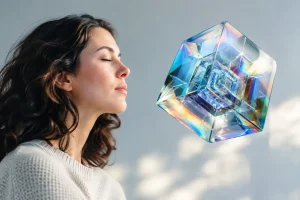

At Burning Man, a mirror sculpture can become a strange instrument for attention. A person approaches expecting an object, then finds apparent depth where a solid boundary should be. Color repeats into a receding grid. Their own body appears in fragments, multiplied and repositioned. This is where altered states and art become inseparable for me, not as an escape from physics, but as a direct encounter with the limits of ordinary perception.
I build tesseract sculptures to make that encounter physical. The work asks a simple but disorienting question: what would a fourth dimensional shape feel like if it had to announce itself inside three dimensions? Mirrors, reflected color, spatial geometry, and carefully controlled illusion cannot give human vision access to a literal fourth spatial direction. They can, however, create an interactive threshold where the mind begins to sense that its usual map of space is incomplete.
Altered States and Art Begin With Perception
An altered state does not have to mean leaving reality behind. It may arise through a lucid dream, focused meditation, exhaustion on the open playa, music felt through the body, or the intense concentration that comes from trying to understand something that refuses to sit still. The common feature is not fantasy. It is a shift in how the brain organizes sensation, time, selfhood, and space.
Perception is not a passive recording of the world. The brain continually predicts what it expects to find, then revises those predictions using incoming sensory information. Most of the time, this process is so efficient that a room seems self evident. It has walls, a floor, a stable scale, and a clear distinction between near and far.
An infinity mirror interrupts that efficiency. The eye receives evidence of a deep chamber, while the body knows there is a surface directly ahead. Neither signal is false. They describe different aspects of the same construction. That tension creates a perceptual loop, an experience in which the viewer must actively negotiate what space means.
The work is interactive even before anyone touches it. A small movement of the head changes sightlines, reflections, and apparent depth. The sculpture does not offer one fixed image. It offers a changing relationship between the viewer, the material, and the geometry. For me, that is the artistic potential of altered perception. It turns certainty into investigation.
A Tesseract Is Not a Cube With Extra Drama
The tesseract is the four dimensional analogue of a cube. A point extended in one direction becomes a line segment. A line segment extended at a right angle becomes a square. A square extended along another perpendicular direction becomes a cube. Extend a cube in a direction perpendicular to all three familiar axes, and the result is a tesseract.
That last instruction is mathematically precise, even though human intuition cannot picture the new direction directly. A tesseract has 16 vertices, 32 edges, 24 square faces, and 8 cubic cells. Where a cube is bounded by six square faces, a tesseract is bounded by eight cubes. Those cubes are not arranged like rooms in a building. They are parts of a four dimensional structure, connected along directions unavailable to three dimensional bodies.
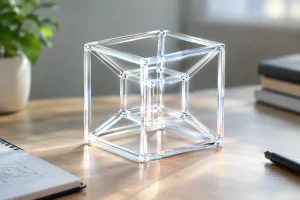
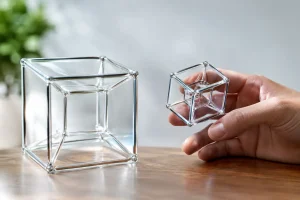
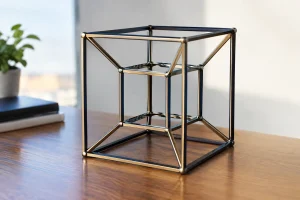
What people often recognize as a tesseract is actually a projection. Just as a three dimensional cube can cast a two dimensional drawing of two offset squares connected by lines, a tesseract can be projected into three dimensions as two offset cubes joined by corresponding edges. The projection contains distortions because projection always trades dimensional information for a lower dimensional image.
That trade is central to my sculptures. The visible hypercube framework is not pretending to be a literal four dimensional object. It is a three dimensional translation of one. Its power lies in making the translation felt. The outer and inner cube may appear to recede, overlap, invert, or contain each other, even though the sculpture remains rigorously constructed in ordinary space.
Reflection Turns Geometry Into Apparent Depth
Mirrors are often treated as visual magic, but their behavior is exact. The angle at which a ray arrives equals the angle at which it leaves. Place reflective surfaces in opposing relation, and each surface can image the other again and again. A partially reflective plane allows the eye to receive both a foreground reflection and a view into a repeated interior field.
Every repeated image is physically diminished. Reflective surfaces absorb or transmit some portion of the light at each encounter, so the receding copies fade rather than continuing forever with equal intensity. This gradual loss is not a flaw. It creates depth cues. The mind reads smaller, dimmer repetitions as distant, even though their apparent distance is generated by repeated optical paths inside a compact volume.
The engineering challenge is to make this optical behavior serve the geometry rather than overwhelm it. Color sequences must reinforce the structural rhythm of the hypercube. Reflective surfaces must align precisely enough that repetition feels intentional. A slight angular error can fracture the apparent space, while an exact alignment can produce a corridor that seems to pass through the object and beyond it.
This is why I think of the sculpture as a physics experiment with emotional consequences. It is built from measurable relationships, yet the result can provoke awe, vertigo, recognition, or the peculiar feeling of seeing a place remembered from a dream.
Lucid Dreams and the Architecture of Inner Space
Lucid dreams are especially relevant because they reveal how convincingly the mind can construct spatial worlds. In a dream, a hallway may lengthen when entered. A door may open into a landscape with no possible relation to the room behind it. The dreamer generally accepts these discontinuities until lucidity introduces a new question: what are the rules here?
A tesseract installation can create a waking version of that question. The viewer stays grounded in a real environment, among other people, with the material edges of the sculpture visible. Yet reflection suggests a space that exceeds its container. The experience is not about claiming that the installation proves hidden dimensions. It is about recognizing that a sense of dimensional reality is constructed through perception, expectation, and embodiment.
Sacred and spatial geometry become meaningful here when they are treated as languages of relation rather than decoration. Symmetry, recursion, proportion, and repeated transformation have long carried psychological force because the human mind is intensely responsive to pattern. A hypercube extends that response into a structure whose full form can be calculated but never fully occupied by ordinary vision.
Why Festival Space Changes the Work
At a festival, the viewer rarely arrives in the neutral state imagined by a gallery diagram. They may have walked for miles, watched the sky change color, heard distant music, spoken with strangers, or spent hours moving through temporary architecture. Their attention is already more porous, more curious, and more available for surprise.
Burning Man has taught me that large scale experiential art does not simply sit in a landscape. It changes the behavior of the landscape around it. People slow down. They circle the work. They point out a new angle to someone else. They photograph it, then put the camera away because the spatial effect refuses to flatten into a single frame.
That social discovery matters. One person may see an elegant mathematical projection. Another may feel as though they have encountered a dream machine. Someone else may notice the craft, the joins, the reflected structure, and the labor required to make a fragile illusion hold together in the physical world. These readings do not compete. They are different entrances into the same interactive system.
Stepping Virtually Inside the Hypercube
Augmented reality makes another kind of encounter possible. With an interactive AR headset, viewers can step virtually inside the sculpture and experience the projected hypercube at a scale impossible for a physical body to occupy. The viewer is no longer only looking toward apparent depth. They are positioned within a spatial model of it.
This does not replace the physical installation. The mirror sculpture depends on bodily scale, material reflection, and the beautiful disagreement between touchable structure and ungraspable depth. Virtual interaction offers a complementary perspective. It can reveal the geometric relationships that the physical work intentionally complicates.
The two experiences create a productive contrast. One asks the eyes to doubt their interpretation of a real object. The other lets the body move through an impossible spatial proposition. Together, they make the tesseract less like a symbol and more like a question that can be entered from multiple directions.
The most useful way to meet altered perception is with curiosity and discernment at once. Let the image destabilize familiar space, then look again at the structure that made the experience possible. Somewhere between the calculation and the wonder, the mind may discover that reality is stranger not because it has abandoned its laws, but because those laws contain more dimensions of feeling than habit allows.