
A strange object in the sky does not have to be an extraterrestrial craft to be genuinely strange. It may be distant, moving through unstable air, viewed through a camera sensor, or caught at the edge of a nervous system built to recognize patterns quickly. UFO and hyperdimensions belong together not because either proves the other, but because both press on the same question: how much of reality can human perception actually resolve? I am Alice, and I build spatial instruments for sitting with that question rather than rushing to close it.
Why UFOs Raise Questions About Hyperdimensions
UFO is an observational category. It means unidentified flying object, not identified alien technology. The distinction matters. A sighting begins with incomplete information, often in conditions that make ordinary scale, velocity, and distance difficult to judge. A point of light can appear to stop, pivot, or accelerate when the observer lacks a stable frame of reference.
That uncertainty is not disappointing. It is the experiment.
When people describe an object that seems to blink in and out, change shape, or move in ways that feel impossible, the first task is not to reach for a spectacular explanation. It is to ask what system is being observed. The sky, the atmosphere, the camera, the eye, and the brain all participate in the event. A powerful experience can be real as an experience while its cause remains unresolved.
Hyperdimensions offer a useful conceptual lens here. A higher dimension is not automatically a hidden location occupied by beings or vehicles. In mathematics, it is an additional independent direction of extension. A line has one dimension, a plane has two, and ordinary space has three. A fourth spatial dimension would be a direction that cannot be pointed toward using any combination of up, down, left, right, forward, or back.
That is difficult to picture because the mind is shaped by three dimensional movement. Still, difficulty is not incoherence. Mathematics is full of objects that can be defined precisely before they can be visualized intuitively.
The Tesseract and the Problem of Projection
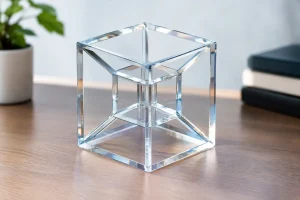
The tesseract is the four dimensional analogue of a cube. A point extends into a line. A line moves in a new perpendicular direction to form a square. A square extends in another perpendicular direction to form a cube. Extend the cube in a direction perpendicular to all three familiar axes, and the result is a hypercube, commonly called a tesseract.
A cube has six square faces, twelve edges, and eight corners. A tesseract has eight cubic cells, thirty two edges, and sixteen corners. Those numbers are not mystical codes. They are the clean consequences of geometry continuing beyond the space available to human bodies.
No physical sculpture can contain a literal four dimensional tesseract in the same way a wooden model contains a literal cube. What I can make is a projection, an analogy, an encounter with its rules. The familiar wireframe tesseract, a small cube nested inside a larger cube with corresponding corners connected, is one projection. It is not the tesseract itself. It is a three dimensional shadow of four dimensional structure.
That word, shadow, changes the conversation around UFOs and hyperdimensions. If a four dimensional object intersected three dimensional space, a three dimensional observer might not see the whole object. They would see a changing cross section. A three dimensional sphere passing through a flat two dimensional world would appear there as a point, then a growing circle, then a shrinking circle, then nothing. The flat observers could reasonably report that an object appeared from nowhere, transformed, and vanished.
This thought experiment does not explain UFO reports. It does show why apparent impossibility is not always a reliable measure of what is possible. An incomplete view of a larger structure can look like a violation of the rules.
Physics Is More Demanding Than a Beautiful Idea
The language of extra dimensions has real standing in theoretical physics, but it should be handled with care. Some frameworks in high energy physics use additional dimensions as part of their mathematical machinery. These dimensions are generally not imagined as wide open adjacent rooms through which objects casually travel. Depending on the theory, they may be compact, extremely small, or expressed through relationships that have no direct visual counterpart.
There is also no accepted scientific evidence that unexplained aerial phenomena are visitors from higher dimensions. That is the honest boundary. A compelling hypothesis is not evidence, and a story that feels expansive can become less interesting if it refuses the discipline of uncertainty.
Yet speculation has a role when it remains labeled as speculation. It can train the imagination to distinguish between what is observed, what is inferred, and what is projected onto an event. This is where art and physics make unusually good collaborators. Physics asks what can be tested. Art asks what it feels like to confront an idea before the mind has mastered it.
Building Perceptual Uncertainty Into Space
My Tesseract installation uses mirrored surfaces, recursive reflection, and precise geometric framing to produce a sense of depth that is both present and impossible to locate. A viewer sees corridors of repetition receding beyond the dimensions of the physical object. The eye reports vastness. The body knows there is an edge. Those two truths coexist, and the gap between them becomes the work.
This is not an attempt to trick people into believing they have entered another universe. It is an interactive study of perception. Reflection creates images that seem to occupy space behind a surface. Repeated reflection creates an apparent sequence of spaces. Geometry gives that sequence a skeletal logic, so the illusion does not read as random infinity. It reads as a place with rules that are almost familiar.
At Burning Man and other immersive gatherings, that ambiguity becomes collective. A person may approach the sculpture as a glowing structure across open ground, then stand before it and lose ordinary depth cues. Friends disappear into reflected corridors. Movement becomes multiplied. The installation does not merely represent a hypercube. It gives the nervous system a temporary problem that a diagram alone cannot provide.
The interactive augmented reality activation extends this inquiry virtually. With an AR headset, the viewer can step inside the hyperdimensional structure and encounter scale, motion, and recursion from a position unavailable outside it. The virtual experience does not replace the physical sculpture. It changes the question. Instead of asking what a tesseract looks like from outside, the viewer asks how it might feel to inhabit a projection of higher dimensional order.
Dreams, Pattern Recognition, and the Unknown
Lucid dreams are another territory where ordinary spatial rules become negotiable. A hallway may fold back into itself. A room can become larger after a door closes. A person can know they are dreaming and still be astonished by the authority of the dream world. This does not mean dreams are evidence of hidden dimensions. It means consciousness can construct convincing spaces without the usual constraints of waking sensory input.
That capacity is relevant to UFO encounters because human beings are not passive recording devices. Perception is active prediction. The brain constantly combines sensory information with expectation, memory, emotion, and learned pattern. Under ambiguity, it offers the best available model, sometimes accurately and sometimes spectacularly wrong.
The mature response is neither blind dismissal nor instant belief. It is sustained attention. What was seen? Under what conditions? What measurements exist? What alternatives remain? And what does the event reveal about the observer’s own assumptions about space, technology, life, and the limits of the visible?
A UFO may eventually become a balloon, a satellite, an aircraft, atmospheric plasma, or an artifact of imaging. A small remainder may stay unresolved because the data is too poor to decide. Hyperdimensions may remain a mathematical possibility, a theoretical tool, or an unanswered physical question. None of that diminishes the wonder. It sharpens it.
The most fertile unknown is not the one that demands belief. It is the one that makes the familiar world strange enough to study again, closely, patiently, and with the imagination fully awake.