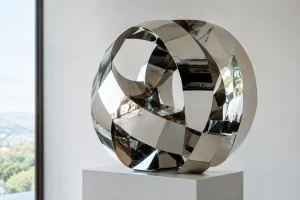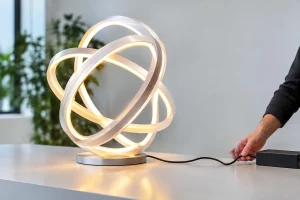
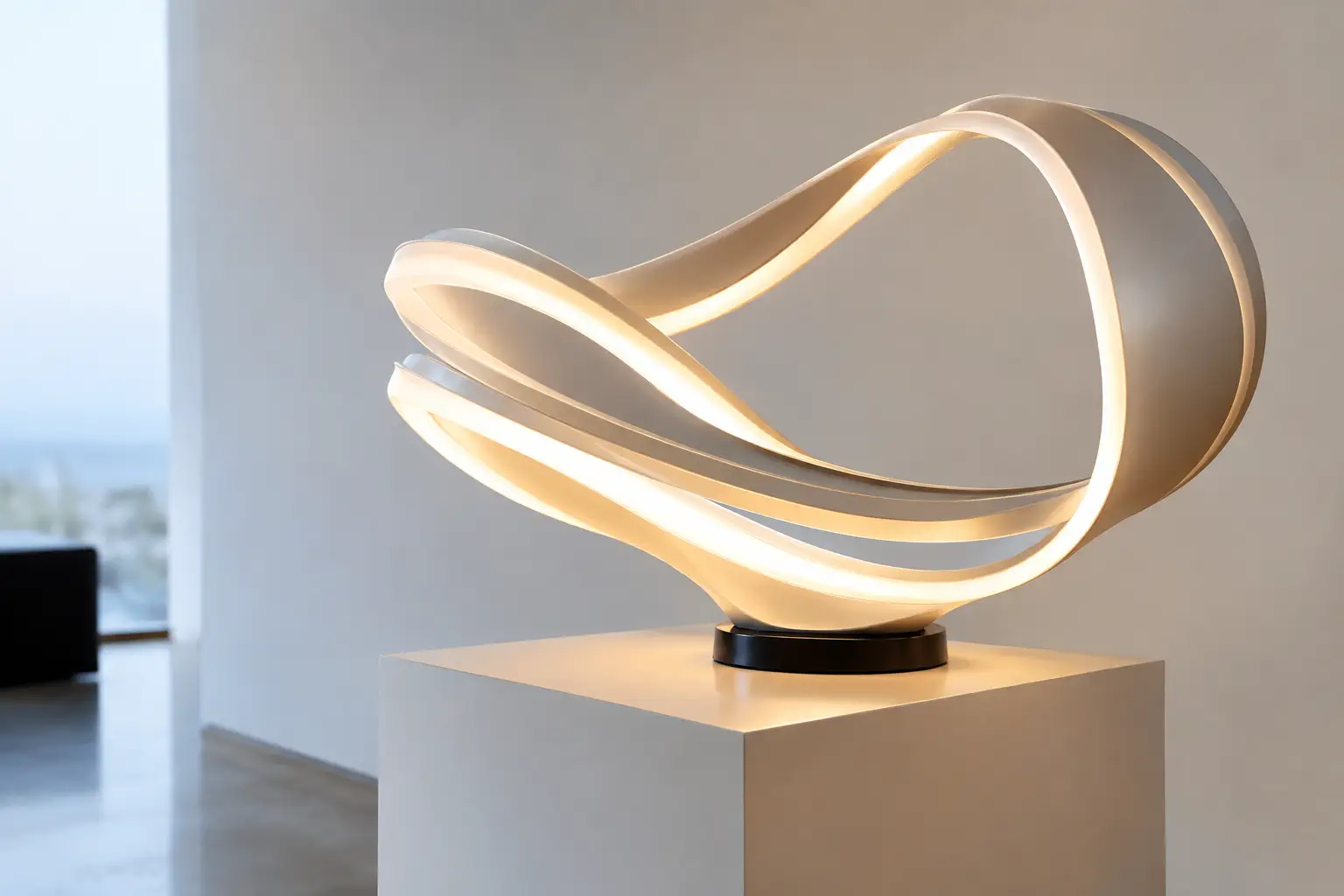
A mirror can return an image. Place mirrors in precise relationship with light, however, and it can return a question: where does physical space end? Collectible contemporary light art becomes most compelling to me when it refuses to behave like an object on a wall or pedestal. It becomes a perceptual instrument, a constructed situation in which the eye keeps traveling after the body knows it has reached a boundary.
My work begins with that tension. A viewer sees a finite structure, then encounters apparent corridors of light extending far beyond its physical depth. The experience is immediate and emotional, but it is not an illusion without a mechanism. It is physics, material engineering, geometry, and the strange ability of human vision to form a believable world from incomplete information.
Collectible Contemporary Light Art as a Spatial Experiment
The category can sound broad, because light art includes everything from projection to neon to kinetic environments. What makes a sculptural light work collectible is not simply its scale or rarity. It is the coherence of its idea, its material presence, and its ability to sustain attention long after the first moment of astonishment.
For me, light is not an applied effect. It is a structural material. Mirrors set the rules of a visual space, LEDs establish rhythm and color, and a frame defines the geometry from which the mind extrapolates a much larger reality. Every decision affects the result. A change in mirror transmission, LED density, viewing angle, or interior spacing can transform a deep void into a flat reflection.
That sensitivity gives the medium its particular charge. A painting can suggest distance through perspective. An infinity mirror creates an apparent distance that shifts with the observer. Move slightly left, and one sequence of reflections aligns. Move right, and another recedes. The sculpture is stable, yet the image produced by it is personal, contingent, and alive.
This is why interactive light sculpture matters. Interactivity need not mean a button, a screen, or a spectacle that asks for constant input. The act of looking is already interactive. The viewer completes the work through position, motion, focus, and expectation. When an installation includes augmented reality, that interactive relationship extends further, allowing a person to virtually enter a geometry that cannot be physically occupied at full scale.
The Tesseract and the Problem of Seeing Four Dimensions
A tesseract is the four dimensional analog of a cube. A point extends into a line. A line extends into a square. A square extends into a cube. Extend a cube in a direction orthogonal to every familiar direction, and mathematics gives us a tesseract, also called a hypercube.
The difficulty is not that the fourth dimension is mystical. The difficulty is perceptual. Human bodies occupy three spatial dimensions, so a true four dimensional object cannot be presented directly to the eye in the same way a cube can. Instead, it must be projected into three dimensions, just as a cube can be projected onto a sheet of paper as a familiar wireframe shape.
That projection is where sculpture enters. A hypercube can be modeled as two cubes connected at corresponding vertices. This does not mean the tesseract is literally two cubes, any more than a cube is literally two squares. It is a useful projection, one that reveals relationships while also distorting them. The inward cube may appear smaller, although in four dimensional terms it is not a smaller object at all.
I use this condition as a design principle. The Tesseract is a five foot hypercube infinity mirror sculpture built to make a mathematical projection feel less like a diagram and more like a place. Light repeats between partially reflective and fully reflective surfaces. The resulting recursion gives visual force to the idea of dimensional extension. The viewer does not merely observe a model of higher geometry. The viewer feels pulled toward a space that seems to continue beyond the available volume.
There is a tradeoff in every such translation. Too much complexity can obscure the underlying geometry. Too little can make the structure feel illustrative rather than transporting. The task is to preserve the mathematical clarity while allowing perception enough ambiguity to wander.
Reflection Is Repetition With Loss
Infinity mirrors are often described as creating endless space. Physically, no reflection is endless. At each bounce, light loses intensity. The partially reflective front surface returns some light to the observer and transmits some back into the chamber. The rear mirror reflects most of what reaches it. Repetition continues, but each image is dimmer than the last.
That loss is not a flaw. It is the reason the depth has atmosphere. The first layers are bright and legible, while distant layers dissolve into darkness. The eye reads this diminishing intensity as recession. A finite enclosure becomes an apparent tunnel because the visual system has evolved to interpret contrast, occlusion, and brightness as clues about location.
Programmable LEDs add a temporal dimension to this process. Color sequences can move across the frame, pulse through a geometric path, or settle into a sustained field. Slow transitions tend to make depth feel fluid and dreamlike. Faster patterns reveal the rhythm of the structure itself. Neither is inherently better. The right behavior depends on whether the work needs to feel meditative, energetic, architectural, or uncanny.
From Sacred Geometry to Buildable Structure
Sacred geometry is often invoked as a vague promise of hidden meaning. I am more interested in its concrete side. Repeating symmetries, nested forms, radial constructions, and proportional relationships have compelled people across cultures because they give form to order. They are not substitutes for mathematics. They are visual encounters with mathematical relationships.
A hypercube belongs to this lineage of spatial geometry, but it also presents an engineering challenge. The frame must remain accurate across large spans. Mirror planes must align closely enough for reflections to read as intentional continuities. Wiring, power distribution, heat management, and LED control all need to serve the visual idea rather than interrupt it.
Building such work means moving continually between abstraction and fabrication. A mathematical model may establish coordinates, edges, and angles. The studio then has to determine how those relationships become material, how components are joined, how surfaces are protected, and how an installation can be assembled safely in a temporary environment. The final piece carries the precision of the model, but also the evidence of hands, tools, testing, and revision.
That process matters at a festival. In a gallery like setting, viewers may approach slowly and alone. At Burning Man and other immersive events, the work enters a moving field of dust, music, night air, conversation, and thousands of bodies. The geometry has to hold its own within that intensity. It must offer a threshold, a moment where someone stops walking and becomes aware of their own perception.
The Festival Encounter Changes the Work
Large scale experiential installations are not passive backdrops. They alter the pace of a gathering. Someone who notices a luminous hypercube across open ground may approach because it appears impossible. Someone else may return later because the changing light made the structure feel different at midnight. Groups gather around the perimeter, each person seeing a distinct alignment of reflections.
The social dimension is as real as the optical one. A stranger points out a detail. A physicist recognizes a projection. A child reaches toward an apparent corridor that has no physical opening. A person who has been awake until dawn describes the work as a lucid dream made structural. None of these responses cancel the others. The sculpture makes room for rigor and wonder at the same time.
Augmented reality expands the encounter without pretending that virtual experience replaces physical presence. Through an AR headset, viewers can virtually step inside a hyperdimensional environment and see relationships that a solid frame cannot contain. This is interactive in a different register. Instead of moving around an object, the body appears to move through a projected spatial logic.
That shift raises a useful question. If a space responds convincingly to sight and movement, what exactly makes it feel real? Physical materials matter. So do bodily orientation, scale, sound, expectation, and social context. Yet perception is always an active construction. The brain does not receive reality as a finished image. It assembles a working world from light, motion, memory, and inference.
Collectible contemporary light art can hold that question in material form. It can be a finite object with an infinite looking interior, a precise geometric structure that generates uncertainty, an interactive invitation to look again. The most enduring works do not insist that another dimension has been proven. They offer something more generous: a carefully built chance to feel how incomplete ordinary seeing may be.