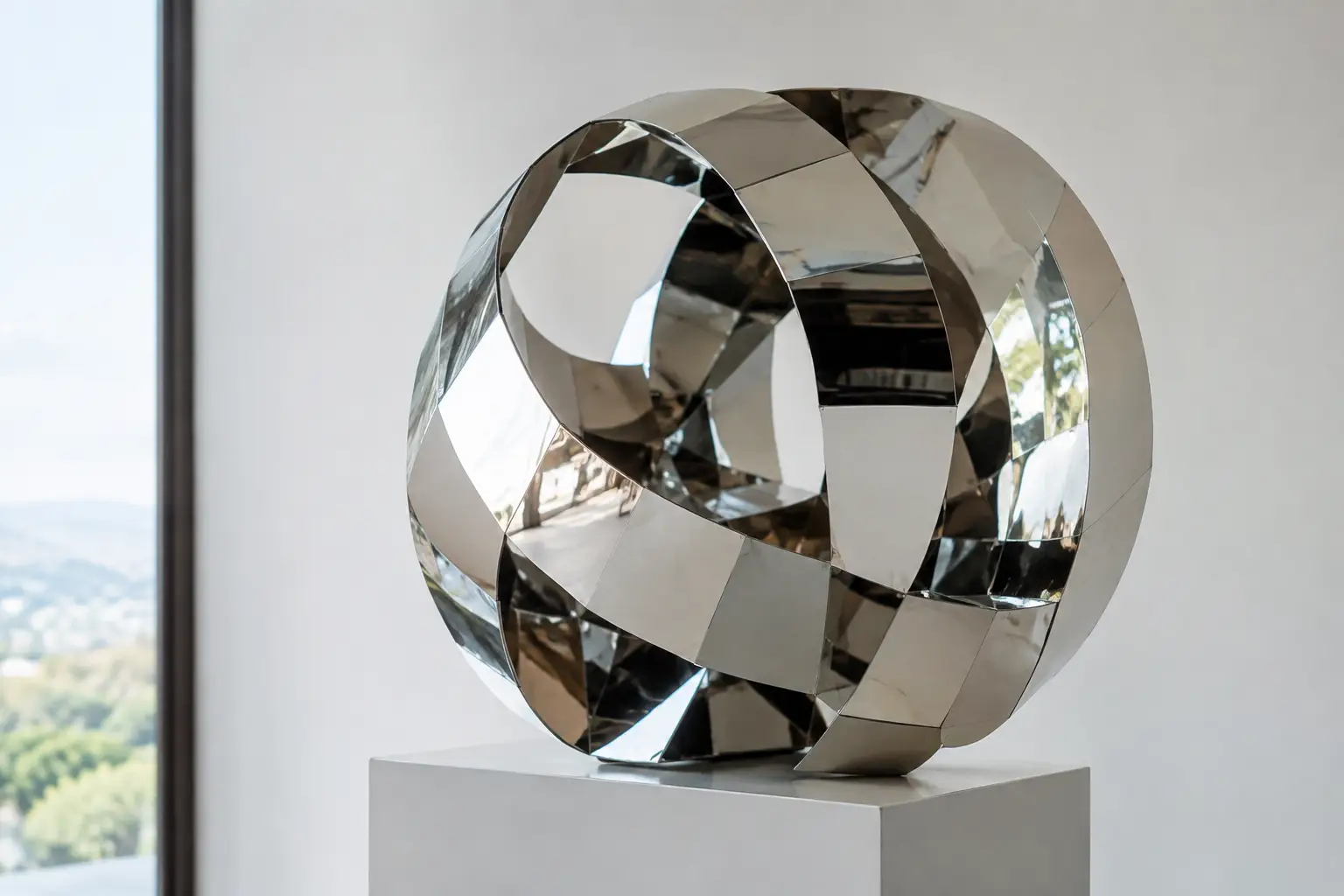
At night on the playa, a handcrafted mirror sculpture can appear less like an object than a breach in ordinary space. A frame of light hangs before the eye, then repeats beyond itself, cube after cube, as if the visible room has opened into a place with no final wall. The experience is optical, mathematical, and bodily at once. Your mind knows the structure is finite. Your perception refuses to agree.
I build mirror sculptures for that disagreement. They are experiments in what happens when a physical structure gives the senses evidence of a space they cannot easily describe. The subject is not a decorative illusion. It is the old and difficult question at the center of higher dimensional geometry, what would a fourth dimensional form feel like to a creature that moves through three dimensions?
Why a handcrafted mirror sculpture feels impossible
An infinity mirror is built from a controlled argument between transmission and reflection. One surface is a conventional reflective mirror. The other is partially reflective, allowing some light to pass through while returning some light toward the viewer. Programmable LEDs sit between them, often around the internal boundary of a geometric form.
Light from each LED travels to the rear mirror, returns to the front surface, and repeats that path many times. At every pass, a portion of the light escapes toward the eye and a portion remains inside the chamber. Because each reflection loses intensity, the repeated forms fade into apparent depth rather than continuing with equal brightness forever.
The depth is not literally infinite. It is an optical sequence shaped by reflectivity, spacing, ambient conditions, LED brightness, and the angle of the viewer. Yet the nervous system does not receive this as a tidy technical fact. It receives a receding corridor of illumination with no obvious floor or endpoint. That is where the sculpture begins to exceed its material boundaries.
Handcraft matters because this effect is unforgiving. A tiny gap in a seam, a slightly misaligned plane, a light source with uneven diffusion, or an uncontrolled reflection can interrupt the spell. I treat the interior geometry, the mirror planes, the frame tolerances, the electronics, and the light programming as one system. The craft is not separate from the concept. Precision is what allows the concept to become perceptible.
The tesseract hiding in the reflection
The central form in this practice is the tesseract, also called a hypercube. A square is the two dimensional analogue of a cube. A cube is the three dimensional analogue of a tesseract. If a cube can be understood as a square extended through a new spatial direction, a tesseract is a cube extended through a direction that cannot be pointed to within ordinary three dimensional space.
That statement can sound mystical until the mathematics makes it concrete. A tesseract has 16 vertices, 32 edges, 24 square faces, and 8 cubical cells. A cube has six square faces. A tesseract has eight cubes as its boundary components, just as a cube has six squares as its boundary components.
No handcrafted mirror sculpture can place a complete four dimensional object in front of a three dimensional viewer. It can, however, build a projection. A shadow of a cube can be drawn on a flat surface without becoming a square. In the same way, a tesseract can be represented as a three dimensional arrangement of edges and cubes without becoming an ordinary cube.
The familiar projection often looks like a smaller cube nested inside a larger cube, connected at corresponding corners. That image is useful, but static diagrams leave out the most provocative part. In four dimensions, the inner and outer cubes are not necessarily one inside the other. They are related through a direction unavailable to the body. Mirror recursion makes that relationship felt rather than merely observed. The repeated frames suggest a movement through an extra axis, even though the structure remains physically still.
Reflection turns geometry into an event
Spatial geometry becomes more powerful when the viewer must move to understand it. Shift left, and the recursive corridor changes. Lower your gaze, and edges that seemed parallel acquire a new hierarchy. Step closer, and your own body may appear multiplied inside the form. The sculpture does not simply present an image. It asks perception to continually revise its model of where surfaces are.
This is why mirror work belongs naturally in immersive environments. At a festival, people do not encounter a sculpture with the detached attention of a textbook diagram. They arrive after walking through darkness, dust, music, conversation, fatigue, curiosity, and altered scales of attention. A glowing hypercube can become a point of orientation, then a puzzle, then a shared threshold.
At Burning Man and related art gatherings, the work changes with the crowd. One person sees a technical construction and wants to understand the optics. Another sees a lucid dream rendered in aluminum, glass, and light. Another watches a child reach toward a depth that does not exist. None of these responses are wrong. The physics supplies the mechanism, while the human nervous system supplies the astonishment.
Sacred geometry often enters this territory because symmetrical forms have long been used to organize ideas about order, balance, and cosmic scale. I approach that history with respect, but I do not need to claim that geometry possesses supernatural authority. The wonder is already present in the real thing. Symmetry constrains possibility. Projection reveals hidden relationships. Reflection duplicates space according to clear physical laws. Those laws are strange enough.
Building an interactive threshold
A large scale Tesseract installation, such as a 5 by 5 by 5 foot infinity mirror hypercube, requires more than an elegant sketch. Structure must carry mirror weight safely. Wiring must be serviceable. LED systems need clean power, thermal awareness, and control logic that can survive the practical demands of a public environment. Every surface must support the intended optical path without distracting artifacts.
Programmable light adds a fourth parameter to the geometry, time. A static white line can clarify the tesseract structure. A slow change in color can make the recursion breathe. Pulses traveling along connected edges can imply the route of a signal through a larger dimensional network. Faster sequences can fracture the sense of volume, making the sculpture feel briefly unstable, as though the projected form is rotating through a direction the eye cannot follow.
Interactive elements extend that question. With an augmented reality headset, viewers can virtually step inside the sculpture, moving through a volume that the physical mirrors only suggest. This interactive encounter does not replace the object. It reveals another layer of the same inquiry. The physical installation anchors the body in shared space, while the virtual interior lets the body test an impossible orientation.
That contrast matters. A headset can place cubes around a viewer, but the mirrored structure supplies resistance, scale, glare, shadow, and the awareness of other people witnessing the same anomaly. The most compelling interactive work lets these conditions speak to each other. It does not ask the audience to leave reality behind. It makes reality behave strangely enough that its dimensions become newly visible.
What altered perception can teach
Lucid dreams are compelling for a related reason. Within a dream, a hallway can be both familiar and endless. A room can open into itself. Distance can change without any corresponding physical journey. The dreaming mind accepts these contradictions until awareness interrupts and asks how the impossible architecture is holding together.
Infinity mirrors make a similar interruption available while awake. They create a perceptual event in which the eye receives a credible depth cue and the intellect identifies the trick. Rather than canceling each other, those two modes of knowing can coexist. The viewer can understand the optical mechanism and still feel the pull of an abyss made from reflected light.
That coexistence is valuable for anyone drawn to physics, mathematics, art, or consciousness. It trains attention on the boundary between model and experience. A mathematical object can be exact, while every embodied encounter with its projection remains partial. A mirror can be a precise instrument, while the space it seems to reveal can feel intimate, cosmic, or dreamlike.
The next time a recursive field of light pulls your gaze beyond the surface, stay with the contradiction for a few extra seconds. Ask which cues make depth persuasive, which edges belong to the object, and which belong to expectation. That small act of attention is its own passage into a larger geometry.