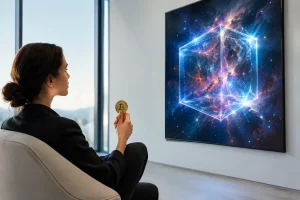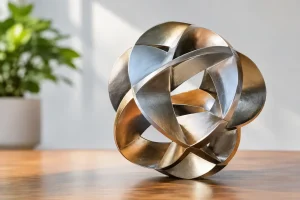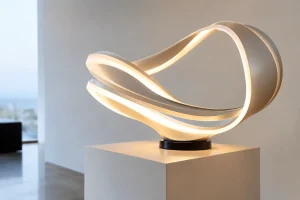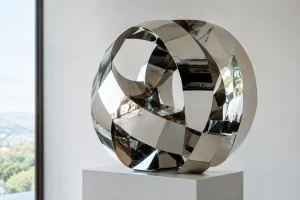
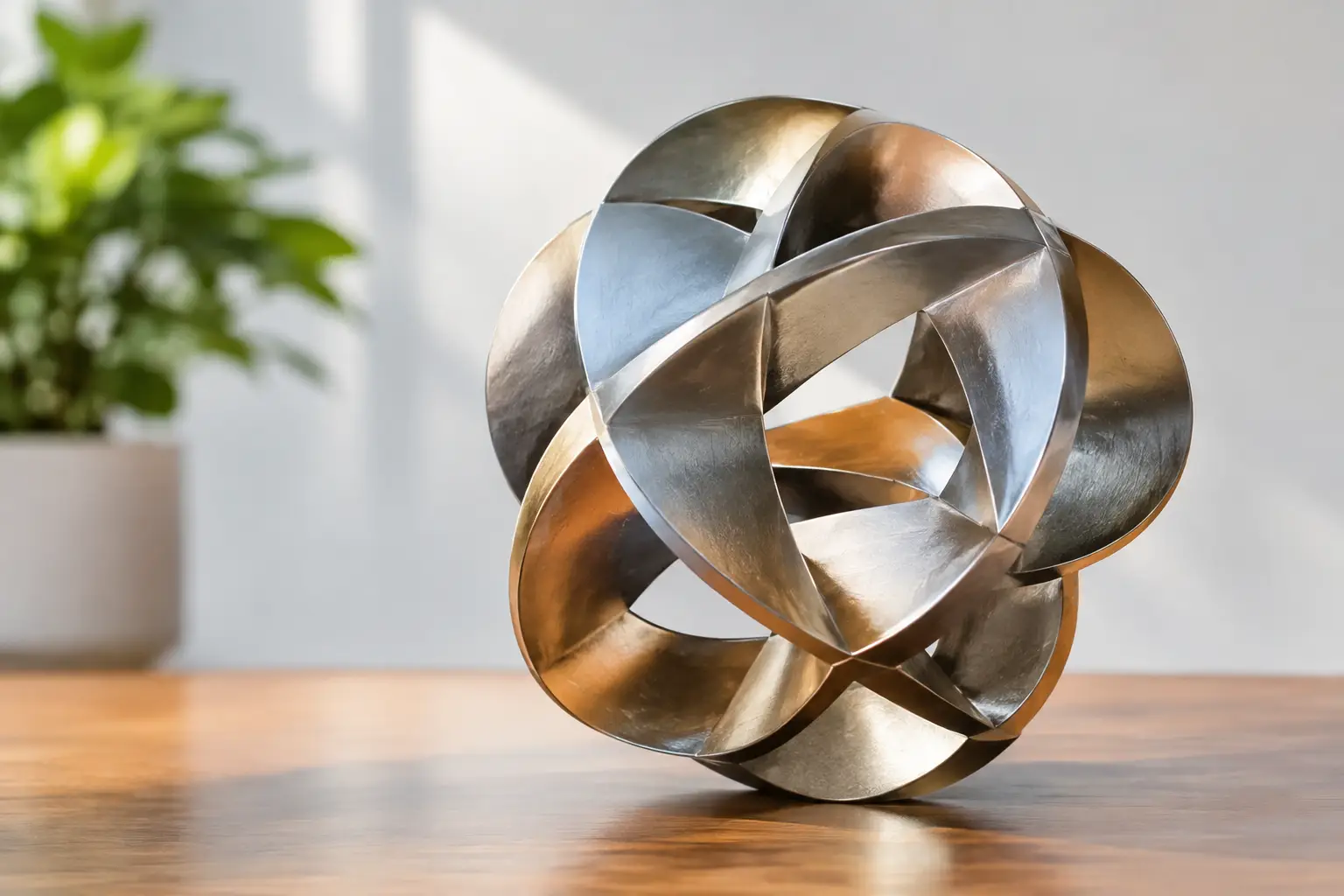
A cube is familiar because the mind can hold it all at once. It has six faces, twelve edges, eight vertices, and a physical certainty that fits the hands. A mathematical art sculpture becomes stranger when it asks the mind to confront the next step, a form built from cubes in the way a cube is built from squares. That form is the tesseract, or four dimensional hypercube. It cannot be placed whole in ordinary space, yet its projections can be built, illuminated, reflected, and experienced.
I make sculptures at this threshold. Light and mirror turn a finite object into an interactive encounter with apparent infinity. The work is not an illustration of mathematics hung at a safe distance. It is an attempt to give geometry scale, atmosphere, and psychological force, so a visitor can feel the question before they have fully answered it: what might a fourth spatial dimension be like from inside three?
Mathematical Art Sculpture as Dimensional Translation
Mathematics is often treated as a language of clean symbols, separate from bodily experience. Sculpture refuses that separation. It has weight, material limits, wiring, angles, shadows, and the stubborn fact that a viewer must stand somewhere. A mathematical art sculpture translates an abstract structure into those physical constraints without pretending the translation is complete.
A two dimensional square can be understood as a boundary traced in a plane. Move every point of that square through a new perpendicular direction and a cube emerges. Repeat the operation from the cube into another direction, one perpendicular to every direction available in three dimensional space, and the tesseract emerges. The difficulty is not that the tesseract is incoherent. The difficulty is that human perception evolved to navigate three spatial dimensions.
The familiar wireframe image of a tesseract, a cube nested inside another cube with corresponding vertices connected, is a projection. It is analogous to the shadow of a cube on a wall. A cube can cast a two dimensional drawing that contains skewed squares and lines. Likewise, a tesseract can cast a three dimensional image that contains cubes and connecting edges. The projection is not the full object, but it is evidence of a consistent underlying structure.
This distinction matters. A projection can distort distances, angles, and apparent scale, while preserving relationships that reveal the higher dimensional source. In my work, that instability is not a flaw to correct. It is the experience. The form seems legible, then begins to resist the habits the eye brings to ordinary objects.
Why Mirrors Change the Geometry
An infinity mirror is not literally infinite. It is a carefully controlled optical system, usually built from a partially reflective front surface, a reflective rear surface, a contained light source, and a chamber with enough depth to support repeated reflections. Each bounce returns less light than the last, which is why the apparent corridor eventually fades. Physics sets the limit, but perception notices the invitation.
When programmable LED light sits between mirrored planes, the sculpture gains a visual recursion. A single illuminated edge becomes many apparent edges. A finite frame can seem to continue inward, outward, or through itself, depending on the viewing angle and the sequence of light. Reflection does more than multiply an image. It multiplies spatial possibilities.
In a tesseract sculpture, that recursion carries unusual conceptual weight. The tesseract is already a projection of a form beyond direct three dimensional access. The mirror system adds another layer of projection, producing a field where the geometry appears to contain more volume than the physical structure possesses. The viewer knows there is a boundary, but the eye keeps receiving evidence of depth.
That tension can create a powerful altered perceptual state. Not confusion for its own sake, but a temporary suspension of certainty. Depth becomes difficult to measure. Edges become portals. The distinction between an object and the space inside it becomes unstable. The sculpture remains rigorously engineered, yet the experience can feel close to lucid dreaming, where a room is recognizable but suddenly impossible.
The Tesseract Is Not Just Sacred Geometry
Geometric forms have long carried symbolic meaning. Symmetry can suggest order, recurrence, balance, and a reality organized beneath visible change. In many traditions, geometric diagrams become tools for contemplation. I respect that history, but I do not use the tesseract as a vague emblem of hidden wisdom.
The tesseract has real mathematical properties. It contains sixteen vertices, thirty two edges, twenty four square faces, and eight cubical cells. Its symmetry is exact and exceptionally rich. Those facts do not reduce its mystery. They give the mystery a framework.
Sacred and spatial geometry become more compelling when the symbolism and the mathematics can coexist without being confused. A viewer may have a spiritual response to a hypercube projection. Another may see a group theoretical object, a study in symmetry, or an optical experiment in reflection. Both responses can be valid, provided the physical and mathematical claims remain honest.
The sculpture creates room for both. It asks the rational mind to follow the structure, then gives the body an experience that exceeds diagrammatic understanding. Awe does not require abandoning rigor. Often, rigor is what makes awe durable.
Building an Interactive Encounter With Light
The visual result can appear effortless, but every apparent corridor begins with material decisions. The frame must hold precise geometry. Mirror surfaces must align closely enough that the repeated images do not collapse into visual noise. LEDs require power, heat management, controls, and programming that honors the form rather than simply filling it with color.
I treat light as a moving dimension of the sculpture. A static illumination reveals structure, while an animated sequence can suggest rotation, expansion, collapse, or the passage of a coordinate through space. Slow pulses can make the volume feel breathable. Sharper sequences can make edges snap into focus, then dissolve. Color shifts alter depth perception because the eye reads brightness, contrast, and saturation as spatial cues.
Interactivity changes the role of the visitor. As someone walks around the piece, parallax reveals different recursive paths. The body becomes part of the measurement system. At large scale, a person does not merely look at the geometry. They navigate its visual consequences.
Some works extend this encounter through augmented reality. With a headset, visitors can virtually step inside the hyperdimensional structure and encounter an interactive environment that physical materials alone cannot contain. This is not a replacement for sculpture. It is another projection, one that lets the visitor test the scale of the idea from within.
When the Work Enters a Festival Landscape
At Burning Man and other immersive art festivals, context alters everything. A tesseract standing in open darkness is not encountered with the quiet framing of a gallery. It may appear after a long walk across dust, amid sound, weather, strangers, and the heightened attention of nighttime exploration. The conditions make the work more vulnerable, more public, and more alive.
Large scale installations need engineering equal to the vision. They require stable structures, weather aware materials, cable management, power planning, transport considerations, and safe circulation for many bodies. An interactive sculpture must endure repeated encounters while preserving the precision that makes its illusion work.
Yet the practical labor serves a rare social moment. Someone trained in physics may stand beside someone who has never heard the word tesseract. Both can see the same luminous recursion. One may explain dimensional projection, while the other says it feels like a dream remembering itself. The installation becomes a meeting point between formal knowledge and direct perception.
That is why scale matters. A diagram communicates information. An environment can reorganize attention. When thousands of people encounter a mathematical form as a shared physical event, abstraction becomes culture.
A Question the Eye Cannot Finish
The fourth dimension may remain inaccessible to ordinary sight, but inaccessible does not mean irrelevant. Human beings regularly understand realities that cannot be directly seen, from electromagnetic fields to curved spacetime. Mathematics gives those realities structure. Art gives them presence.
The most useful way to meet a hyperdimensional sculpture is to let it remain partly unresolved. Study the edges. Move until the reflections change. Notice where the eye insists on depth and where it loses its footing. The goal is not to claim that a mirror chamber proves another dimension is nearby. The goal is more generous, to train perception to recognize that reality may be larger than its first appearance.