
A mirror appears to return a room exactly as it is. Add depth, repetition, controlled light, and a precise geometric frame, and certainty begins to feel less stable. Quantum physics lives in that productive tension: reality is measurable, yet stranger than instinct suggests. For collectors drawn to art that creates a genuine pause in conversation, its ideas offer more than scientific decoration. They offer a new way to look.
The point is not to turn a sculpture into a physics textbook, or to claim that LEDs make a room quantum. The point is more compelling than that. Quantum theory changed the language we use for matter, light, observation, and possibility. Contemporary light art can draw from that shift in perception, creating an encounter that feels less like viewing an object and more like standing at the edge of an unfolding system.
What Quantum Physics Actually Changed
At its core, quantum physics describes behavior at extremely small scales: atoms, electrons, photons, and other elementary constituents of matter and energy. At that scale, the tidy rules that work beautifully for a billiard ball or a falling apple no longer tell the whole story.
A quantum object can be described by a range of possible outcomes rather than one fixed, fully knowable condition. Measurement matters. Light can behave as both a wave and a particle, depending on the experiment. And two particles can become entangled, with correlated properties that remain connected across distance in ways Einstein famously found unsettling.
These ideas are often flattened into mystical slogans. They deserve better. Quantum physics does not prove that thought alone invents reality, nor does it give sacred geometry a laboratory endorsement. Its real power is subtler and more radical: it reveals that nature does not always conform to the visual logic evolved for navigating rooms, streets, and solid objects.
That is why it remains so artistically fertile. It asks us to accept that what seems obvious may be only one useful approximation of a deeper order.
Quantum Physics and the Limits of Intuition
The most arresting art does not merely confirm what the eye already knows. It makes perception aware of itself. Infinity mirrors, layered reflections, and illuminated geometric structures do exactly this. They establish a visual condition in which the eye reads depth that is physically absent, edges that seem to repeat beyond reach, and light that appears to occupy a volume larger than the sculpture itself.
This is not quantum mechanics in a literal sense. It is a perceptual rhyme.
A handcrafted Tesseract-inspired infinity mirror may present a finite physical form while suggesting a corridor of impossible extension. The viewer sees structure, but cannot immediately resolve its endpoint. The mind searches for a stable interior and finds recurrence instead. That friction between what is built and what is perceived is where the work becomes experiential rather than merely decorative.
For a collector, that distinction matters. A painting may reward repeated looking through imagery or technique. A dimensional light sculpture changes with the ambient conditions of the room, the lighting program selected, the viewer’s angle, and the length of attention given to it. It does not sit passively on the wall. It activates the space around it.
Observation Is Part of the Experience
In quantum experiments, observation has a specific technical meaning tied to physical measurement and interaction. In art, observation is personal, spatial, and embodied. A visitor approaching an infinity mirror is not altering electrons by looking at it. But they are changing the work’s experience through position, expectation, and movement.
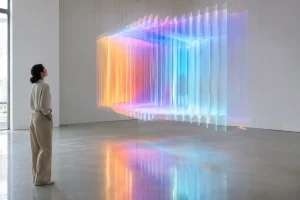
From across the room, a sculpture may read as a pristine geometric icon. At closer range, the construction becomes more complex: the density of reflections intensifies, color transitions become more apparent, and the boundary between surface and apparent depth begins to dissolve. A single piece can feel architectural at ten feet and intimate at ten inches.
That shifting relationship is especially powerful in a residence designed for hosting. The work becomes a conversation-starting presence without asking for explanation. Guests move toward it, test its perspective, and recognize that the room contains something more deliberate than an accessory.
Light Is the Material That Refuses to Stay Still
Light occupies a rare position in both physics and art. It is an object of scientific inquiry, a medium of measurement, and one of the most immediate emotional forces available to an artist. Change the color, rhythm, intensity, or sequence of light, and a sculpture can seem to change its mass, mood, and perceived dimensions.
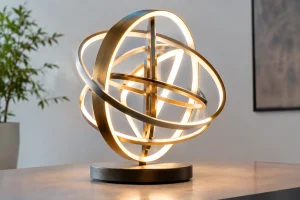
Programmable LED systems make this transformation unusually precise. A cool white sequence can emphasize the clean, architectural authority of a geometric form. Saturated violet and electric blue can produce a more cosmic, nocturnal atmosphere. Slow gradients reward extended viewing, while more dynamic programs can give a space the energy of an installation rather than a static interior.
There is a trade-off. A highly animated lighting sequence can become the dominant event in a quiet room, while restrained programming may better support a refined dining space, study, or gallery wall. The right choice depends on the architecture, surrounding materials, and the owner’s intended relationship with the work. Sophistication is not always maximum brightness. Often, it is control.
This is where custom art surpasses generic illuminated decor. Scale, power configuration, placement, and lighting behavior can be considered as one composition. The sculpture is built not only for a wall, but for the atmosphere it will create there.
Dimensions Are More Than a Visual Effect
The tesseract, often called a hypercube, is a mathematical model of a four-dimensional cube. Because human beings live and perceive in three spatial dimensions, we cannot hold a four-dimensional object in ordinary visual space. What we can see are projections: translations of higher-dimensional relationships into forms the eye can interpret.
That makes the tesseract an enduringly potent artistic structure. It is legible enough to feel intentional, yet strange enough to resist full visual possession. Its nested geometry suggests a form that exceeds the frame containing it.
Infinity mirrors amplify that proposition. Reflection introduces repetitions of the visible geometry, creating a field of apparent depth where the physical object ends. The result can evoke a portal, an interior architecture, or a luminous diagram of another order of space. No claim of literal dimensional travel is necessary. The visual experience is already extraordinary.
For design-conscious collectors, this conceptual depth creates lasting value. Trend-based objects tend to exhaust themselves once their novelty fades. A work grounded in geometry, material craft, and perceptual complexity has more room to reveal itself over time. It can sit comfortably alongside contemporary architecture, minimalist interiors, maximalist collections, or technology-forward spaces because it is not tied to a passing motif. It is built around a fundamental question: what else might be there?
The Difference Between Science-Inspired Art and Science Branding
There is a meaningful difference between borrowing the authority of science and allowing scientific thought to shape artistic inquiry. The first produces empty jargon. The second produces work with rigor.
Science-inspired art should be clear about its relationship to science. A hypercube sculpture is not a physics experiment. An infinity effect does not demonstrate quantum entanglement. Yet the sculpture can honestly engage with themes that quantum physics made culturally unavoidable: uncertainty, hidden structure, the instability of appearances, and the possibility that reality is richer than everyday perception admits.
That honesty makes the work stronger. It invites intellectual curiosity without requiring the viewer to become a specialist. A collector can be captivated by the formal precision of the piece, then discover the mathematical and philosophical references beneath it. The experience has layers, much like the reflections themselves.
Nicky Alice approaches this territory through handcrafted dimensional construction, advanced programmable lighting, and a singular focus on the tesseract as sculptural language. The result is not a replica of scientific imagery. It is an authored visual encounter with scale, repetition, perception, and the thrill of the unknowable.
Choosing a Piece That Holds a Room
A dimensional light sculpture should be chosen with the same seriousness as a major work of art or a defining piece of furniture. Consider where sightlines begin. An entry wall creates immediate impact; a living room placement supports longer viewing; a private office can turn contemplation into part of the daily environment.
Scale determines whether the work feels like a jewel, a focal point, or an architectural intervention. A smaller piece can create concentrated intensity in a curated niche. A larger custom commission can anchor an expansive wall and establish the emotional center of the room. Reflected depth also changes the calculation: a sculpture does not merely occupy its physical footprint. It projects visual space outward.
Then consider lighting as a collection-level decision. The most effective color programming does not compete with every other element in the room. It creates a relationship with stone, metal, wood, artwork, and evening light. In some interiors, a controlled monochrome program offers the greatest drama. In others, richly saturated transitions give the space its signature after dark.
The best choice is the one that remains compelling after the first astonishment. Look for real construction, intentional geometry, customization that serves the setting, and an artist’s point of view strong enough to carry the concept.
Quantum physics reminds us that reality can be more surprising than the senses initially report. A great light sculpture gives that idea a place to live: not as a slogan, but as an experience waiting in the room whenever someone chooses to look again.