
People often assume my work is made by AI. I understand why. The geometry is precise, the light is exact, and the finished effect looks like something a machine rendered rather than something a person built by hand. But the truth is stranger than a computer, and far more human. Some of my most important design solutions did not come from software. They came from a dream.
The Tesseract was the first of them.
I Knew What It Was. I Did Not Know How to Build It.
I have always been fascinated by higher dimensions, and by the question of what they would even look like inside our three dimensional universe. There is really no way to picture a fourth spatial dimension with a three dimensional brain, and that impossibility is exactly what pulled me in. Long before I built anything, I could see the finished piece in my mind. I knew what the Tesseract was supposed to be.
What I did not know was how to complete it.
I bought the materials for the first Tesseract and then hit a wall. I could not work out where the light source should sit, how to arrange the different nested cubes, or how to run the wires so the illusion held without the mechanics showing. I had the vision and the parts, and no path between them. That gap, the space between an idea and a finished object, is where most work either dies or becomes something worth making.
Over time I came to see that gap as the whole point. The reaction I want from my work is the one every artist secretly chases: how did he do that? And I have learned that this feeling only appears when the artist himself did not know how to do it either. If the maker had every step planned from the start, the finished piece carries no mystery. The wonder in the work comes directly from the not knowing. I just always find a way.
The Dream That Finished the Piece
I have practiced lucid dreaming since I was very young, and I have been writing my dreams down since I was twenty. When I am carrying a creative question, one I cannot solve at the workbench, my dreams often become lucid. It happens reliably enough now that I almost expect it. The unsolved problem follows me to sleep, and somewhere in the night my mind keeps working on it without me getting in the way.
That is what happened with the Tesseract. Stuck on the build, I had a dream that turned lucid, and in it I was shown how to complete the transition from an unfinished pile of materials to the finished object I had been picturing all along. The placement, the arrangement, the way the light needed to move through the structure. I woke up knowing how to build the thing I already knew I wanted.
This was the first of many designs I could not finish until a dream finished them for me. Dreams are how I connect my subconscious to my conscious mind, and when those two finally talk to each other, new things emerge that neither could produce alone. The Tesseract exists because that conversation happened.
A dream can give you an image, or in my case a method, but it cannot give you the engineering drawings, the mirror tolerances, or the wiring. The dream pointed the way. The craft still had to be earned in the studio. That is the part no one dreams for you.
What a Tesseract Actually Is
Here is where the dream ends and the mathematics begins, because the Tesseract is not a mystical object. It is a precise one.
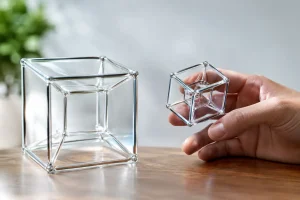
A square is the two dimensional version of a cube. Move every point of a square in a new perpendicular direction and you get a cube. Apply that same operation to a cube, moving it in a fourth direction perpendicular to the three we know, and you get a tesseract, also called a four dimensional hypercube.
No human can point toward that fourth direction. Every direction available to a hand, a body, or a camera belongs to three dimensional space. Yet the geometry stays perfectly coherent, because dimensions are not magical places. They are simply the independent directions needed to describe a space.
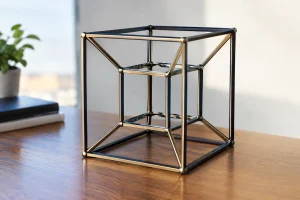
A tesseract has 16 vertices, 32 edges, 24 square faces, and eight cubic cells. Those eight cubes are the four dimensional equivalent of the six square faces that bound an ordinary cube. The familiar picture of a small cube suspended inside a larger one is a three dimensional projection of that structure, useful but incomplete, in exactly the way a drawing of a cube on paper is a useful but incomplete flattening of a real cube.
Projection is the bridge between dimensions. A three dimensional object casts a two dimensional shadow. A four dimensional object can be represented by a three dimensional projection. Every projection distorts something, and that distortion is part of the fascination. If you want to see the geometry move, I break it down in two short videos, building the Tesseract dimension by dimension and a closer look at how the hypercube unfolds.
Turning the Tesseract Into a Physical Illusion
My task was never to build a literal four dimensional object. That cannot happen inside ordinary three dimensional space. The task was to create conditions under which perception could feel the pressure of that missing direction. This is the part the dream helped me solve.
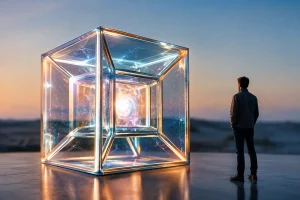
The Tesseract begins with a cubic framework and a mathematical arrangement of illuminated edges. Mirrors and partially reflective surfaces turn that finite structure into an apparent volume of recursive depth. When you look into an infinity mirror, light does not physically travel forever. A controlled fraction of it reflects back and forth between two reflective planes, and each return appears deeper in space, dimming gradually as the reflections repeat. A few physical layers become a seemingly endless interior. The eye reads recurrence as distance.
Programmable LEDs let the geometry behave over time instead of sitting still. Color, rhythm, and directional sequences can make a line seem to travel through the structure, or make an interior cube emerge from the depth. Light becomes an active coordinate. It tells the eye where to look, then changes the apparent structure before the mind can settle on a single reading.
This is why the work is interactive before any interface is added. A small movement of the viewer changes the angles, the reflections, and the perceived depth. One person sees a corridor. Another sees a void. Someone else sees an object turning inside out. The sculpture never changes its physical dimensions. The viewer’s position changes the projection their eye receives.
Why Infinity Mirrors Feel Larger Than Their Dimensions
An infinity mirror does not fool the eye with a single trick. It recruits several systems of perception at once. Binocular vision estimates depth from the small difference between what each eye sees. Motion adds more evidence, since nearby points shift faster across your view than distant ones. Repeated reflections supply a pattern that reads like receding architecture.
The mind is remarkably good at building a stable world from incomplete visual information, and usually that skill serves us. In the Tesseract, that skill becomes the raw material. Reflection makes a finite chamber feel bottomless, while the hypercube structure gives that depth an organized grammar.
There are limits, and this is where the dream hands the problem back to craft. The illusion depends on contrast, viewer position, and the brightness of the room. Harsh daylight competes with reflected light. Dust, scratches, and misaligned surfaces interrupt an effect built on precision. So the transcendent part rests entirely on the practical part: measured joinery, carefully chosen mirror materials, clean cable management, stable power, programmable control, and a structure that survives a demanding public setting. The wonder is made possible by the craft, not separate from it.
The Fourth Dimension as Orientation Breaking
The phrase fourth dimension often gets used as shorthand for the paranormal. I am interested in something stranger and more grounded. The fourth dimension is a legitimate mathematical framework, and the experience of failing to orient inside it is deeply human.
Picture a two dimensional being living on a flat plane. A three dimensional sphere passing through that plane would appear first as a point, then a growing circle, then a shrinking circle, then nothing. The being could record every stage and still never directly see the sphere’s full form. We face the same limitation one dimension up. A tesseract projected into three dimensions can appear to shift, overlap, or invert in ways that feel impossible, because the projection changes as the object rotates through a direction our eyes cannot follow. That unease is not a failure of intelligence. It is an honest response to a model that exceeds what the body can intuit.
The Tesseract turns that difficulty into a physical encounter. It does not claim to reveal another realm. It asks what happens when your depth perception is made to behave as though space has gained another layer.
From Lucid Dream to Festival Encounter
Burning Man and immersive festivals are powerful settings for this question, because they already interrupt ordinary orientation. At night, desert darkness strips away familiar visual anchors. Dust, sound, movement, temporary architecture, and thousands of wandering people create a field that feels displaced from daily life before you ever reach the art.
A large interactive light sculpture becomes a point of collective recalibration in that environment. People approach from different distances, circle it, photograph it, fall silent, or start explaining geometry to a stranger. A child responds to the color and repetition. A physicist recognizes the projection. A tired traveler simply feels that the sculpture has opened a hole in space. None of those readings cancel the others. The mirrors are real, the light paths are real, the hypercube is mathematically real, and the sense of infinite interiority lives in the relationship between those facts and a perceiving mind.
Virtually Stepping Inside the Geometry
The interactive Augmented Reality activation extends the piece beyond its exterior. With a headset, a viewer can virtually step inside the geometric system and feel its scale from within. This does not replace the physical sculpture. It opens another mode of access to the same spatial logic.
The physical mirrors make the eye work with reflection, surface, and shifting angles. The interactive virtual experience can place the body at the center of an expanded tesseract projection, where the edges become architecture and the surrounding volume responds to movement. Together they make one thing clear: geometry is abstract, but perception is always embodied.
The dream gave me the way through. The sculpture became my way of asking that first intuition a harder question. If human senses were never designed to perceive higher dimensions directly, what combination of light, reflection, structure, and interaction might let us stand at the edge of one and look in?
That is the question I have been building ever since. It started with a dream. It has never stopped.
Experience the Tesseract
See the Tesseract, the sculptures, and available works at nickyalice.com.
Follow the work in progress on Instagram, watch full installation and explainer videos on YouTube, and catch quick clips on TikTok.
Interested in a commission or in bringing the Tesseract to your event? Reach out through nickyalice.com.