Tesseract vs Hypercube vs 4D Cube: Are These the Same Thing?
Almost, but not quite.
Tesseract, hypercube, and 4D cube get used interchangeably all over the internet, and most of the time nobody gets hurt. But they are not the same word, and the difference is worth two minutes of your attention.
Here is the short version:
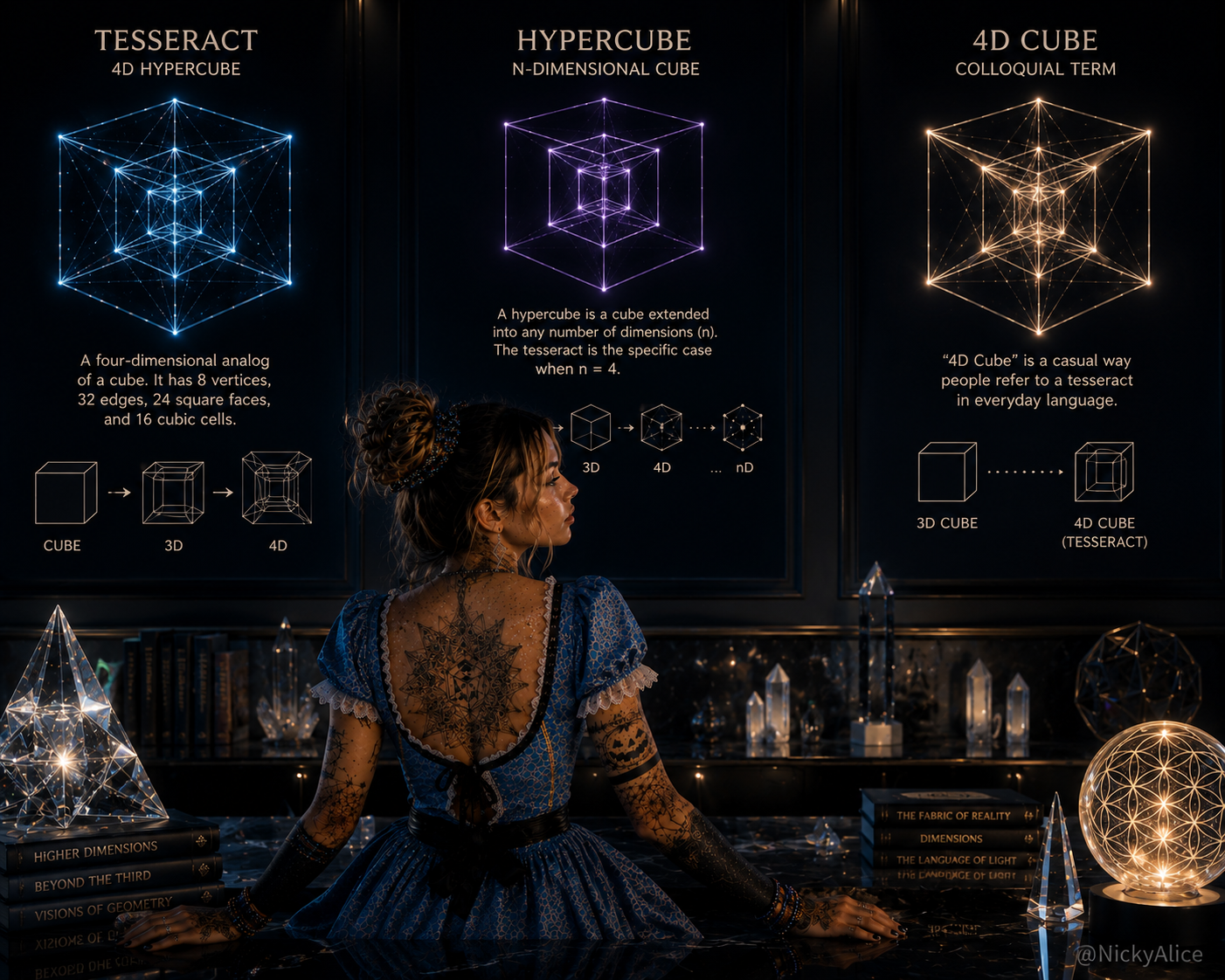
A tesseract is a specific type of hypercube.
What Is a Hypercube?
A hypercube is the generalization of the square and the cube into any number of dimensions. Mathematicians also call this family the n cubes, or measure polytopes.
The ladder looks like this:
- 0 dimensions: point
- 1 dimension: line segment
- 2 dimensions: square
- 3 dimensions: cube
- 4 dimensions: tesseract
- 5 dimensions: 5 cube, sometimes called a penteract
- n dimensions: n cube
The word hypercube can refer to this entire family. By that logic, a square is a 2D hypercube. An ordinary cube is a 3D hypercube. A tesseract is a 4D hypercube.
The ladder never stops. There is a 10 cube, a 100 cube, a million cube. Each one is defined just as precisely as the square on a sheet of graph paper, and each one has exactly 2^n vertices, n·2^(n-1) edges, and 2n cells of the next dimension down. A cube has 6 square faces, and a tesseract, sure enough, has 8 cubic cells.
What Is a 4D Cube Called?
A 4D cube is called a tesseract.
That is the informal phrasing people usually search for. The formal names are:
- tesseract
- 4 cube
- four dimensional hypercube
- 8 cell, because it is bounded by eight cubes
All four describe the same object. The word tesseract itself dates to 1888, coined by the mathematician Charles Howard Hinton from the Greek for “four rays,” a reference to the four perpendicular directions meeting at each corner.
Is Every Hypercube a Tesseract?
No. This is the actual distinction, and it runs in one direction only.
Every tesseract is a hypercube. Not every hypercube is a tesseract.
A five dimensional hypercube is not a tesseract. It is a 5 cube. A six dimensional hypercube is a 6 cube. The word tesseract belongs specifically to the four dimensional case, the way the word cube belongs specifically to the three dimensional one.
Think of it like squares and rectangles. The relationship is one of category and member, not synonym.
Watch the Fourth Dimension Get Built
Words can only carry this so far. Seeing the dimensions stack one on top of the next is where it usually clicks, so I made a video walking through exactly that:
How a Tesseract Is Built, Dimension by Dimension
Why Does a Tesseract Look Like a Cube Inside a Cube?
The famous image shows one cube nested inside a larger cube, corresponding corners joined by connecting edges. That picture is a projection, specifically a Schlegel diagram.
It works the same way a drawn cube works on paper. A flat drawing is not a physical cube, but nobody struggles to read it as one, because everyone has held a real cube and knows what the drawing is standing in for.
A tesseract projection asks the same favor, one dimension higher. The inner cube is not really smaller and it is not really inside anything. Those distortions are the price of flattening four dimensions into three, exactly as a drawn cube pays for its flattening with skewed right angles and false-looking diagonals.
Is a Tesseract Real?
As a mathematical object, completely real. Its coordinates, rotations, symmetry group, and volume can all be calculated exactly. In 4D it can even perform a double rotation, spinning in two independent planes simultaneously, which nothing in this world can do.
What cannot happen is building a full four dimensional tesseract inside ordinary three dimensional space without distortion or projection. What gets built physically are representations.
That distinction sits at the center of my Tesseract installation.
The sculpture makes no claim to be a literal 4D object. It is a 5x5x5 foot infinity mirror sculpture built from architectural grade tempered mirrored panels and programmable LEDs, using structure and repeated reflection to produce infinite recursive depth, an experience drawn from the geometry and the perceptual mystery of a tesseract. The piece was personally requested by Subtronics for Cyclops Cove, and it has stood in front of crowds who spend a long time not moving.
A mathematical object can exist entirely beyond direct sensory experience. Art can build the doorway that lets you stand at the question and look through it.
Experience the Tesseract
See the sculptures, installations, and available works at nickyalice.com.
Follow the work in progress on Instagram, watch full installation and explainer videos on YouTube, and catch quick clips on TikTok.
More on the geometry: a closer look at how the 4D hypercube unfolds.
Interested in bringing the Tesseract to your festival, event, or venue? Reach out through nickyalice.com.