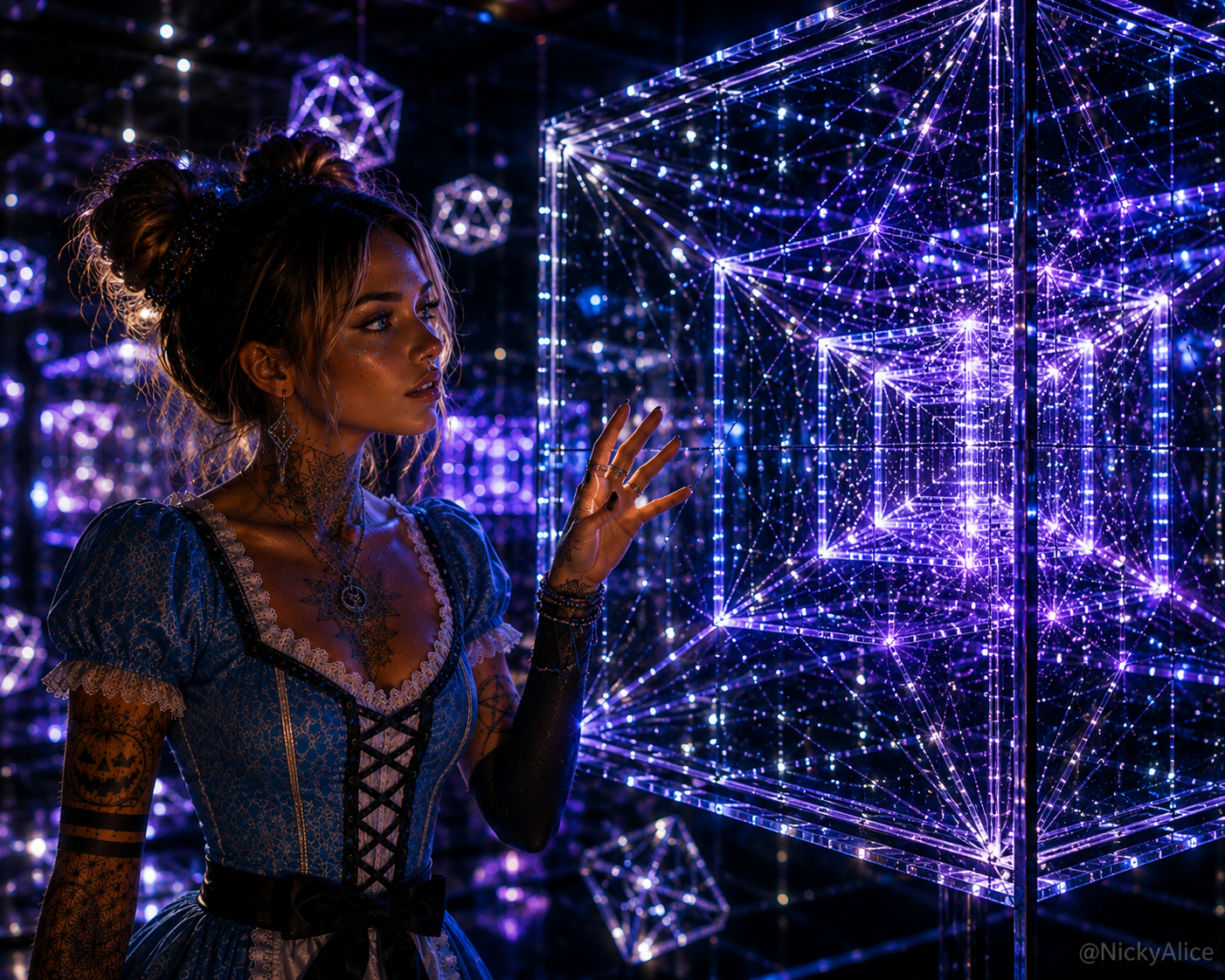
A room can feel larger than its physical footprint. Not because its walls have moved, but because light, reflection, and geometry have disrupted the eye’s usual agreement with space. That perceptual rupture is where the 5th dimension becomes compelling – not as a claim that a sculpture opens a literal portal, but as an invitation to experience more than one reality at once.
For collectors who want art to do more than complete a room, dimensional light sculpture offers a rare kind of presence. It can hold mathematics, mystery, engineering, and atmosphere inside a single object. The result is not décor. It is a visual event that changes with the viewer, the hour, and the chosen light program.
The 5th Dimension Is a Question, Not a Place
In everyday language, a dimension is a direction or measure of space: up and down, left and right, forward and back. Time is often described as the fourth dimension. From there, the idea of a fifth dimension enters physics, mathematics, philosophy, and popular imagination – each with a different definition.
Some theories in physics propose additional dimensions beyond those we can directly perceive. In mathematics, higher dimensions are precise conceptual systems that can be modeled even when they cannot be physically inhabited in the familiar sense. In spiritual and cultural language, the phrase can suggest expanded consciousness, a shift in perception, or a reality beyond ordinary limits.
Those meanings should not be collapsed into one. A work of art does not prove a scientific theory, and scientific language should not be used as empty mysticism. Yet the gap between what we can see and what we can imagine is artistically fertile. The 5th dimension becomes a powerful frame for work that makes space feel unstable, layered, and impossible to fully resolve.
Why Higher-Dimensional Geometry Feels So Magnetic
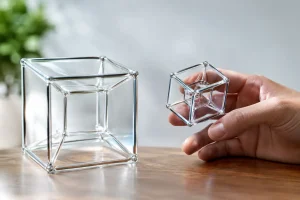
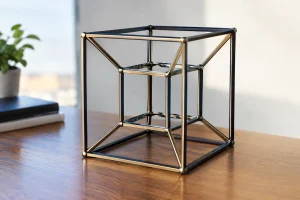
A cube is easy to understand because we live with three-dimensional objects. A tesseract, often called a hypercube, is the four-dimensional analogue of a cube. We cannot view it directly in the way we view a chair or a building, so it is commonly represented through a projection: a cube within a cube, connected by lines.
That projected form has a peculiar authority. It looks architectural, precise, and almost familiar, but it refuses to settle into a single reading. Is the inner form receding? Is it advancing? Are the edges connected in ordinary space, or are they describing something the eye cannot follow?
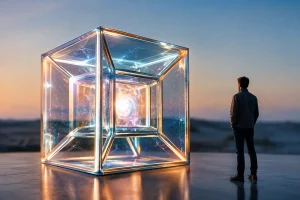
Infinity mirrors intensify that tension. Repeated reflections create apparent depth where there may be only inches. LEDs establish luminous lines that seem to continue beyond the frame. A geometric structure that already implies a higher-order object begins to behave like an aperture into a larger system.
The experience is especially powerful because it remains physical. You can see the materials, the frame, the crafted edges, and the controlled light. At the same time, the image inside the piece appears to exceed its construction. That contradiction is the point.
5th Dimension Art Is Built Through Perception
The most affecting dimensional art does not ask the viewer to merely look at an object. It asks the viewer to negotiate it. A slight shift in position can change the depth of a reflection. A darkened room can make the interior geometry feel infinite; daylight can bring the sculpture’s physical construction forward. A programmed color transition can turn a rigorous white structure into an electric field of violet, cyan, or red.
This is why lighting is not an accessory to the work. It is part of its visual language. Programmable LEDs allow a collector to alter mood without altering the sculpture’s identity. A restrained cool-white program can emphasize line, proportion, and architectural calm. Saturated color can heighten the sensation of velocity and depth. Slow gradients create contemplation, while sharper movement can give a room a charged, cinematic pulse.
There is a trade-off. More animation is not always more powerful. In a refined interior, a highly active sequence may compete with the architecture, artwork, or conversation already present. The strongest installation considers the room’s intended emotional register. A collector’s lounge, media room, entry hall, gallery wall, or private office can each call for a distinct approach.
From Sacred Geometry to Contemporary Collectible Design
Sacred geometry has long offered artists a visual vocabulary for order, repetition, symmetry, and the relationship between part and whole. Its enduring appeal is not limited to any one belief system. Geometric forms can feel ancient and futuristic at the same time because they are grounded in patterns the mind recognizes before it names them.
A hypercube-inspired sculpture extends that vocabulary into a more contemporary register. It carries the discipline of geometry but avoids the static quality of conventional wall art. It references mathematical thought while speaking fluently to advanced interiors, digital culture, science fiction, and experimental design.
For a serious collector, that breadth matters. A sculptural light work should not rely only on spectacle. It should reward repeat attention. Its shape should remain composed when powered off. Its materials should feel intentional up close. Its illumination should reveal new spatial relationships rather than simply add brightness.
At Nicky Alice, the tesseract is treated as more than a recognizable symbol. Handcrafted hyper-dimensional infinity mirror sculpture turns the form into an experiential structure – one that can be specified for scale, light behavior, and the particular energy of the space it will inhabit.
Choosing Scale and Placement for Dimensional Light Sculpture
A higher-dimensional piece needs visual breathing room. The goal is not to make it disappear into a wall of objects, but to give the viewer enough distance to read the outer silhouette and enough proximity to fall into the internal depth.
An entryway can create an immediate first impression, especially when the sculpture is positioned where guests encounter it before they understand the rest of the home. In a living room, the work becomes a focal point that holds its own after sunset, when reflective depth and programmable light become most pronounced. A private office offers another compelling setting: the piece can signal intellectual curiosity and original taste without becoming corporate ornament.
Scale depends on viewing distance, ceiling height, existing art, and the desired level of drama. A smaller work can operate like a concentrated jewel of light in an intimate setting. A larger custom piece can command a double-height wall, gallery corridor, or hospitality environment. Bigger is not automatically better. A sculpture that is oversized for its sightline can flatten into glare, while one that is too small may lose the spatial authority that makes the form persuasive.
Power planning also deserves attention early. Hardwired installation can create a highly integrated finish, while flexible power options may better suit collectors who want placement freedom or anticipate moving the work. Programmable lighting should be considered alongside practical matters such as control access, cable routing, ambient light, and whether the sculpture will be photographed or viewed primarily at night.
The Value of an Object That Cannot Be Mass Produced
The market is crowded with illuminated objects that imitate depth. What separates collectible work from novelty is authorship, fabrication, and conceptual clarity. A limited-edition or custom sculpture carries the marks of decisions that cannot be automated away: proportion, structural refinement, reflective calibration, material finish, and the particular behavior of light within the form.
That is also why authenticity matters. Signed, numbered works and certificates of authenticity establish provenance, but they also clarify the nature of the purchase. This is not a disposable trend object. It is a work of contemporary light sculpture designed to remain relevant as technology, interiors, and personal collections evolve.
For clients building a home around distinctive pieces, dimensional art can become the object that makes the rest of the space feel intentional. It creates a center of gravity without requiring a room to become a theme. It communicates a willingness to live with ideas, not just surfaces.
The most rewarding way to approach a 5th dimension-inspired sculpture is to let the room participate. Consider what it will reflect, when it will be seen, and how you want people to feel when they stop in front of it. Give it darkness when it needs darkness, distance when it needs distance, and enough attention to reveal the impossible space it has been built to hold.