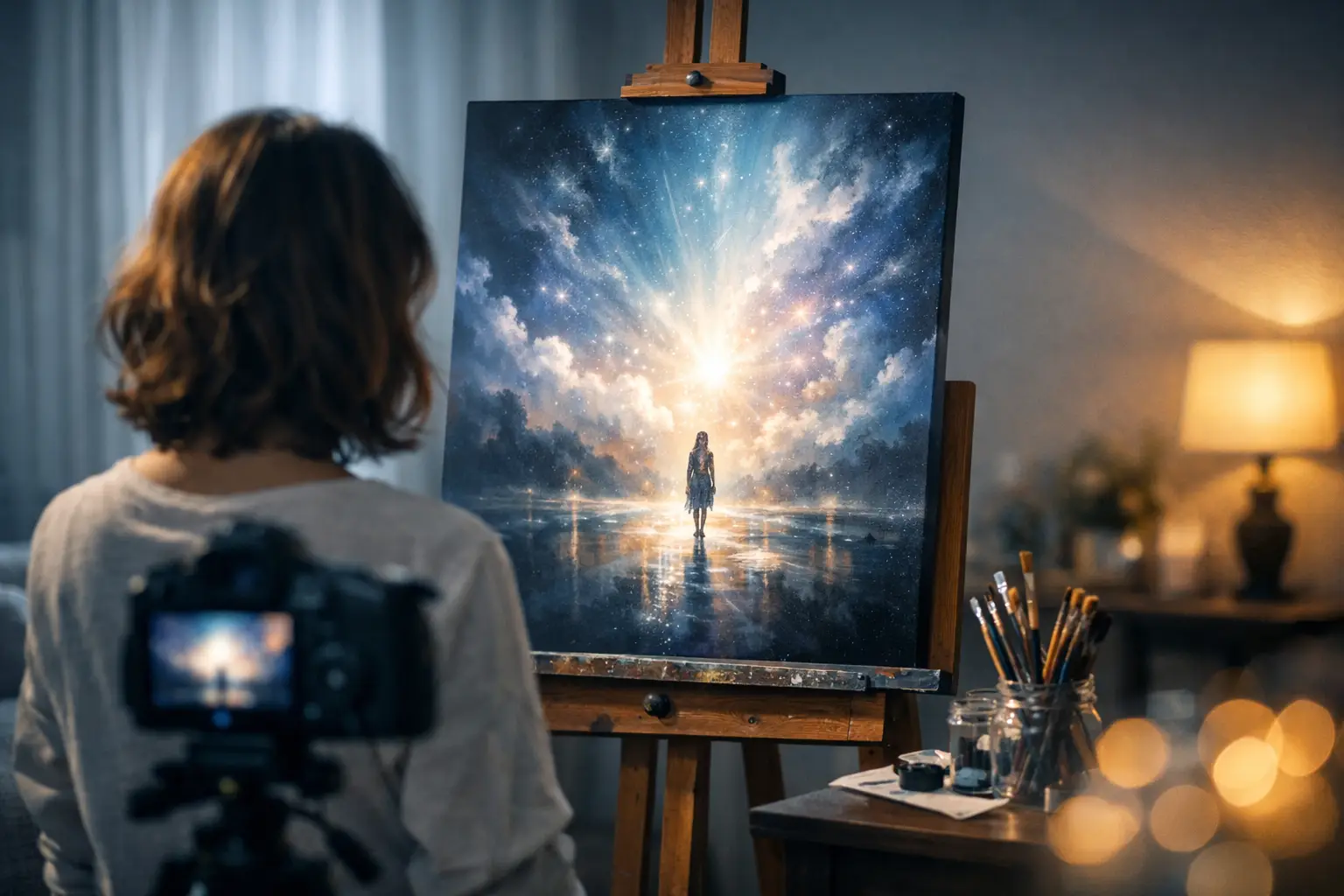
A lucid dream does not arrive as a finished image. It arrives as an impossible certainty. A room becomes much larger than its walls, light has physical weight, and an object can be inside itself without contradiction. How I create art with my dreams begins there, with the sensation that ordinary space has briefly stopped obeying its own rules.
I do not treat dreams as private symbols waiting to be illustrated. I treat them as perceptual experiments. In lucid states, the mind can accept shifts in scale, depth, sequence, and geometry with startling ease. The work in my studio asks a related question in waking life: can physics, mathematics, light, and reflection create a space that the body understands even when language cannot?
Dreams are laboratories for impossible space
Dreams make a useful studio because they expose a gap between what the eye sees and what the mind concludes. In a dream, a corridor can fold back into itself. A doorway can lead to a place that is both distant and immediately present. There is no need for a conventional map because perception is constructing the map as it moves.
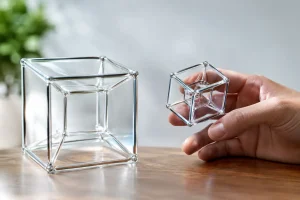
That flexibility is compelling to me because higher dimensional geometry creates a similar cognitive pressure. A tesseract is a four dimensional hypercube, just as a cube is a three dimensional extension of a square. Human vision is adapted to three spatial dimensions, so a true tesseract cannot be placed intact in front of the eye. What can be seen is a projection, a lower dimensional trace of a form that exceeds the space containing it.
That is not merely an abstract mathematical limitation. It is an artistic opportunity. A shadow of a cube is not a cube, yet it tells us something real about the object casting it. In the same way, an installation can give the nervous system a vivid encounter with the projected logic of a hypercube, even if no one is literally walking through a fourth spatial dimension.
How I create art with my dreams and geometry
I begin with a dream memory, usually not its plot but its spatial behavior. Perhaps the memory is of standing at the edge of an endless chamber, or watching a form repeat into the distance while remaining close enough to touch. I then look for a geometric structure capable of carrying that feeling without reducing it to a story.
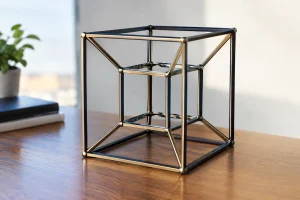
The tesseract is one of the most powerful structures I return to. Its familiar projection appears as a cube within a cube, connected by edges. It is visually direct, but it carries a profound implication: the inner and outer cubes are not simply nested boxes. They are aspects of a four dimensional object viewed from an incomplete vantage point.
This is where spatial geometry becomes more than ornament. Every edge has a job. Every repeated plane establishes orientation, disorientation, or both. I work through proportion, symmetry, and the relation between near surfaces and receding surfaces until the sculpture can hold a paradox. It must feel mathematically disciplined while also suggesting that its boundaries are unstable.
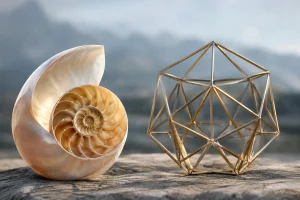
Sacred geometry interests me for a related reason. The term is often used loosely, but the underlying forms deserve precision. Symmetry, recursion, radial organization, and polyhedral structures have appeared across human visual culture because they make order visible. They allow intuition to meet number. In my work, geometry is not proof of hidden supernatural claims. It is a rigorous visual language for approaching experiences that can feel transcendent.
Mirrors turn a finite object into a perceptual event
The physical sculpture has limits. It occupies a specific volume, has material thickness, requires structural integrity, and must travel safely into a festival environment. Infinity mirrors allow that finite object to produce a field of apparent depth that far exceeds its actual dimensions.
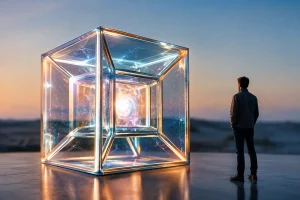
The effect comes from controlled reflection. A reflective mirror and a partially reflective surface face each other, with programmable LED light placed between them. Some light is reflected back and forth repeatedly. At each pass, a portion reaches the viewer, creating a sequence of diminishing images that appears to extend deep into the structure.
The mathematics of the visual effect is elegant. The reflected light loses intensity with each bounce, so the apparent corridor eventually fades. Yet the eye reads the repeated intervals as continuation. The result is not actual infinity, but a convincing encounter with an asymptote, a depth that seems to keep going while becoming increasingly faint.
That distinction matters. I am not trying to trick anyone into believing the sculpture is physically endless. I want the viewer to feel the exact friction between fact and perception. The body knows there is a wall. The eye reports a vast interior. For a moment, both statements remain true in different ways.
Building the conditions for altered perception
A successful installation is not produced by mirrors alone. It emerges from a series of engineering decisions about material, light, power, framing, safety, and sightlines. An angle that is mathematically clean on paper may break the illusion when viewed from human height. A brighter LED program may increase spectacle but erase the subtle falloff that gives depth its credibility.
Programmable light lets the geometry behave over time. Color can travel along edges, pulse through nested planes, or pause long enough for the structure to become still and architectural. Motion changes interpretation. A slow expansion can make the object feel as though it is breathing. A rapid chase can reveal the wireframe logic of the hypercube. Neither approach is automatically better. The desired state depends on whether the work needs contemplation, movement, or a more intense interactive encounter.
At large scale, the installation must also meet the reality of its setting. Burning Man and art festivals bring dust, wind, darkness, crowds, heat, curiosity, and a deep willingness to be changed by an encounter. The work has to be durable enough for that environment while preserving enough precision for the geometry to read. Those demands are not separate from the concept. They are the concept made accountable to the world.
The viewer completes the dimensional projection
The sculpture is interactive because perception changes as the viewer moves. A slight shift to one side can make an edge align, split, or disappear. Reflections capture fragments of faces and bodies, then multiply them into the illuminated structure. The viewer does not stand outside the work as a neutral observer. They become one more moving element in its optical system.
This is especially potent in an augmented reality activation. With an AR headset, visitors can virtually step inside the hyperdimensional form and encounter spatial relationships that could not be built at full physical scale. The virtual experience does not replace the material sculpture. It extends the question posed by it. What happens when an object already capable of unsettling depth becomes an interactive environment around the body?
The answer varies. Some people become quiet. Some laugh, reach toward an apparent void, or begin explaining the geometry to a stranger. Others recognize the sensation from meditation, psychedelia, lucid dreaming, or a childhood memory of looking between mirrors. I am interested in all of these responses because they reveal how much perception is an active construction.
Why dreams remain essential to the work
Physics gives me constraints, mathematics gives me structure, and fabrication gives the ideas a body. Dreams give me permission to begin with a question that has no obvious practical answer. What would it feel like to stand inside the projection of a fourth dimensional object? Could reflection make finite space feel recursive? Can an interactive work make someone aware of the assumptions their senses make before thought begins?
I return to dreams because they are not opposed to rigor. They are where unfamiliar relationships can first be felt before they are named. The studio process then asks those feelings to survive contact with geometry, material, circuitry, and light.
If a viewer leaves an installation with the sense that reality may contain more structure than the senses usually report, that is enough. The dream has not been copied. It has been given edges, reflection, and a place to happen again.