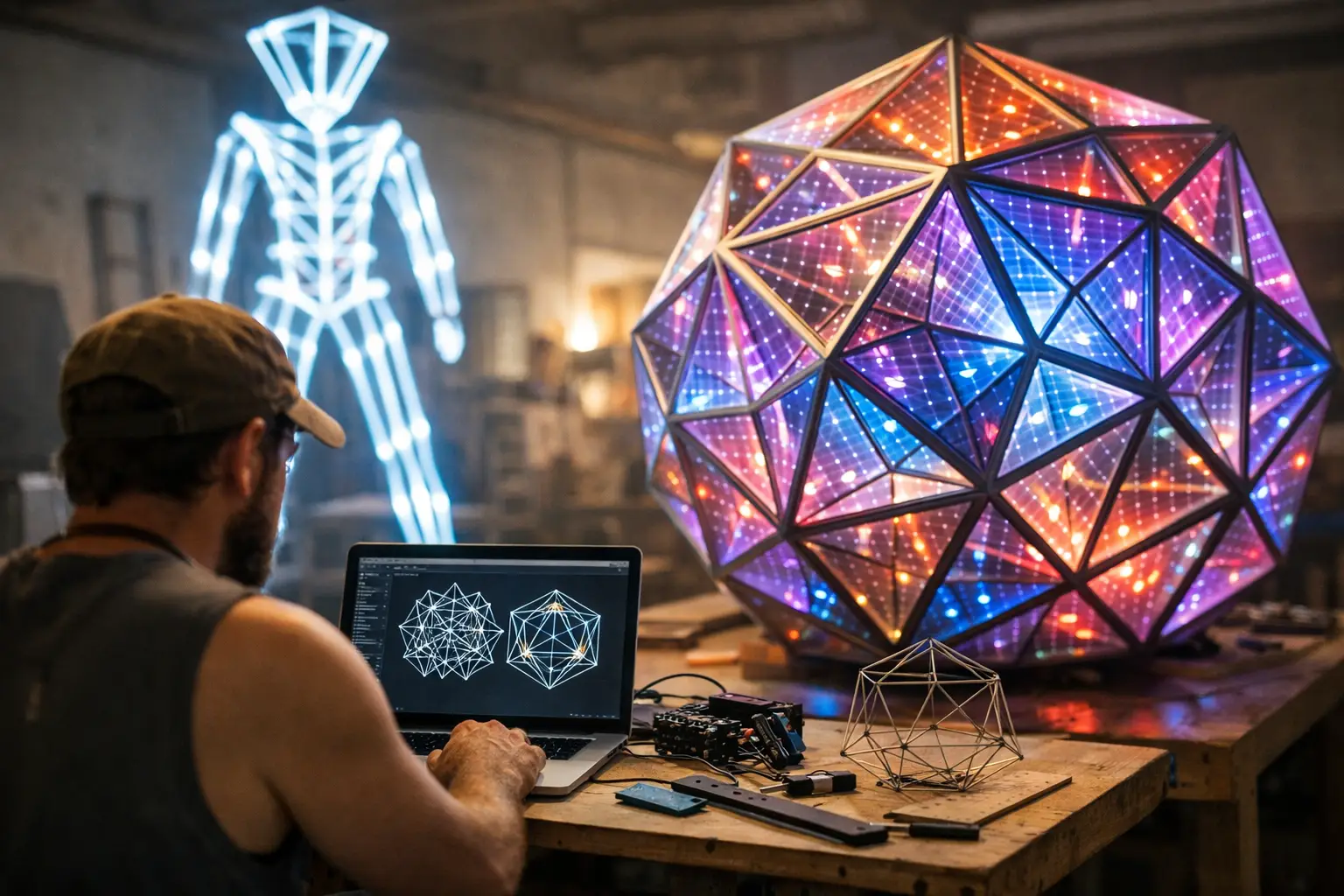
At night on the open playa, an artwork has almost no background. There is only dust, horizon, human movement, and light crossing an enormous field of darkness. That condition changes how burning man art is made. A sculpture cannot rely on a gallery wall, controlled weather, or a quiet audience. It must become architecture, beacon, experiment, meeting place, and sometimes a brief portal into a reality that seems larger than the senses.
For Alice, the work begins with a question that is both mathematical and visceral: what would a fourth dimensional object feel like if it entered the physical world? The answer is never just an image. It is a structure people can circle, touch with their eyes, enter through attention, and sometimes experience virtually through an interactive Augmented Reality activation. Building that experience takes geometry, material science, electrical planning, fabrication, patience, and a willingness to make beauty answer to physics.
How Burning Man Art Is Made for the Playa
The romantic image of festival art is often a sudden act of inspiration, a glowing object rising from dust. The reality is a long chain of decisions, beginning months before the event. Every artistic decision is tested against wind, heat, vibration, transport, assembly time, public safety, power, and the fact that thousands of people may encounter the work in radically different states of attention.
A concept has to earn its scale. On the playa, small details can disappear, while a simple geometric form can become monumental because it reads cleanly from far away. I begin by asking what the work needs to communicate at a distance, then what it reveals as someone approaches, and finally what happens when a viewer stands close enough for perception to become unstable. Those three scales create a kind of spatial narrative.
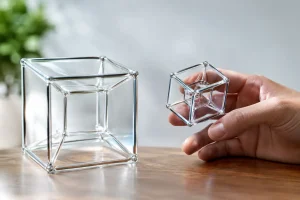
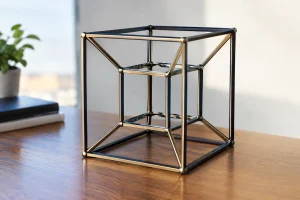
For a hypercube sculpture, the outer silhouette is only the first layer. A cube is familiar. A tesseract is not. Mathematically, a tesseract is the four dimensional analogue of a cube, just as a cube is the three dimensional analogue of a square. Since no one can directly see four spatial dimensions, the sculpture uses projection, repetition, reflection, and light to create an intuition for that impossible extension.
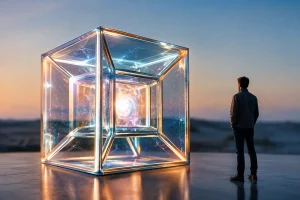
The goal is not to claim that mirrors literally reveal another dimension. They do something more interesting. They make the brain confront an image whose depth appears to exceed the physical volume in front of it. The viewer knows the object is finite, yet the visual system keeps reporting an interior that recedes beyond reach. That tension is where the experience begins.
Geometry Becomes Structure
The first physical problem is translation. A drawing of a tesseract projection may look effortless on a screen, but a five foot cube made from real materials has loads, joints, tolerances, and failure points. Geometry becomes a fabrication map.
I work from proportional systems that preserve the legibility of the form. Repeated lines need to align precisely, because slight errors multiply inside an infinity mirror. A frame that is visually close may be structurally sound, yet still collapse the illusion if its internal reflections drift out of register. In this kind of sculpture, accuracy is not merely engineering. It is perception.
The frame must be strong enough to survive transport and assembly while remaining visually quiet. Materials depend on scale and site conditions. Metal can provide stiffness and durable connections. Wood can bring warmth and efficient fabrication. Acrylic, polycarbonate, mirrored surfaces, and diffusion materials each change how light enters and travels through the work. There is no universal best choice. A material that produces exquisite reflections may be too fragile for a public environment. A tougher surface may soften the optical effect. The final form is always a negotiation between ideal geometry and lived reality.
This is also where sacred and spatial geometry becomes practical rather than ornamental. Repetition, symmetry, nested forms, and proportion are powerful because the human visual system recognizes pattern before language catches up. A repeated cube can feel architectural. A recursive lattice can feel like a dream that has discovered its own rules. These effects emerge from structure, not from decorative excess.
The Physics Inside an Infinity Mirror
An infinity mirror is a controlled argument between reflection and transmission. One surface is highly reflective. Another is partially reflective and partially transmissive. Light placed between them bounces back and forth, and each reflected image loses a portion of its intensity. The result is a sequence of smaller, dimmer images that appears to recede into depth.
That apparent depth is not infinite in a strict physical sense. It is an exponential visual sequence, limited by reflectivity, surface cleanliness, alignment, ambient light, and the brightness of the LEDs. Yet the eye does not experience it as a calculation. It experiences it as a corridor, chamber, or opening.
Programmable LEDs make this space dynamic. Color, rhythm, gradients, and brightness can transform the same geometry from a calm field of depth into a pulsing system that seems to breathe. But motion must be used with restraint. Too much animation can flatten the form into spectacle. The strongest sequences give the geometry time to exist, then alter it slowly enough that a viewer notices the transformation in their own perception.
On the playa, brightness is especially complicated. A sculpture must contend with moonlight, vehicle lights, neighboring installations, dust on reflective surfaces, and the sudden visual adaptation of people arriving from darkness. The lighting design needs enough intensity to remain legible, but not so much that it erases the subtler recursive layers. Light is the material, but darkness is part of the medium.
Engineering for Wind, Dust, and Human Curiosity
Burning Man art is public infrastructure for wonder. That means safety cannot be an afterthought. Every element must be designed for people who may lean, climb, dance near it, photograph it, or encounter it without understanding its boundaries.
The playa adds another force, wind. Large flat surfaces can behave like sails, and dust can enter places that seemed sealed in the studio. Foundations, anchoring, ballast, cable routing, access panels, and weather resistant enclosures all need to be considered early. A beautiful piece that cannot be secured is not ready for the environment it hopes to inhabit.
Power is equally central. Interactive light systems require careful electrical planning, from LED voltage and controller capacity to cable protection and backup behavior. The work should fail gracefully if a component needs attention. A single inaccessible connection can turn a minor repair into a major interruption during an event.
Then there is the human factor. Interactive art must invite participation without demanding an instruction manual. Sometimes the invitation is a doorway. Sometimes it is a reflection that catches a moving body. Sometimes it is an AR headset that lets a person virtually step inside the hypercube, changing scale and orientation until the sculpture becomes an environment rather than an object. The best interactive moments make people feel curious before they understand why.
Installation Is the Final Act of Making
A festival installation is not complete when it leaves the studio. It is completed in the field, where components become a whole under actual sky, actual dust, and actual pressure. Assembly is choreography. Frames rise in a planned order. Mirrors are handled carefully. Lighting is tested after sunset. Wiring is secured. Alignment is checked again, because travel and temperature can shift what was perfect indoors.
The first night is a revealing moment. People do not encounter the piece according to an artist statement. They encounter it while walking, riding, searching, resting, or following a line of light across the playa. Some will see a geometric sculpture. Some will see a machine for lucid dreaming. Some will recognize the logic of higher dimensional projection immediately. Others will only feel that space has become unreliable.
That range is not a problem to solve. It is the purpose of immersive art. Physics supplies the constraints. Mathematics supplies the grammar. The festival gives the work its living audience. When someone pauses before a tesseract and senses a depth that cannot quite exist, the sculpture has done more than glow in the dark. It has given perception a new question to carry home.