A wall can hold a painting. It can also appear to open into a space with no visible end. That distinction is where dimensions explained through light art becomes more than a lesson in geometry. It becomes a physical encounter with perception – a moment when the eye understands that space is not always as stable as it seems.
A hyper-dimensional infinity mirror sculpture uses familiar materials – glass, reflective surfaces, structural geometry, and programmable LEDs – to create an unfamiliar result. A finite object can appear to contain an endless corridor of light. A cube can suggest a form that extends beyond the three dimensions we move through every day. For collectors drawn to mathematical beauty, futuristic design, and art with real conceptual voltage, that tension is the point.
Dimensions Explained: From Space to Experience
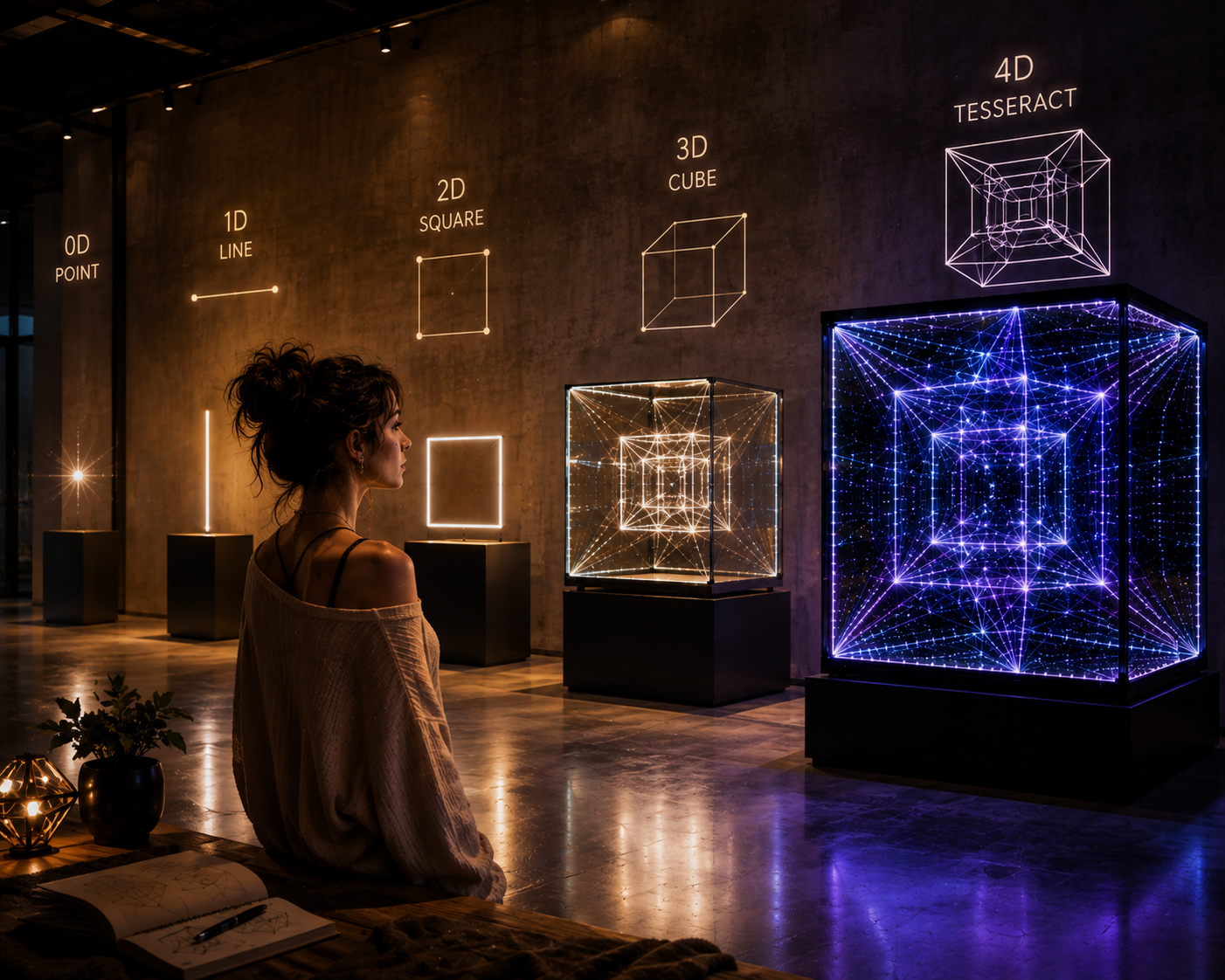
A dimension is, at its most practical, a direction in which something can be measured or moved. A line has one dimension: length. A flat plane has two: length and width. The room around you has three: length, width, and depth.
The fourth dimension is often described as time in physics. In geometry, however, it can also mean another spatial direction beyond the three we can directly see. We cannot point toward it in the way we point up, down, left, or right. But mathematics can describe it precisely, and sculpture can give it a visual language.
That is why the hypercube is so compelling. A cube is the three-dimensional extension of a square. A hypercube, also called a tesseract, is the four-dimensional extension of a cube. Just as a cube has square faces, a tesseract has cubic cells. We cannot build a literal four-dimensional object in ordinary physical space, but we can build a three-dimensional projection of one.
Think of a shadow. A hand is three-dimensional, yet its shadow on a wall is two-dimensional. The shadow carries information about the hand while changing its appearance. A tesseract sculpture works in a related way: it is a three-dimensional representation of a four-dimensional idea. Its nested cubes and connecting edges are not a compromise. They are the visual evidence of a form our senses cannot fully access.
Why Mirrors Make Geometry Feel Infinite
A tesseract outline alone is intellectually striking. Add infinity mirror construction, and the geometry becomes emotionally persuasive.
An infinity mirror creates a repeated field of reflections between a reflective back surface and a partially reflective front panel. LEDs positioned inside the structure appear again and again, receding into apparent depth. The enclosure is physically finite. The visual space seems unbounded.
This is not an illusion in the dismissive sense. It is a controlled optical event. Every reflected point of light travels farther into the repeated image field, becoming smaller and dimmer as it appears to move away from the viewer. The eye reads that sequence as depth. When the lights trace the edges of a cube or hypercube projection, the viewer does not merely see geometry. They feel as though geometry has become a portal.
The strongest pieces hold two truths at once. Up close, the craft is evident: clean joins, deliberate spacing, reflective precision, and light calibrated to the structure. From across the room, the same object interrupts the architecture around it. It changes the emotional temperature of a hallway, library, entry, lounge, or private collection wall.
The Difference Between Decorative Light and Dimensional Art
Not every illuminated object creates dimensional presence. A glowing sign, backlit panel, or standard LED fixture can add color, but it typically performs one visual function. Hyper-dimensional sculpture asks the eye to keep working.
As you shift your position, reflective planes alter the apparent depth. A color transition can make the form feel cool and distant, then saturated and electric. A slow animation emphasizes contemplation; a faster sequence introduces pulse and movement. The artwork changes without becoming random.
That distinction matters in a considered interior. Decorative lighting fills a role. Dimensional light sculpture establishes a point of view. It signals that the room has been composed by someone interested in ideas as much as finishes.
A collector may choose a monochromatic white program for a restrained architectural space, then switch to cobalt, violet, or flowing multicolor sequences for an evening gathering. Smartphone-controlled LED programming gives the piece range, but customization should serve the geometry rather than compete with it. More effects are not automatically more powerful. Often, a measured sequence with strong contrast makes the infinity field feel deeper and more intentional.
How a Tesseract Changes a Room
A tesseract-inspired work has unusual spatial authority because it operates at several scales. At close range, it rewards inspection. From the far end of a room, it reads as a luminous architectural gesture. In photographs, it creates a focal point. In person, it becomes the conversation that continues after guests have moved on.
Placement changes the experience. In an entryway, a piece can establish a sense of arrival before any furniture is noticed. In a dining room or entertaining space, it gives the room an after-dark identity. In a home office, it can offer a counterweight to screens and hard-edged technology: still technological, but materially authored and unmistakably human-made.
Scale deserves careful thought. A compact sculpture can create an intimate window into impossible depth, especially in a corridor, niche, or curated gallery wall. A larger commission can hold its own against tall ceilings and expansive stone, plaster, or wood surfaces. The right choice depends on sightlines, wall dimensions, ambient light, and the amount of visual tension the room can carry.
The trade-off is simple. Larger works create more immediate impact, but they need room to breathe. A dramatic sculpture squeezed between competing art, heavy shelving, or ornate furnishings can lose its authority. Let the piece have negative space around it. Infinity needs a frame, even when that frame is the architecture itself.
Craftsmanship Is Part of the Concept
Dimensional art is often discussed as if the idea alone carries the work. It does not. If reflections are misaligned, if the structural lines lack precision, or if the lighting is poorly diffused, the sense of impossibility collapses. The viewer sees construction before they feel wonder.
Handcrafted fabrication is therefore not a romantic extra. It is what allows an abstract mathematical proposition to become convincing in a physical object. The material choices, mirror quality, edge treatment, LED density, wiring, and power configuration all influence the final perception of depth.
For a custom commission, the practical questions are worth asking early. Should the work be hardwired for a permanent architectural installation, or powered through a standard outlet for flexibility? Is the intended wall exposed to daylight that may soften the mirror effect? Does the collector want a calm, gallery-like program or a more kinetic centerpiece for entertaining? These decisions shape the experience long after installation day.
Nicky Alice approaches the tesseract not as a decorative motif, but as a sculptural problem: how can a finite, handcrafted object make a viewer feel the pressure and possibility of another dimension?
A More Personal Way to Read Dimensions
There is a reason sacred geometry, cosmology, and higher-dimensional mathematics continue to appear in contemporary art. They offer a vocabulary for experiences that language struggles to contain: awe, scale, mystery, continuity, and the sense that ordinary perception is only a partial view.
A hypercube sculpture does not need its owner to solve advanced equations. The intellectual pleasure is available without technical training. You can understand the work through the body first. Step closer. Watch the lights repeat. Notice the way the central void seems to pull backward. Move to one side and see the structure reorganize.
For those who want the deeper framework, it is there. The object becomes a projection, the mirrors become an engine of apparent extension, and the LEDs become coordinates drawn in light. For those who simply want a room to feel unforgettable, it does that too.
The best place to begin is not with the question, “Which dimension is this?” Begin with a more useful one: “What kind of space do I want to create when someone looks at this?” A well-chosen dimensional sculpture answers with light, depth, and a quiet refusal to end at the wall.