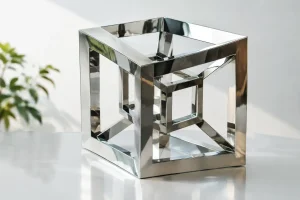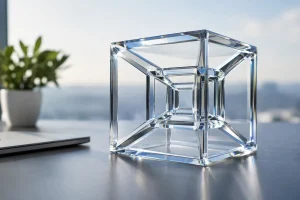
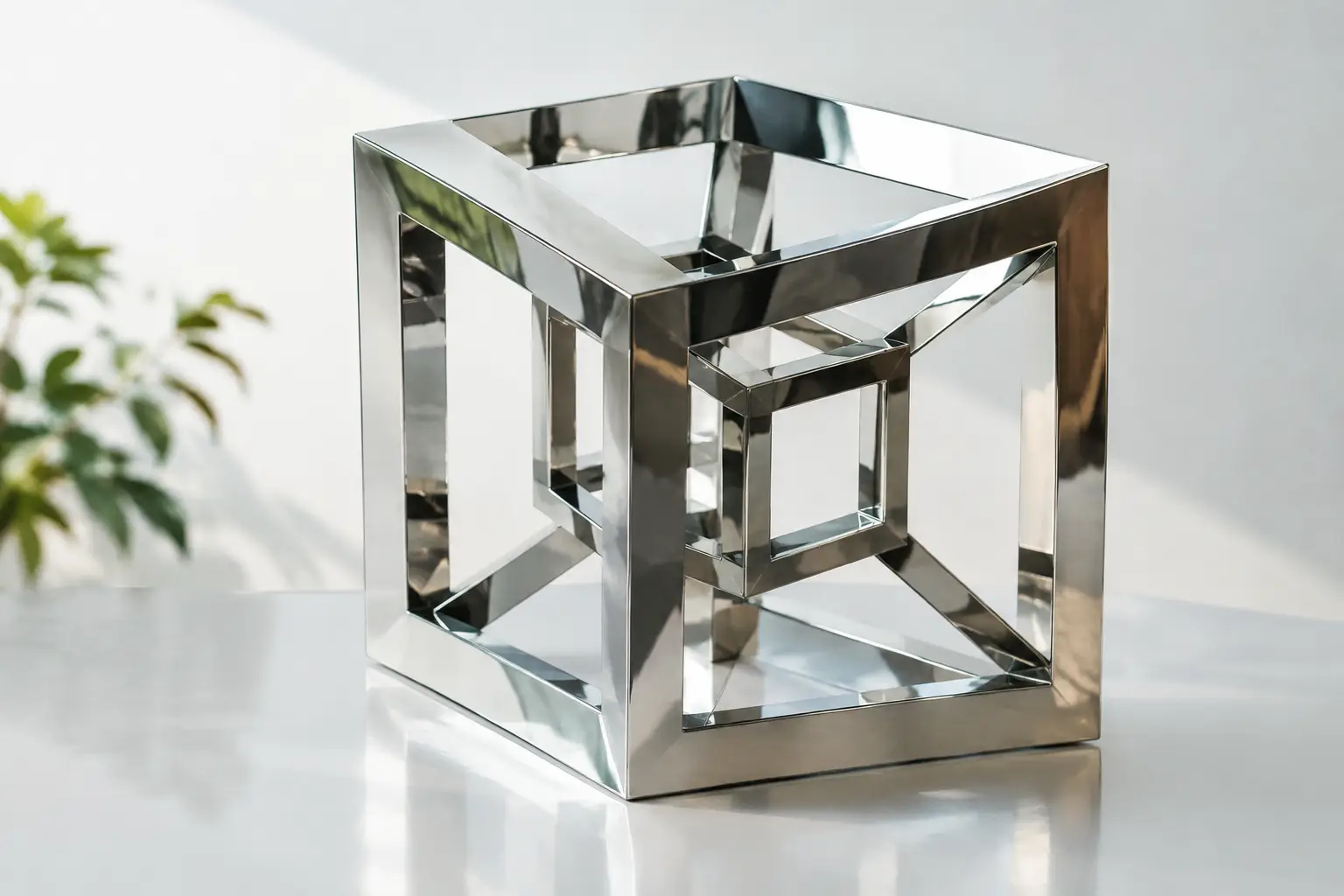
A mirror sculpture can do something a drawing of a hypercube cannot. It can recruit your body. The instant a viewer steps in front of an infinity mirror structure, depth appears where there is very little physical depth, edges repeat into apparent distance, and a stable room begins to feel less certain. I am interested in that moment, when perception realizes it may not be telling the whole story.
The Tesseract is built around a simple but unsettling proposition. If a two dimensional square can be projected into three dimensions as a cube, then a three dimensional cube can be projected into four dimensions as a tesseract. Human eyes do not receive four dimensional space directly. Yet mathematics gives us a rigorous map of its structure, and reflection gives sculpture a way to make that map felt.
Mirror Sculpture as a Dimensional Experiment
A conventional sculpture occupies volume. It has an outside, an inside, a surface, and a limit. An infinity mirror sculpture disrupts those assumptions. Its physical frame may be finite, but reflected images of that frame recur again and again. The eye reads those repetitions as a corridor, a chamber, or a geometric void extending beyond the material object.
That effect is not magic. It is optics. A partially reflective surface allows some light through while returning some light to the viewer. Paired with a fully reflective surface, it creates a loop of reflections. Each return loses intensity, so the sequence gradually falls away into darkness. The fading is essential. Without it, the image would not feel like distance. With it, a shallow structure can suggest immense interior space.
I use this physics as a perceptual instrument rather than a visual trick. The point is not merely to make something look infinite. The point is to let a visitor encounter the gap between measured space and experienced space. The body knows it is standing before a finite object. Vision proposes another reality.
That tension is especially potent when the frame is a cube. A cube is one of the most familiar forms in human construction, yet it also serves as the shadow of a more complex object. The tesseract is made of eight cubic cells, just as a cube is made of six square faces. It has sixteen vertices, thirty two edges, and twenty four square faces. These numbers are not ornamental facts. They describe a precise geometry that can be projected, rotated, and interpreted within the dimensions available to us.
Why the Tesseract Refuses to Sit Still
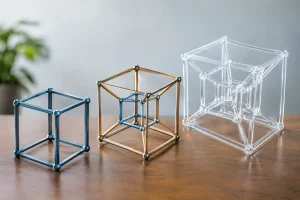
Most people first encounter a tesseract as a small cube nested inside a larger cube, with connecting edges between corresponding corners. That image is useful, but it can also mislead. It is not a tesseract itself. It is a three dimensional projection of a four dimensional form, much like a cube drawn on paper is not actually a cube.
Projection always changes what it describes. Imagine a transparent cube casting a shadow onto a wall. Depending on the angle, the shadow might look like a square, a hexagon, or an irregular set of overlapping lines. None of those shadows contains the full cube, but each carries information about it. A tesseract projected into three dimensions behaves similarly. Its apparent inner and outer cubes are relationships created by projection, not a literal smaller cube sitting inside a larger one.
This is where mirror sculpture becomes unusually alive. Reflections create their own projections. Every plane produces another apparent plane. Every edge repeats and shifts. As a viewer moves, the geometry moves with them. The sculpture is interactive because position changes the image. There is no single correct view, only a changing family of views generated by the relationship between body, mirror, angle, and light.
A static photograph cannot fully carry this experience. In person, a tiny movement of the head may cause an edge to align, split, disappear, or seem to open into a new chamber. That instability resembles the challenge of imagining higher dimensions. The mind keeps trying to settle the object into familiar three dimensional logic, then the visual evidence slips away.
Building Infinity From Finite Materials
The making begins with mathematics, but it also demands uncompromising physical decisions. Every line in the frame must hold its intended relationship. A small error in alignment can disrupt the recursive geometry, because reflected structures multiply inaccuracies as readily as they multiply depth.
I begin by considering the specific projection I want to make physical. Some tesseract projections emphasize nested cubes. Others privilege rotation, diagonal connections, or a more abstract lattice of points and edges. The selected geometry determines the structural skeleton, the placement of reflective surfaces, and the pathways available to the viewer’s eye.
Scale changes the question. A small work can feel like a private portal, a compressed impossibility held at arm’s length. A large installation changes the terms entirely. The viewer no longer observes an object from outside. They stand near a spatial event that appears to continue beyond its own boundaries. At festival scale, the work must also survive proximity, movement, weather, curiosity, and the collective energy of thousands of people encountering it after dark.
The Tesseract, at five feet by five feet by five feet, is designed for that threshold between object and environment. It remains a sculpture, with a legible external form, but it asks for a slower encounter. The surrounding world continues at the edge of vision while the reflected interior seems to open inward. This contrast is part of the work. A hypercube is not a place one can enter physically, but an immersive installation can create the felt question of what entering one might mean.
The Festival as a Laboratory of Perception
At Burning Man and other immersive gatherings, people arrive ready to experiment with attention. They may have spent hours moving through dust, sound, open sky, and temporary architecture. Their sense of ordinary scale is already loosened. A mirror sculpture in this environment does not need to explain itself immediately. It can meet viewers in a state of alertness and let the geometry unfold over time.
I have watched people approach an infinity structure cautiously, then lean closer, laugh, go quiet, or reach toward an apparent depth that is not there. Those gestures matter. They show perception testing its own evidence. Children often accept the impossible image before adults do. Mathematicians may trace the edges, looking for the logic of the projection. Dancers and dreamers often respond to the feeling first, describing a corridor, a portal, or a memory of a lucid dream.
These responses are different languages for the same encounter. The work gives no proof that hidden dimensions exist in the everyday sense. Physics does, however, ask serious questions about dimensions beyond ordinary experience, from the spacetime of relativity to theoretical models with additional compact dimensions. My sculptures do not illustrate those theories as if they were settled visual facts. They give the imagination a disciplined place to practice.
Sacred and spatial geometry enters here without requiring vague claims. Geometric forms have carried symbolic force across cultures because they offer order, symmetry, repetition, and transformation. A cube can be architectural, mathematical, ritual, and intimate all at once. When its edges recur into apparent infinity, the form becomes a meditation on scale. The smallest movement can reorganize the whole visible universe.
An Interactive Threshold Between Dream and Measure
Lucid dreams have their own strange spatial grammar. A room can expand without adding walls. A doorway can lead somewhere emotionally exact but physically impossible. The dreamer may recognize the contradiction and still inhabit it. Mirror structures create a related waking condition. They establish enough real structure for the mind to trust, then introduce recursive depth that exceeds the structure’s literal dimensions.
That is why the interactive element matters. Viewers are not passive receivers of an image. Their motion generates changing projections, and their attention decides which pattern becomes dominant. With augmented reality, visitors can also virtually step inside the geometry, extending the encounter beyond the physical perimeter. The virtual experience does not replace the sculpture. It gives the tesseract another mode of presence, one in which the body can explore a projected dimensional architecture from within.
The most compelling mirror sculpture does not ask anyone to abandon reason. It asks reason and imagination to stand together for a moment. Mathematics supplies the grammar. Physics supplies the behavior of reflection. Craft gives the illusion enough precision to hold. Then the viewer arrives, shifts half a step, and discovers that the edge of what can be seen is not necessarily the edge of what can be conceived.