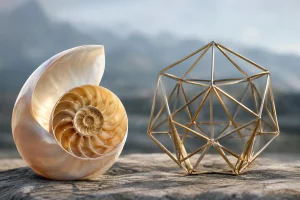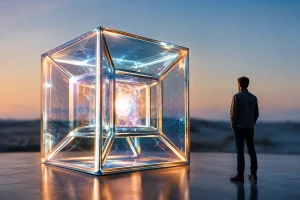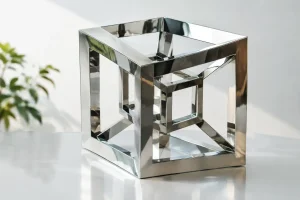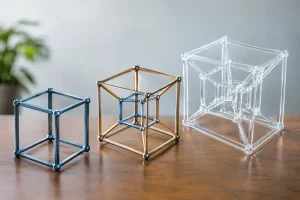
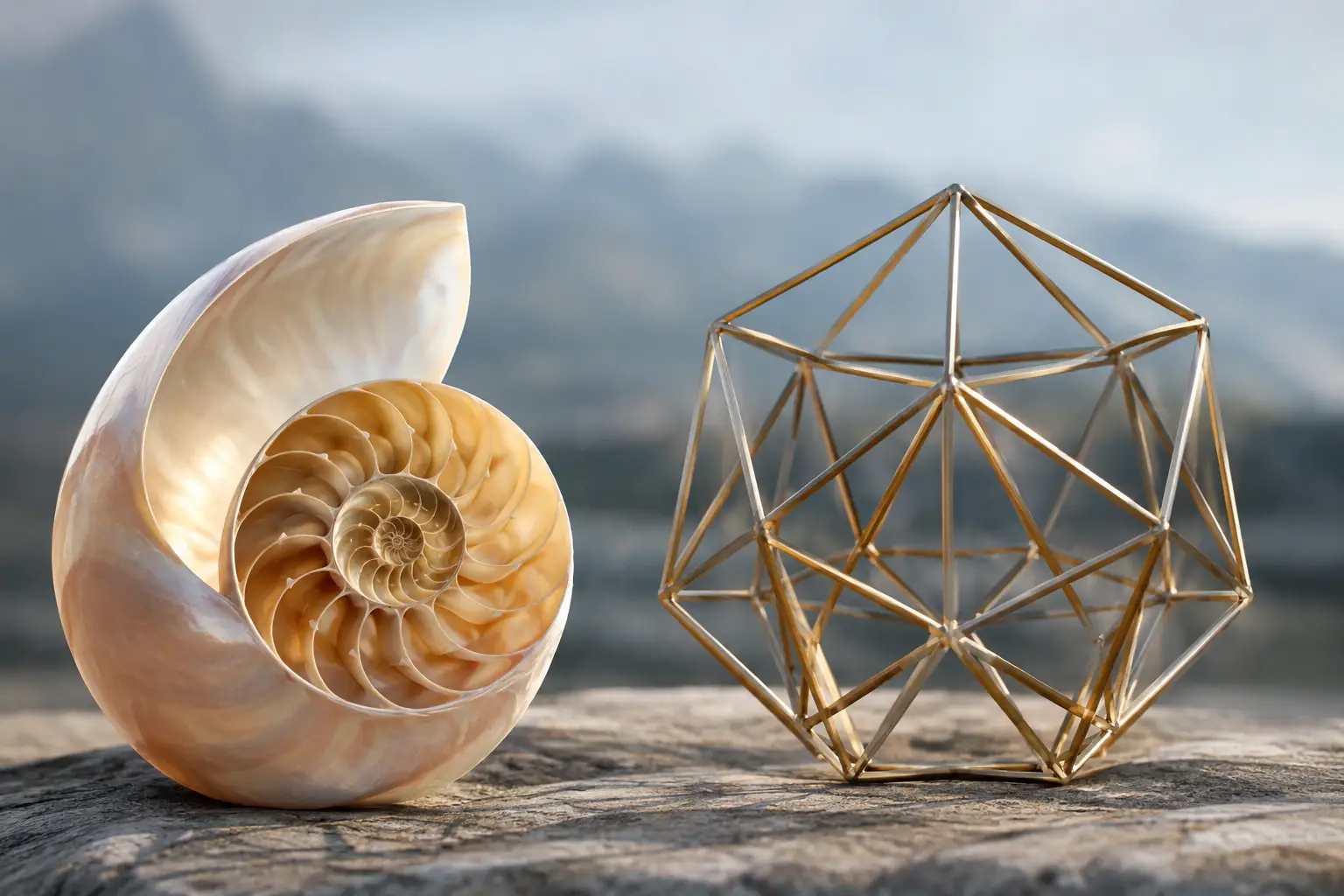
A honeycomb cell, a nautilus shell, a crystal face, and a cube projected from a tesseract all begin with geometry. Geometry in nature and art is not simply a catalog of beautiful patterns. It is a way of asking how form emerges, how the mind recognizes order, and where perception starts to fail. That last boundary is where I like to build.
A geometric sculpture can be immediately legible, then become strange the longer a person stands before it. A square becomes a cube. A cube appears to contain another cube, then a corridor, then an impossible interior. The object has not changed, but the viewer’s interpretation has. This is the productive tension between physics and imagination: the material is real, while the space it seems to reveal may feel impossible.
Geometry in Nature and Art Is a Language of Form
Nature does not use geometry because it wants to make an image. Geometric order appears because matter is constrained by energy, growth, force, and time. Soap films seek configurations that reduce surface area. Snow crystals form according to the molecular structure of water. Sunflower spirals often follow arrangements related to Fibonacci numbers because the pattern distributes seeds efficiently as the flower grows.
Art begins somewhere else. The artist can select a constraint, exaggerate it, interrupt it, or make it perceptually unstable. A circle can become a ritual boundary. Repeated squares can establish a rhythm. A mirrored plane can turn a finite chamber into what looks like endless depth. The geometry remains rigorous, but its effect is psychological.
This is why sacred geometry deserves both attention and precision. Certain forms have accumulated spiritual and cultural meanings across centuries, often because symmetry feels unusually complete to the human nervous system. But geometry does not need unsupported claims to be astonishing. A hexagon is remarkable because of what it does. It fills a plane without gaps. A sphere is remarkable because every point on its surface is the same distance from its center. Meaning can arise from encountering these facts directly.
Nature Produces Patterns, Not Perfect Diagrams
It is tempting to call every spiral in nature a golden ratio spiral or every branching system fractal. Reality is more interesting than that. Biological forms are shaped by changing conditions, imperfect materials, local competition, and adaptation. A leaf network has recognizable branching logic, yet no two leaves are identical. A shell may approximate a logarithmic spiral without obeying a textbook equation at every point.
That variation matters. Nature is not a static geometry lesson. It is geometry under pressure.
The same is true of the patterns visible in clouds, coastlines, lungs, and river deltas. They reveal self similarity across scales, but not perfect repetition. Fractal mathematics offers a powerful model for understanding them, not a claim that every natural edge contains infinite exact detail. The distinction protects the wonder. A model is valuable precisely because it helps reveal the underlying process without pretending to replace the living thing.
Symmetry Is a Constraint on Possibility
Symmetry can make an object feel stable, but it also limits what the object can become. A perfectly symmetrical body has fewer degrees of visual freedom than an irregular one. A slight break in symmetry can therefore create a surge of attention. The eye notices the deviation because it has already learned the rule.
In my work, symmetry is often the first invitation. A viewer recognizes the cube, the repeating frame, the central axis. Then reflections multiply the known form until its orientation becomes difficult to trust. The interactive experience depends on that sequence. Recognition creates footing. Disorientation opens the question.
Art Can Make Abstract Geometry Physical
Mathematics can describe objects that cannot be fully built in ordinary space. A tesseract, or four dimensional hypercube, is one of the most famous examples. Just as a square extends into a cube when a new spatial direction is added, a cube extends into a tesseract when another spatial direction is added. Human vision and touch evolved within three spatial dimensions, so the whole object cannot be placed before us in the usual sense.
It can, however, be projected.
A cube drawn on paper is not a three dimensional cube. It is a two dimensional projection that preserves enough relationships for the mind to infer depth. In the same way, the familiar image of a smaller cube nested inside a larger cube, with corresponding corners connected, is a three dimensional projection of a tesseract. It is not the tesseract itself. It is a shadow of its structure.
That distinction is not a disappointment. It is the central artistic opportunity. Projection lets a higher dimensional rule leave a trace in a lower dimensional world. The trace can be measured, built, entered, and felt, even though it never gives the observer total access to the original object.
My tesseract sculptures use frames, mirrors, reflective surfaces, and carefully organized illumination to make projection experiential. The goal is not to claim that a physical room has gained an extra spatial dimension. The goal is more exacting: to create conditions in which ordinary depth becomes uncertain, recursive, and emotionally immense. The mind begins trying to map a space that refuses to settle into one simple reading.
Reflection Turns Space Into a Question
A mirror does not create an infinite volume. It produces an image governed by the law of reflection: the angle at which a ray arrives at a surface equals the angle at which it leaves. Place reflective planes in relation to one another and the images repeat. Add a partially reflective surface and an illuminated structure beyond it, and the repetitions can appear to recede far past the material boundary.
The physics is clear. The perceptual result can still be uncanny.
This is where an installation becomes interactive without requiring a screen or a button. A viewer’s position changes the geometry of what is visible. Move a few inches and a line aligns, an opening closes, a reflection reveals itself as a reflection. The body becomes part of the experiment. Perception is no longer passive observation. It is an interactive act of testing the space.
An augmented reality activation can extend that investigation. It allows participants to virtually step inside a hyperdimensional structure and examine relationships that would otherwise remain outside reach. The virtual experience does not replace the physical sculpture. It offers another projection, another way to move through the same mathematical question. Each medium exposes different limits and possibilities.
Why These Forms Belong at Festivals
At Burning Man and other large scale immersive events, geometry operates differently than it does in a classroom or gallery. A person may encounter a luminous cube after hours of walking through dust, sound, darkness, conversation, and sensory overload. The installation is not isolated from the environment. It becomes a coordinate inside a shifting social landscape.
That context intensifies the encounter. People gather around a structure, point to an apparent passage, try to explain the depth to one another, then return later and see it differently. The work becomes interactive at the scale of a crowd. It produces not only individual perception but shared speculation.
For organizers and curators, this is part of the value of spatial geometry. A strong installation does more than occupy a site. It gives people a new behavior within the site: circling, pausing, entering, discussing, and looking again. The geometry holds attention because it contains a real problem for the senses.
Lucid dreams can feel related for a similar reason. In a lucid dream, the dreamer may recognize that familiar rules have changed while still inhabiting the scene. A hallway extends too far. A room contains another room. Scale shifts without warning. Immersive geometric art cannot reproduce dreaming, nor should it pretend to. But it can create an awake encounter with the same fertile uncertainty: the feeling that reality is stable enough to stand in, yet stranger than the mind expected.
The most useful response to geometry is not to memorize every pattern. It is to spend time with a form until its logic becomes felt, then notice where that logic carries imagination beyond ordinary space.