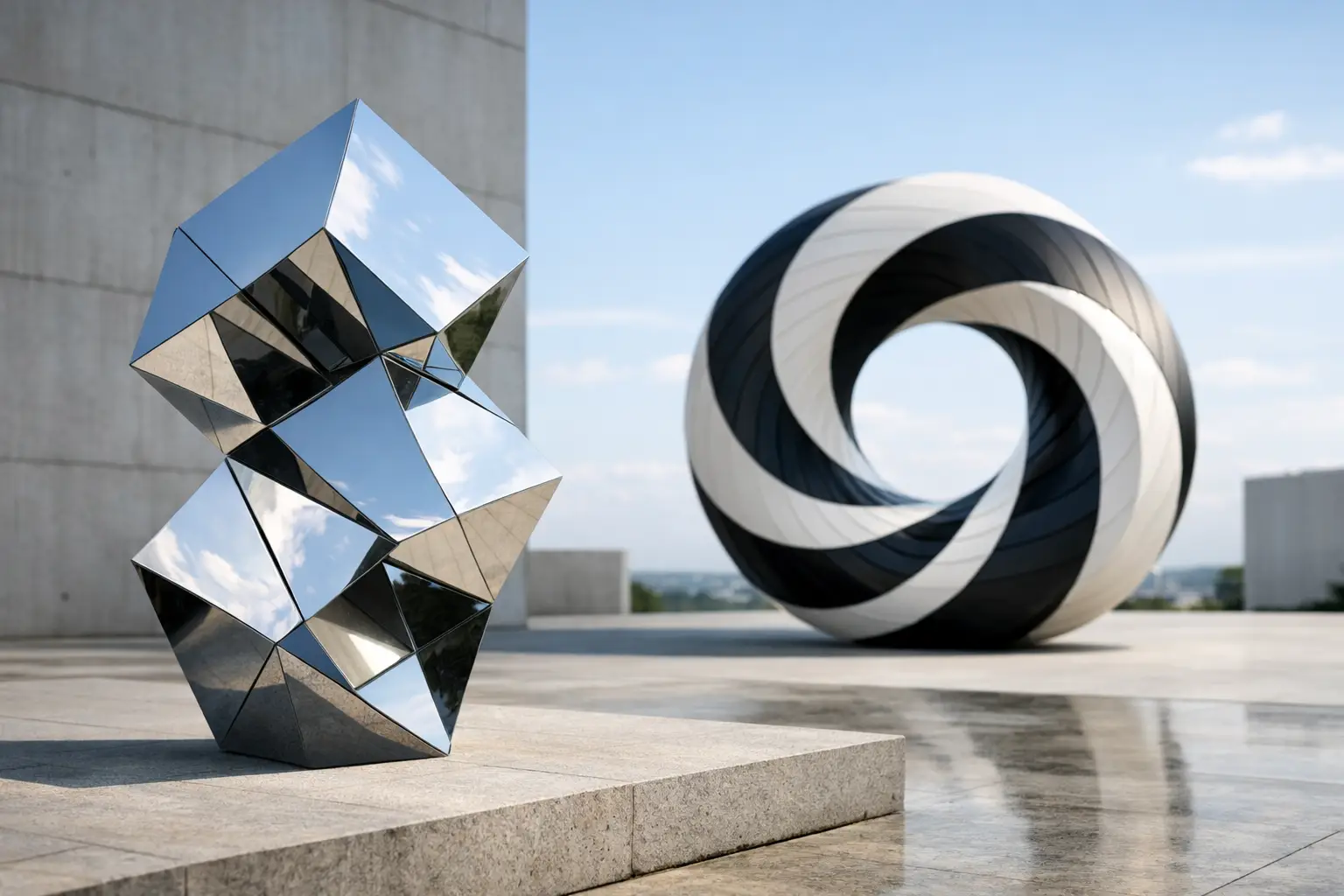
A cube is so familiar that the mind stops seeing its strangeness. It has six square faces, twelve edges, and eight vertices, yet it occupies three dimensions with total confidence. Geometric sculptures become most powerful when they interrupt that confidence. They use form, light, reflection, and scale to make a viewer question whether the space in front of them is truly as simple as it appears.
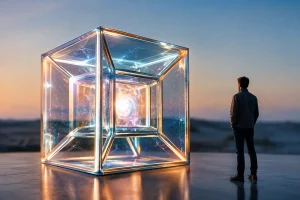
I build geometry as an encounter rather than an illustration. A diagram of a tesseract can explain a projection from four dimensions into three. Standing before a luminous hypercube, watching light repeat into apparent infinity, asks a different question: what would a higher dimension feel like inside a body built to perceive only three?
Why Geometric Sculptures Change Perception
Geometry is often taught as a fixed language of clean lines and solved problems. In sculpture, it becomes active. A line can become an edge, an edge can define a plane, and a plane can block, reflect, or transmit light. The viewer completes the system by moving through it. A form that looks stable from one position may open into impossible depth a few steps later.
That shift matters because perception is not a passive recording device. The brain continuously constructs a working model of space from partial information: binocular vision, motion, shadows, perspective, and memory. When a sculpture carefully manipulates those cues, it exposes the construction. The mind knows a mirrored chamber has limits, but the eyes report corridors of light that seem to continue beyond the material boundary.
This is where spatial geometry becomes more than visual order. It becomes a kind of physics experiment. The sculpture presents a finite structure. Reflection repeats that structure. Programmable LED light gives the repetition time, rhythm, color, and apparent motion. The result can feel less like looking at an object and more like encountering a rule of reality that has briefly become visible.
A Tesseract Is Not a Cube With Extra Drama
The tesseract, also called a hypercube, is the four dimensional analogue of a cube. The progression is elegant. A point can be extended to form a line. A line can be moved in a new perpendicular direction to form a square. A square can be moved in another perpendicular direction to form a cube. Move the cube in one more direction, perpendicular to all three familiar axes, and the conceptual result is a tesseract.
That last direction is the difficult one. It is not up, sideways, or forward. It cannot be pointed toward within ordinary physical space because human bodies inhabit three spatial dimensions. Mathematics has no trouble describing it. Human intuition does.
A tesseract has sixteen vertices, thirty two edges, and twenty four square faces. Its boundary consists of eight cubes, just as the boundary of a cube consists of six squares. These are not mystical claims. They are consequences of dimensional geometry. Yet the numbers become emotionally charged when a physical sculpture gives them scale and light.
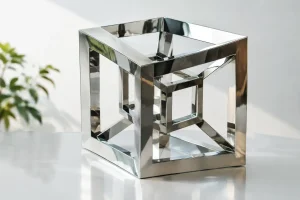
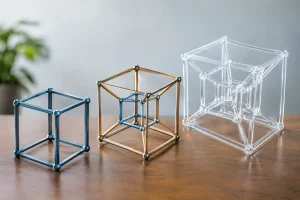
Any visible tesseract in a gallery or festival is necessarily a three dimensional representation, usually a projection or a skeletal interpretation. That limitation is not a failure. Projection is the whole invitation. A cube casts a two dimensional shadow that can appear as a square, a hexagon, or many other shapes depending on the light and angle. In the same way, a tesseract can cast a three dimensional projection that appears as a cube within a cube, connected by corresponding edges.
The familiar cube inside cube image is therefore not the tesseract itself. It is evidence of a higher dimensional object translated into a lower dimensional language. That translation produces visual tension, and tension is fertile material for sculpture.
Light Turns Structure Into Apparent Infinity
An infinity mirror is a precise optical device, not a metaphor pasted onto a surface. It usually combines a reflective mirror, a partially reflective front panel, and lights positioned between them. Some light passes through the front panel to the viewer. Some is reflected back and forth between the two mirrored surfaces. With each bounce, the light loses energy, so the repeated images gradually dim.
The eye reads those diminishing repetitions as receding depth. A shallow physical chamber can appear to extend far beyond its actual dimensions. The illusion has a boundary, but it is a boundary perception has trouble locating.
Inside a geometric frame, the effect becomes especially strange. A simple illuminated edge does not merely repeat. It produces a nested family of related edges, each smaller and farther away. A hypercube form can seem to generate hypercubes within hypercubes, as though the object is folding through itself in an endless recursive sequence.
Color changes the reading of that sequence. Slow gradients can make depth feel atmospheric and dreamlike. Sudden pulses make the structure feel computational, almost as if a hidden equation is being evaluated in real time. Programmable LEDs are essential because they allow light to behave as a fourth material alongside mirror, frame, and space. The sculpture is not fixed. It has states.
There is a tradeoff. More light is not always more powerful. Excess brightness can flatten the reflection field and reveal the mechanical limits of the chamber. Too little light sacrifices definition. The most compelling balance preserves the sharpness of the geometry while allowing the dark intervals to remain active. Darkness is what gives apparent infinity somewhere to go.
The Interactive Threshold
An interactive sculpture changes when a person changes their relationship to it. Sometimes that means physical movement. A viewer circles the form, and the spatial projection reorders itself. Sometimes it means an augmented reality activation that allows visitors to step virtually inside the geometry through a headset. The virtual interior can extend the physical work without replacing it.
That distinction is crucial. The physical sculpture establishes trust. It has mass, edges, wiring, reflections, and a real relationship to gravity. Once the viewer has felt its scale and seen light operate on real materials, the interactive virtual experience can carry the geometry beyond ordinary access. A person can stand inside a tesseract projection, observe recursive chambers around them, and become a moving point inside the equation.
The aim is not spectacle for its own sake. It is to let perception participate in the problem. What happens when the observer is no longer outside the model? What does it mean to navigate a form whose defining direction cannot be physically walked toward? These questions resemble lucid dreams, where the mind accepts a world that follows recognizable rules until one impossible detail reveals that the rules have changed.
From Mathematical Model to Festival Encounter
At Burning Man and large scale immersive events, geometry meets a different kind of laboratory: a temporary city of movement, dust, sound, heat, and altered attention. Thousands of people may arrive at the same sculpture with radically different frames of reference. A mathematician may recognize a projected hypercube. A child may see a portal. Someone awake before sunrise may simply feel that the night has opened.
All of those responses can coexist because the structure is doing real work. The art does not require a viewer to memorize four dimensional topology before feeling wonder. But the mathematics is there for anyone who wants to follow it further. This is one reason festival installation art can be intellectually serious without becoming instructional signage. The experience comes first, then the questions keep unfolding.
Engineering for that setting requires rigor. Large luminous works must account for structural loads, cable paths, power distribution, weather, transport, assembly time, and the behavior of materials after long exposure to heat and dust. Mirror alignment matters. Frame tolerances matter. LED programming must support the perceptual intention rather than compete with it. Every technical decision affects the illusion.
I think of this process as building a bridge between abstraction and sensation. The equations establish proportion and correspondence. Physics determines how light will travel, reflect, attenuate, and reach the eye. Fabrication gives those principles a body. Then a viewer arrives, pauses, moves, and makes the final connection.
Geometry Is a Behavior, Not a Symbol
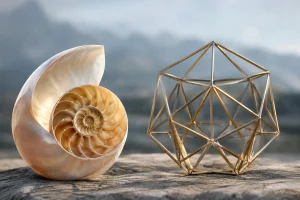
Sacred geometry can be meaningful when it is approached through actual structure rather than vague decoration. Symmetry, recursion, proportion, and tiling have appeared across cultures because they describe patterns found in nature, mathematics, and human making. Their power comes from the way they organize attention.
A geometric sculpture does not need to promise access to hidden truths. It can offer something more honest and perhaps more profound: a direct encounter with the limits of perception. It can show that a finite room may feel infinite, that a cube may imply a dimension beyond reach, and that light can turn a strict mathematical framework into a living, interactive threshold.
The next time a reflected edge appears to continue beyond itself, stay with the uncertainty for a moment. The sensation is not proof that reality contains an unseen direction. It is proof that the mind is capable of sensing the edge of what it understands, then imagining further.