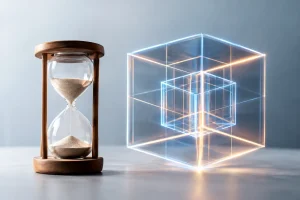

A tesseract is difficult to see because the problem is not a lack of imagination. It is a problem of embodiment. Human eyes evolved to navigate three dimensions, so any encounter with a hypercube must arrive as a projection, a sequence, a shadow, or a feeling of impossible continuity. The best films about higher dimensions understand that limitation. They do not merely add strange corridors or cosmic portals. At their best, they make perception itself feel unstable, then let the audience sense a larger geometry pressing through the frame.
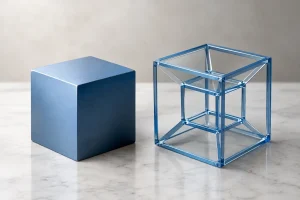
I return to these films while thinking through sculpture. A cube inside a cube can suggest the projection of a tesseract, but mirrors, repetition, scale, and movement change the equation. A visitor can walk around the object, watch reflections multiply, and briefly lose confidence about where physical space ends. Cinema has a related power. It uses time, editing, sound, and the bounded rectangle of the screen to make an impossible space feel briefly inhabitable.
What makes a higher dimensional film work
Higher dimensions in physics do not automatically mean alternate universes. A dimension is an independent direction needed to specify a position or event. Three spatial dimensions describe ordinary location. Relativity treats time as another coordinate, forming spacetime. Some theoretical models propose additional spatial dimensions that may be compact, hidden, or inaccessible at human scales.
Film is free to interpret those ideas poetically, and it should be. The interesting question is whether a movie understands the consequence of an added dimension. A being able to move through a fourth spatial dimension might pass around a locked room as easily as a person steps around a line drawn on paper. A person who sees time as a whole may experience cause and effect very differently from someone trapped in the present moment.
This ranking favors films that give dimensional ideas emotional and visual consequences. Some are scientifically speculative, some are metaphors, and some are gleefully absurd. All of them are useful references for makers, dreamers, and anyone who has stood inside an immersive installation and wondered whether the room had quietly acquired another direction.
The best films about higher dimensions
1. Interstellar
Christopher Nolan’s Interstellar gives the tesseract a central dramatic role, and that alone earns it a permanent place in this conversation. Its fifth dimensional library is not a literal mathematical model of a hypercube, yet its basic intuition is potent. Time becomes something that can be approached from many positions, like a physical landscape.
The film’s strongest move is making abstraction intimate. Cooper does not encounter higher dimensional structure as a lecture. He encounters it through memory, grief, and the effort to communicate across time. For a sculptor, the sequence is a reminder that geometry becomes unforgettable when it carries human stakes.
2. 2001: A Space Odyssey
Stanley Kubrick never explains the final transformation in the reassuring language of a classroom. That restraint is the film’s force. The star gate sequence and the hotel room place the viewer inside an encounter with scale, symmetry, recurrence, and evolutionary rupture without reducing any of it to a diagram.
Its clean architectural spaces feel especially relevant to spatial geometry. The room at the end is familiar, but familiarity becomes eerie when every surface appears staged by an intelligence whose relation to human perception remains unknown. 2001 understands that the sublime can be precise.
3. Arrival
Arrival treats time as a dimension that might be perceived differently rather than conquered. The heptapods do not simply know the future. Their language reorganizes experience so that past and future no longer arrive as separate categories. That premise draws from the real conceptual strangeness of spacetime, while preserving ambiguity about free will.
The circular logograms matter because they give a visual form to nonlinearity. They are not just alien ornament. They propose a language without a conventional beginning or end. The film is essential viewing for anyone interested in how a geometric form can change the felt structure of thought.
4. Contact
Contact turns a cosmic machine into an argument about perception. Ellie Arroway travels through structures that appear engineered beyond familiar human methods, then arrives in a space where alien intelligence takes a form she can emotionally bear. The film does not insist that every image be physically literal. Instead, it asks what an encounter with a vastly larger reality would do to evidence, belief, and memory.
Its dimensional feeling comes from translation. The universe may be stranger than the traveler can process, so the experience is rendered through symbols, architecture, and a shoreline assembled for one human mind.
5. Cube 2: Hypercube
This is the most uneven film on the list, but it belongs here because it commits to a genuinely dimensional premise. The rooms are not simply rearranged. They exist as cells of a hypercube, with characters crossing between states of space that should not coexist in ordinary three dimensional architecture.
The science is loose, and the dialogue can be blunt, yet the central spatial nightmare is effective. A hypercube is often taught through projections of cubes connected by edges. This film asks what it might feel like if that diagram became a prison. For anyone building physical interpretations of higher geometry, that is a productive question.
6. Donnie Darko
Richard Kelly’s film approaches dimensional rupture through adolescent dread, prophecy, and a tangent universe that seems to be shedding reality around its edges. Its rules are deliberately unstable, but its imagery is unusually memorable. Liquid paths extend from bodies, time seems to announce itself before it happens, and ordinary suburbia becomes a fragile surface over a much stranger structure.
Donnie Darko is less interested in physics than in the psychic cost of seeing patterns nobody else can see. That makes it a powerful companion to lucid dreaming, where familiar spaces retain their appearance while acquiring impossible causal rules.
7. Everything Everywhere All at Once
The film is fundamentally about the multiverse, not higher spatial dimensions, and that distinction matters. Still, it earns a place because it makes the emotional burden of infinite possibility visible. Every choice branches into versions of a life, and the result is not liberation alone. It is exhaustion, comedy, grief, and finally attention.
Its visual abundance suggests what happens when perception is asked to hold too many realities at once. The movie’s answer is unexpectedly tender. Meaning does not come from accessing every world. It comes from caring within the world currently in front of you.
8. Annihilation
Alex Garland’s Annihilation imagines a zone where biology, identity, and physical boundaries refract into unfamiliar forms. The Shimmer is not presented as a clean dimensional portal. It is closer to a region where the rules that preserve separateness have become porous.
That makes the film valuable for artists working with reflection. A mirror can duplicate a form without changing it. A refractive system can split, bend, and recombine it into something that feels related but transformed. Annihilation turns that principle into an unsettling meditation on selfhood.
9. The Fountain
Darren Aronofsky’s The Fountain moves across historical periods, interior visions, and cosmic space without offering a single stable map. It may not be a higher dimensional film in a strict physics sense, but it understands how time can collapse under the pressure of love, mortality, and myth.
Its recurring geometries, especially the tree and the floating sphere, make it feel like an attempt to picture eternity with finite materials. The images are lush, sometimes excessive, but that excess is part of the experiment. Not every attempt to represent the infinite should look restrained.
10. Primer
Shane Carruth’s Primer is the opposite of cosmic spectacle. Its time travel mechanism is cramped, technical, and almost aggressively ordinary. That modest scale makes its dimensional implications more disturbing. Once characters can enter a device and emerge earlier in the timeline, identity begins to multiply through overlapping versions of the self.
The film understands a crucial truth about time as a dimension. The problem is not only going somewhere else. The problem is that your departure may already have altered the conditions under which you decided to leave.
11. Flatland: The Movie
Edwin Abbott’s original story remains one of the clearest thought experiments about dimensional perception. A two dimensional inhabitant cannot comprehend a sphere until that sphere intersects the flat plane, appearing first as a point, then an expanding circle, then a shrinking one. The animated adaptation makes this lesson accessible without losing its bite.
Its relevance to the tesseract is direct. Just as a sphere casts a changing circular cross section into Flatland, a four dimensional object would reveal changing three dimensional cross sections in our world. The limitation is not necessarily in reality. It may be in the observer.
Watch for the projection, not just the portal
The deepest lesson in these films is that a higher dimension rarely arrives as a destination. It arrives as a failure of ordinary orientation. A corridor loops when it should end. A memory becomes an address. A reflection keeps going after the object has stopped. Time ceases to feel like a river and becomes a structure with hidden rooms.
That is the territory I pursue in the Tesseract and related interactive sculptures. The physical object remains finite, yet reflection and spatial recursion can make it feel as if the interior has slipped beyond its measurable boundaries. When a viewer virtually steps inside through an interactive AR experience, the question becomes more immediate. Is the space expanding, or is perception finding a new route through it?
The next time a film offers an impossible room, resist the urge to ask only whether it is scientifically correct. Ask what kind of geometry would make that room possible, what it would look like in projection, and what a human mind might sacrifice or gain by finally seeing it whole.