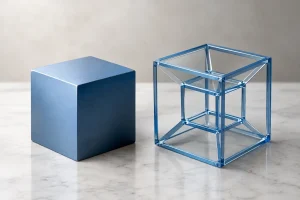

A cube feels complete because human perception is built for three dimensions. It has length, width, and height, six square faces, twelve edges, and eight corners. But tesseract versus cube geometry begins at the moment that apparent completeness breaks open. A tesseract is not a cube made stranger by visual effects. It is the four dimensional analogue of a cube, a form whose full structure cannot be held directly in ordinary space.
That limitation is not a failure of imagination. It is a condition of embodiment. Human eyes gather a three dimensional scene through a two dimensional surface, then the brain assembles depth, motion, scale, and orientation. The fourth spatial dimension asks the mind to perform one more step than experience normally requires. Mathematics can take that step exactly. Sculpture can make its consequences felt.
Tesseract Versus Cube Geometry, One Dimension Further
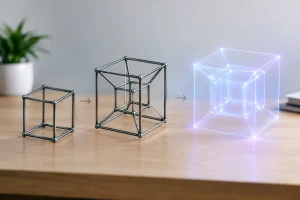
The cleanest way to understand a tesseract is to build upward from the simplest possible shape. A point has no extent. Move a point in one direction and it traces a line segment. Move that line in a new perpendicular direction and it sweeps out a square. Move the square perpendicular to its plane and it creates a cube.
Now continue the same operation once more. If a cube moves in a direction perpendicular to all three of its existing directions, it sweeps out a tesseract, also called a hypercube. That new direction is inaccessible to ordinary physical movement, but the rule is coherent. Geometry does not stop at the edge of what a body can walk through.
Each step doubles a recognizable part of the previous form. A line segment has two endpoints. A square has four edges. A cube has six square faces. A tesseract has eight cubic cells. These cells are not merely cubes placed next to one another in the familiar sense. Each is a three dimensional boundary element of a single four dimensional object.
The numerical pattern is equally revealing. A cube has 8 vertices, 12 edges, and 6 square faces. A tesseract has 16 vertices, 32 edges, 24 square faces, and 8 cubic cells. The form is not an abstraction with vague mystical status. It has a precise combinatorial anatomy.
Why a Tesseract Looks Like a Cube Inside a Cube
No drawing can show a tesseract as it actually exists in four dimensions, just as no flat drawing can show a cube in all of its three dimensional fullness. What a drawing can show is a projection.
Imagine a transparent cube casting a shadow onto a flat surface. The resulting image might be a hexagon, a set of overlapping quadrilaterals, or another arrangement that changes as the cube turns. None of those shadows is the cube itself. Yet each can carry accurate information about the cube’s structure.
A tesseract projection works the same way. Its familiar image, a smaller cube nested inside a larger cube with corresponding corners connected, is a three dimensional shadow of a four dimensional form. The inner and outer cubes do not mean that the tesseract is a box containing another box. They represent different regions of a projection, compressed along a direction the viewer cannot inhabit.
This is why rotating tesseract animations can feel so unsettling. In four dimensional rotation, portions of the form may appear to pass through one another or exchange apparent size without breaking any geometric rule. The confusion comes from projecting a motion with more degrees of freedom into a space with fewer.
A cube rotating in three dimensional space can present different faces. A tesseract rotating in four dimensional space can present different cubic cells. The projected result can look like an object turning itself inside out. Nothing supernatural has occurred. The projection is revealing that intuition is calibrated to a smaller arena.
The Cube Is Not Simpler, It Is More Familiar
Calling the cube simple is useful, but incomplete. It is simple only because the nervous system has spent a lifetime learning its behavior. A cube can be held, walked around, measured, stacked, and seen from changing angles. Its geometry is continuously confirmed by touch and gravity.
The tesseract receives none of that sensory reinforcement. It cannot be grasped as a whole by a three dimensional hand. Its interior is not available in the ordinary architectural sense, because concepts such as inside, outside, and around become more intricate when an additional spatial direction exists.
A thought experiment makes this vivid. A two dimensional being living on a plane could understand a square by moving along its boundary. But a cube would disrupt every expectation. A three dimensional sphere passing through the plane would appear first as a point, then a growing circle, then a shrinking circle, before vanishing. The planar being would not see the sphere as a sphere. It would see a sequence of changing cross sections.
Human beings are in a comparable position with respect to four dimensional objects. If a tesseract intersected ordinary space, its appearance could be understood as a sequence of three dimensional cross sections. One cube might emerge, divide or transform according to the angle of intersection, then recede. The event would look impossible only because the full object exceeds the space in which the observer lives.
Mirrors Turn Projection Into an Experience
I build tesseract sculptures because a static diagram gets the mathematics right but rarely gets under the skin. The challenge is to create an encounter where the mind can feel the tension between a finite physical structure and a space that appears to continue beyond it.
Mirrors are unusually suited to this task. Opposing reflective surfaces create recursive images, each reflection carrying another reflection behind it. The physical object remains bounded, but perception finds an apparent corridor of repeated geometry. Corners multiply. Edges recur. A finite room can suddenly suggest an unmeasurable interior.
This is not an attempt to claim that a mirror sculpture contains a literal fourth spatial dimension. The work is more interesting when it remains honest about the mechanism. Reflection creates optical recursion. Geometry gives that recursion a disciplined structure. Human vision supplies the feeling of depth, extension, and disorientation.
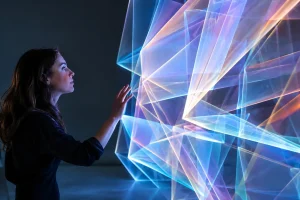
In a large interactive tesseract installation, the visitor becomes part of the projection problem. A body approaches the frame, sees itself repeated within the cubic lattice, then loses confidence about where the visible boundaries end. Movement changes the image immediately. A slight shift of the head reorders planes that looked fixed a moment earlier.
At a festival, this can become a collective experiment in perception. People who may not arrive seeking topology or higher dimensional mathematics still recognize the sensation of encountering a space that refuses to settle. Some describe it through physics, some through dreams, some through sacred geometry. Those languages are not identical, and they should not be forced together. What they share is an attention to pattern, scale, and the limits of ordinary orientation.
Sacred Geometry Without Pretending Mathematics Is Magic
The phrase sacred geometry can carry real power, but it deserves precision. Geometry is not sacred because a shape automatically transmits hidden forces. It can feel sacred because proportion, symmetry, recursion, and repetition draw attention beyond the everyday scale of the self.
A tesseract belongs to that lineage of charged forms while remaining firmly mathematical. Its symmetry is extensive. Every vertex is structurally equivalent. Every cubic cell plays the same role. This deep regularity gives the hypercube a strange calm, even when its projections seem unstable.
That combination matters in immersive work. The visitor encounters a form that is intellectually rigorous yet perceptually slippery. The mind wants to resolve it. The eyes keep receiving evidence that resolution may require another dimension. That gap can resemble the logic of a lucid dream, where the environment is detailed and convincing, but its rules have shifted just enough to expose the act of perception itself.
A Better Question Than Can Humans See the Fourth Dimension
The usual question is whether humans can see the fourth dimension. Strictly speaking, no human eye directly sees four spatial dimensions. But that answer is too blunt to be useful.
A better question is what evidence of higher dimensional structure can be translated into human experience. Mathematics offers equations, coordinate systems, and projections. Physical craft offers frames, reflective planes, controlled spacing, and programmable color sequences. Interactive augmented reality can let a visitor virtually step within a hyperdimensional construction, changing perspective through movement rather than explanation alone.
None of these translations replaces the tesseract itself. Each is a partial view, like a shadow, a cross section, or a map. Yet partial views are how knowledge often begins. A physicist infers invisible structure from measurable effects. A sculptor works similarly, building conditions in which the unseen can become perceptually active.
The cube teaches certainty because its dimensions fit the body. The tesseract offers a more provocative lesson. Reality may contain structures that are fully lawful, fully describable, and still larger than intuition. Stand before its projected geometry long enough, move through the reflections, and the question changes from whether the form is real to how much of reality perception has been trained to exclude.