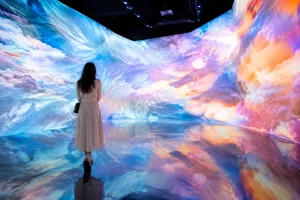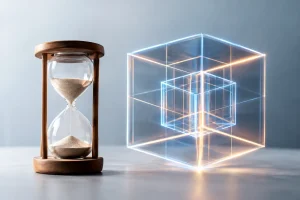

A room can contain an object, or it can contain a question large enough to reorganize perception. The top immersive art experiences do more than surround an audience with spectacle. They make the body doubt its coordinates. A reflected corridor appears to continue beyond the wall. A cube becomes a passage. Color seems to have weight. For a brief interval, the familiar certainty of three dimensions loosens.
That sensation is not merely theatrical. It can emerge from precise physics, spatial geometry, and the peculiar limits of human vision. I build toward that threshold, where an abstract mathematical idea becomes an interactive encounter and where the fourth dimension stops being a diagram in a textbook and becomes something a person can almost feel.
What makes immersive art genuinely transformative
Immersion is often confused with scale. A large projection, a crowded room, or a bright field of color can be impressive, but size alone does not alter perception. The most memorable experiences create a productive disagreement between the eyes, the body, and the mind. The viewer knows they are standing in a finite room, yet vision proposes an infinite volume. The mind must hold both facts at once.
This is why mirrors remain such potent instruments. A mirror does not invent space. It repeats available space according to strict optical laws. When reflective surfaces face one another, light makes multiple passes through the enclosure, producing receding images that can feel endless. The apparent depth is an optical construction, but the awe is physical. A person leans forward because the nervous system is built to trust visual depth.
An exceptional immersive work also gives the audience agency. The work changes as someone shifts position, pauses, turns, or approaches another person. That interactive relationship matters because perception is not passive reception. Human vision constantly tests the world through movement. When the space answers back with unexpected geometry, viewers become participants in an experiment.
Top immersive art experiences use geometry as material
The strongest spatial installations do not use mathematics as decorative symbolism. They allow mathematical structure to determine the experience. Symmetry, recursion, projection, rotation, and reflection become materials as tangible as wood, glass, or metal.
Consider the tesseract, a four dimensional hypercube. A point can be understood as zero dimensional. A line segment extends that point into one dimension. Sweep the line sideways and it becomes a square in two dimensions. Move the square in a direction perpendicular to its plane and it forms a cube in three dimensions. Repeat that operation once more, in a direction unavailable to ordinary three dimensional movement, and the result is a tesseract.
No human eye can directly see four spatial dimensions. Yet a tesseract can be projected into three dimensions, much as a cube can cast a two dimensional shadow. The familiar wireframe drawing of a smaller cube nested inside a larger cube is one such projection. It is accurate in the same limited way that a map is accurate. It preserves relationships, but it cannot deliver the full territory.
My Tesseract begins with that limitation. The sculpture is a five foot hypercube interpretation whose mirrored interior produces recursive depth. It does not claim to be a literal four dimensional object. Instead, it asks what the presence of a tesseract might feel like inside a three dimensional world. The answer is disorientation with structure. An infinite corridor appears inside a bounded form. Nested frames suggest dimensions folding through one another. The geometry remains disciplined even as the experience becomes dreamlike.
Why recursion feels like a portal
Recursion is a simple process with profound perceptual consequences. A form contains a version of itself, which contains another version, continuing toward a limit. In a reflective installation, repeated images generate a visible recursion. The eye traces cube after cube into apparent distance, then discovers that the sequence is not a tunnel built behind the surface. It is an optical event happening here.
That contradiction gives the work its charge. The viewer is looking at a finite object and an infinite proposition at the same time. Similar tension appears in lucid dreams, where the dreamer may recognize the impossibility of a place yet still experience its emotional reality. Both states reveal that perception is less like a camera and more like a living hypothesis about space.
The physics behind the sense of infinite depth
Infinity mirror effects are often described as magic, but their mechanics are wonderfully concrete. Two reflective planes create repeated images because each reflection becomes an object for the opposing surface to reflect again. At every pass, a small amount of light is absorbed or transmitted, so the sequence gradually dims. The apparent infinity is therefore a controlled decay, a series of images falling away into darkness.
That decay is aesthetically essential. Perfect repetition would read as a flat graphic pattern. Diminishing brightness gives the eye evidence of distance, even when the physical enclosure is shallow. Color sequences can strengthen the effect by giving each receding frame a rhythm, like pulses traveling through an imagined architecture.
The build process demands more than visual intuition. Reflective materials must align precisely. Structural edges have to preserve the geometric logic of the form. Internal surfaces must avoid unwanted visual noise. Programmed color and timing must support the illusion rather than overwhelm it. A slight misalignment can become visible many times over through reflection, which means every construction decision is multiplied inside the finished work.
This is one reason immersive installations reward close attention. Their emotional force depends on craft that is often invisible at first glance. The audience encounters wonder, while the maker has spent months negotiating angles, materials, tolerances, optical behavior, and the stubborn fact that geometry must eventually stand upright in the real world.
Interactive art at festivals changes the scale of encounter
A gallery can offer concentration, but a festival offers a different condition, especially after dark. At Burning Man and other immersive gatherings, people arrive already willing to question ordinary boundaries. They move through temporary cities where architecture, music, dust, weather, and conversation become part of the encounter. An installation is not isolated from that context. It becomes a landmark, a meeting point, and sometimes a shared myth carried through the night.
The Tesseract takes on a different life in this setting. One person may approach it with a physicist’s curiosity. Another may see sacred geometry, a memory from a lucid dream, or an impossible room from childhood. A group may stand around it, watching their bodies repeat into the structure, then begin talking about dimensions, mirrors, consciousness, or the nature of reality. The work is interactive not because it asks for a button press, but because it turns perception into a collective event.
For event producers, this distinction matters. A compelling installation can hold attention without competing with every other stimulus in the environment. It gives people a reason to slow down. It creates a visual anchor that photographs cannot fully explain, because the crucial element is the shifting relationship between the visitor and the space. The best response is often not a picture but a sentence: you have to stand in front of it.
Virtually stepping inside the hypercube
Physical scale has limits. A sculpture may suggest an interior vastness that the body cannot enter. Augmented Reality extends the interactive proposition by allowing viewers to virtually step inside the work with an AR headset. The goal is not to replace the physical sculpture. The goal is to continue the same geometric question through another perceptual threshold.
Virtually entering a hyperdimensional mirror structure changes the role of the viewer. Instead of standing before a projection of higher dimensional logic, the viewer occupies its recursive interior. Spatial orientation becomes less stable. Frames expand around the body. The distinction between observing an object and inhabiting a mathematical model becomes wonderfully uncertain.
That uncertainty is valuable when it remains grounded in real geometry. The fourth dimension does not need mystical exaggeration to be astonishing. Its mathematics is already strange enough. A tesseract is not proof of a hidden realm, but it is evidence that human intuition was not built to contain every coherent possibility.
A better question than whether it is real
When an immersive installation makes space feel impossible, audiences often ask whether the experience is real. The more interesting question is, real in what sense? The mirror depth is real as an optical phenomenon. The structure is real as an engineered object. The bodily vertigo is real as a response in the nervous system. The apparent endless interior is real as an experience, even though it is not a literal endless chamber.
Art has always been capable of revealing this layered kind of reality. Geometry gives the revelation a particularly sharp edge because it is exact. A cube is not a metaphor until a mind makes it one. A reflection is not a fantasy until it becomes a route into imagination. Between those two conditions, the mind finds room to expand.
The next time a mirrored form seems to open into impossible distance, stay with the hesitation before naming it. Let the eye follow the recursion. Let the body register the scale it cannot quite verify. That small fracture in certainty may be the closest ordinary perception comes to touching another dimension.