
A recursive mirror does not merely reflect a room. It persuades the eye that space continues beyond the wall, beyond the body, perhaps beyond the dimensions available to ordinary vision. Learning how to build recursive mirrors begins with a simple optical arrangement, but the real work is perceptual. You are building a machine that turns finite materials into an encounter with apparent infinity.
I approach these structures as physical models of a larger question: what would it feel like to stand inside the projection of a higher dimensional object? In a mirror sculpture, every reflection is both real and impossible. The glass is close enough to touch, while the apparent corridor retreats farther than the body can follow.
How to Build Recursive Mirrors From First Principles
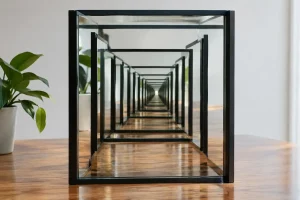
The essential structure requires two reflective planes facing one another. The rear plane is a conventional mirror with a highly reflective surface. The front plane is partially reflective glass, often called two way mirror glass. Between them sits a source of colored illumination. Light enters the viewer’s eye through the front glass, reflects from the rear mirror, returns to the front surface, and repeats the journey many times.
At every pass, a fraction of the light escapes through the front glass. Another fraction remains inside the chamber. This gradual loss is not a flaw. It is the reason the reflected images appear to fade into depth. The eye reads that diminishing intensity as distance, even though the physical gap between the two planes may be only a few inches.
The recursive effect depends on a deliberate imbalance. If the front surface transmits too much light, the viewer sees through it too easily and the chamber loses mystery. If it reflects too much, the interior becomes difficult to see. The exact balance depends on the brightness inside the structure, the ambient conditions around it, and the desired visual density.
This is why an infinity mirror is less like a picture frame and more like an optical instrument. Its behavior changes as the viewer moves, as the surrounding space changes, and as color and pattern shift within the chamber. It is interactive even when no one touches it.
Begin With Geometry, Not a Box
A rectangular mirror chamber can create a compelling tunnel, but a recursive sculpture becomes more interesting when its structure carries mathematical intention. Before cutting material, decide what spatial idea the form is meant to embody. A square suggests stability and orthogonal space. A cube establishes three dimensional volume. A hypercube, or tesseract, offers a way to suggest a fourth spatial dimension through projection.
A tesseract cannot be placed whole inside ordinary three dimensional space, just as a cube cannot be placed whole on a flat sheet of paper. What can be built is a projection, a translation of higher dimensional relationships into a form the senses can encounter. The familiar tesseract drawing, an inner cube connected to an outer cube, is one such projection. In sculpture, that logic can become a framework of edges, mirrored planes, and repeating illuminated corridors.
For my Tesseract, the geometry had to remain legible at human scale. A 5 x 5 x 5 foot structure gives the viewer enough bodily reference to feel the difference between looking at geometry and entering it. The recursive surfaces then complicate the clean mathematical skeleton. An edge becomes a corridor. A corner becomes a vanishing point. The finite cube begins to feel like a fragment of a much larger spatial system.
Start by drawing the form from multiple viewpoints. Identify every plane that will carry a reflection and every open line of sight the viewer will have. In a complex polyhedral structure, one careless angle can reveal supports, cables, or unintended reflections that collapse the illusion. The geometry should direct attention, not compete with the optical field.
The role of angles and alignment
Parallel planes create the most familiar apparent tunnel because each reflection returns along nearly the same path. Small errors in alignment are magnified across repeated reflections. A slight tilt can turn a straight corridor into a drifting sequence, which may be either a problem or an opportunity.
Perfect parallelism produces a controlled, architectural infinity. Deliberate angular offsets can produce branching lattices, fractured horizons, or kaleidoscopic chambers. Neither approach is inherently superior. If the work is intended to evoke the ordered logic of a hypercube, precision serves the concept. If it is meant to resemble a lucid dream, a measured instability may be more truthful.
Build the Optical Chamber With Care
The frame must hold the reflective planes rigidly and keep the interior clean. Dust, fingerprints, visible adhesive, and exposed hardware multiply through the reflection sequence. A mark that seems insignificant on one surface can become a whole constellation of marks in apparent depth.
I begin by treating each chamber as a sealed stage. The rear mirror establishes the deepest visual boundary. The partially reflective front surface sets the threshold between ordinary space and the recursive interior. The frame creates the physical distance between them, while also hiding the construction logic enough for the illusion to survive.
Glass introduces real risks. Its edges should be finished, supported continuously, and protected from torsion. Large panels need a frame designed for their weight and for transport. For public installations, the engineering must account for people leaning close, moving through crowds, heat generated inside the chamber, vibration, and the practical demands of repeated installation. Festival art has to survive more than a pristine studio test.
The illumination source belongs inside the chamber, usually along edges or concealed channels where it can define geometry without exposing the mechanism. Programmable color and timed sequences let the work change its spatial character. A slow pulse can make depth seem to breathe. A traveling sequence can make a static edge feel as if it is folding through itself. Color can clarify the structure, but it can also destabilize it, especially when hues shift at the boundary between the reflected world and the room.
Why the Depth Feels More Real Than It Is
The physics is straightforward, yet the perceptual result is strange. Human vision estimates depth from many cues, including perspective, relative size, overlap, motion, and diminishing contrast. Recursive mirrors supply several of these cues at once. Repeated frames appear smaller. Brightness falls with each reflection. Lines converge toward an apparent vanishing point. When the viewer changes position, the reflections shift in ways that imply volume.
The brain does not inspect each cue separately and announce that it has been deceived. It synthesizes a spatial world. That synthesis is usually useful. Here, it becomes visible as a process.
This is where mirrors touch the questions raised by higher dimensional geometry. A tesseract projection is not a tesseract itself. A recursive chamber is not infinite. Yet both can produce an experience of encountering something that exceeds the immediate evidence of the senses. The eye sees finite glass and finite structure. Perception keeps proposing a space that has no end.
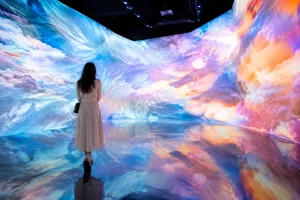
At Burning Man and other immersive festivals, that contradiction becomes communal. A visitor may approach a mirrored form under open sky, see a universe receding inside it, then watch another person become a silhouette within the same impossible depth. The sculpture is interactive because every body changes the image. It is also interactive because conversation becomes part of the work. People compare what they think they saw, as if returning from different regions of the same dream.
Test It Like an Experiment
Build a small chamber first, not as a lesser version of the final work, but as an experiment in optical behavior. Test it in darkness, in daylight, and in the kind of ambient conditions where it will actually be encountered. Observe it from standing height, seated height, and close range. Record what happens when viewers move sideways, since motion often reveals whether the depth holds together.
Pay attention to the first second of perception. Does the viewer recognize a surface, a tunnel, a grid, or a void? That initial reading matters. Then observe the second response, when the mind begins to question the first. The most compelling recursive mirrors preserve enough clarity to orient the viewer, then offer enough complexity to keep orientation from settling.
For an augmented reality activation, the virtual extension should respect the physical geometry rather than replace it. When a viewer virtually steps inside the sculpture, the interactive experience becomes stronger if the spatial rules remain connected to the real frame, reflections, and paths of movement. The physical object establishes trust. The virtual dimension gives the imagination somewhere to go.
A recursive mirror is successful when it does more than create an attractive illusion. It should make the viewer aware of the act of seeing, of the assumptions that turn reflected light into space, and of the possibility that reality may contain structures the body can sense only indirectly. Build with precision, then leave room for the mind to walk past the final reflection.