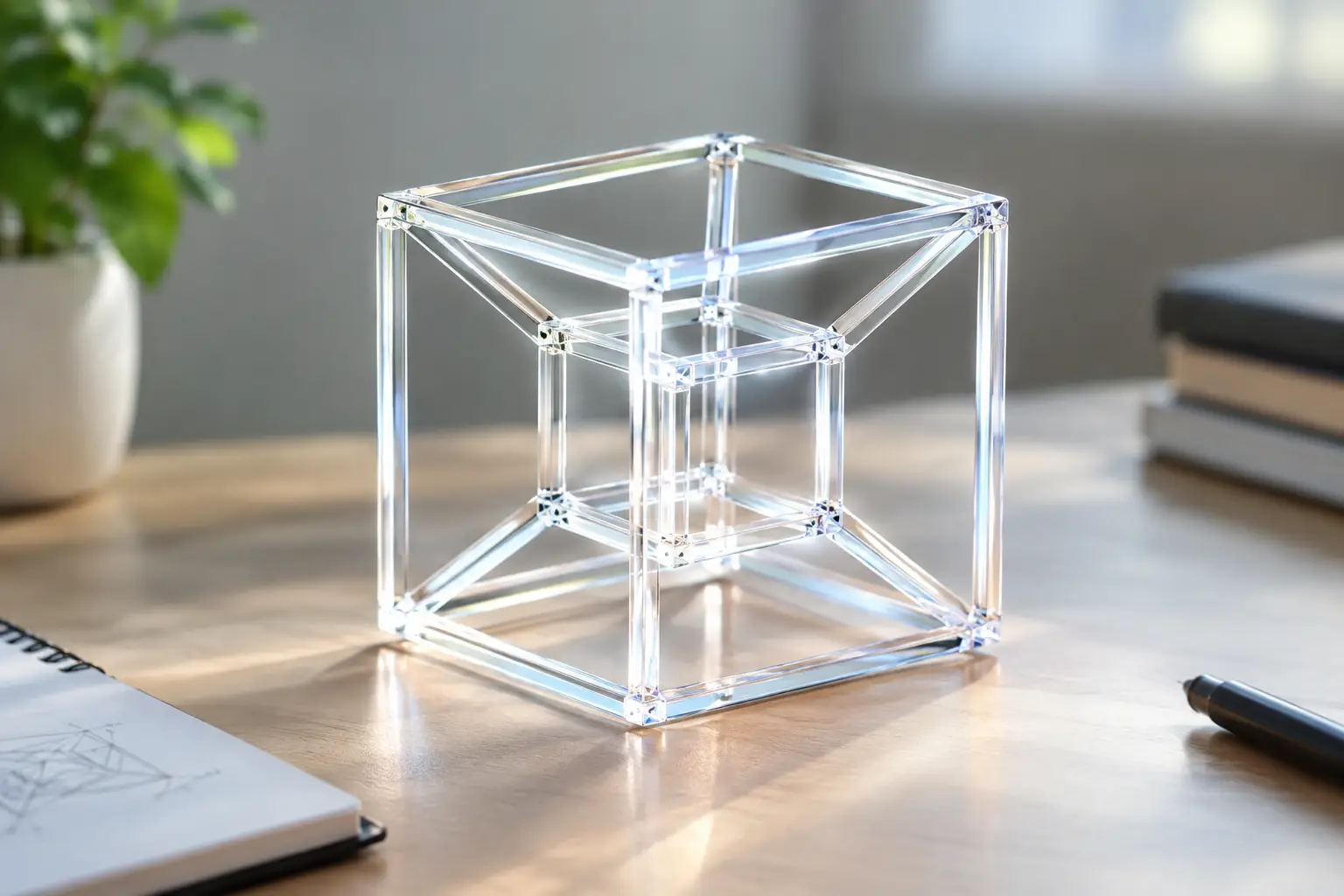
A cube can be understood at a glance. A tesseract cannot. It arrives as a provocation, a structure whose complete form exceeds the dimensions of the room and the senses moving through it. When I am designing art with math and physics, that gap is the material. I am not trying to illustrate an equation. I am building a place where an equation begins to feel physical.
The Tesseract is a five by five by five foot infinity mirror hypercube, an interactive sculpture built to make dimensional projection, reflection, and human perception collide. Viewers do not simply observe a geometric object. They encounter repeating corridors of luminous form, apparently extending beyond the sculpture’s actual boundaries. The body recognizes a room, while the mind suspects another kind of space.
Designing Art With Math and Physics Begins With Constraint
Mathematics gives the work its discipline. A tesseract is the four dimensional analogue of a cube. A point becomes a line when extended in one direction. A line becomes a square when extended in a perpendicular direction. A square becomes a cube through another perpendicular extension. Extend the cube in a direction perpendicular to all three familiar spatial axes, and the result is a tesseract.
That final direction is not one human vision can point toward. It is a mathematical direction, not a secret location somewhere above the ceiling. Still, the tesseract has a precise structure. It contains sixteen vertices, thirty two edges, twenty four square faces, and eight cubic cells. Those relationships are real, even if the whole object cannot sit in ordinary three dimensional space without becoming a projection.
A Projection Is Not a Compromise
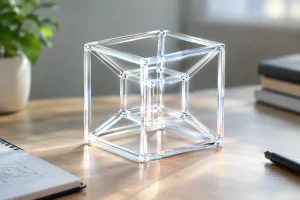
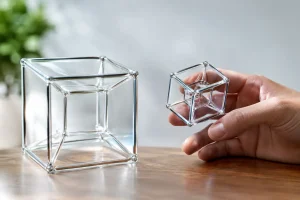
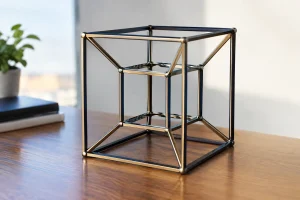
The familiar image of a tesseract, a smaller cube nested inside a larger cube with corresponding corners connected, is a projection. It is comparable to a cube casting a two dimensional shadow. The shadow is not the cube itself, but it faithfully carries information about the cube into a lower dimension. A tesseract projection does the same thing, carrying four dimensional relationships into a form that can be built, entered, and questioned.
This is where artistic decisions become inseparable from geometry. If every line is made equally prominent, the form may become legible but inert. If the structure is obscured too completely, it becomes spectacle without an idea. I look for the threshold where the mathematical skeleton remains exact enough to reward close attention, while the experience stays strange enough to interrupt ordinary spatial certainty.
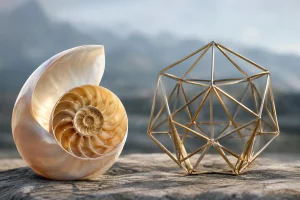
Sacred geometry is often discussed as symbol, but I approach it first as structure. Symmetry can settle the eye and destabilize it at the same time. Repetition creates expectation. A slight shift in scale, angle, or apparent depth can make that expectation fail. The resulting sensation is not proof of a hidden dimension. It is evidence that perception is an active construction, not a passive recording.
Reflection Makes Geometry Behave Like Space
Mirrors give the tesseract its apparent interior. The governing physical principle is simple. The angle at which a ray meets a reflective surface equals the angle at which it leaves. Yet when partially reflective surfaces face one another, that simple rule repeats an image again and again. Each reflection carries another reflection inside it, producing recession that feels far larger than the object containing it.
The effect is never literally infinite. Every reflected image loses some intensity, and every tiny misalignment announces itself across the visual field. Material choices, surface quality, spacing, edge treatment, and structural precision all matter. A few millimeters can decide whether the recursion feels like a coherent volume or a fractured pattern.
That fragility is part of the physics and part of the poetry. The sculpture asks the viewer to trust an impossible depth created by surfaces that are physically close together. It is an honest illusion. Nothing is concealed except the assumptions the brain usually makes about boundaries, distance, and the reliability of a reflected image.
The Viewer Completes the Interactive System
An immersive tesseract is interactive even when no button is pressed. A single step changes sightlines. A lowered head finds a new alignment. Two people standing apart can look into the same structure and describe different architectures. The work does not have one fixed image because the observer is one variable within the optical system.
At Burning Man and other immersive festivals, this becomes especially vivid. A viewer may first encounter the form across open ground, as a crisp hypercube against darkness. Up close, the certainty of that outline dissolves. People circle it, pause at its edges, point inward, and return later with friends. The sculpture becomes a shared experiment in attention, one that can hold a physicist, a first time festival participant, and someone emerging from a lucid dream in the same moment of astonishment.
The crowd is not background activity. It changes the work’s emotional scale. A solitary encounter can feel intimate and disorienting. A collective encounter turns geometry into social choreography, with bodies moving around an idea too large to see all at once.
Virtually Stepping Into a Hypercube
Augmented reality extends this question of scale without replacing the physical sculpture. Through an interactive AR headset, viewers can virtually step inside the geometry and experience a tesseract projection from a position impossible in ordinary construction. The purpose is not to claim that the headset reveals a literal fourth dimension. It offers another perceptual model, another way to test what it means to inhabit a projection.
Physical mirrors make recursion tactile, spatial, and contingent on the body. Virtual interaction makes transformations easier to inhabit and inspect. Each medium has a different truth. One makes the viewer feel the stubborn constraints of material space. The other permits a direct encounter with geometric relationships that physical fabrication can only imply.
For me, the strongest installations allow these modes to speak to each other. A viewer may stand before the sculpture, virtually enter its interior, then return to the physical form with altered eyes. The object has not changed. The mental model has.
What the Equations Cannot Decide
Math can specify proportion, symmetry, connectivity, and projection. Physics can predict reflection, absorption, and the behavior of surfaces. Neither can decide the exact moment when a person feels that reality has briefly become less solid. That requires composition, pacing, craft, and a willingness to leave room for ambiguity.
There is a tradeoff in every immersive work. More visual information can create a stronger immediate impact, but it can also erase the silence needed for thought. Greater geometric purity can clarify the concept, but it may reduce the dreamlike instability that makes a viewer linger. The answer depends on the site, the scale, the surrounding environment, and the kind of attention the installation invites.
The most useful question is not whether a tesseract can be fully seen. It cannot, at least not from within three dimensional perception. The question is what changes when the mind meets a form it can calculate precisely but never completely possess. Stand with that question long enough, and even a familiar room may begin to look like a projection of something larger.