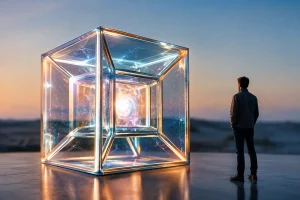
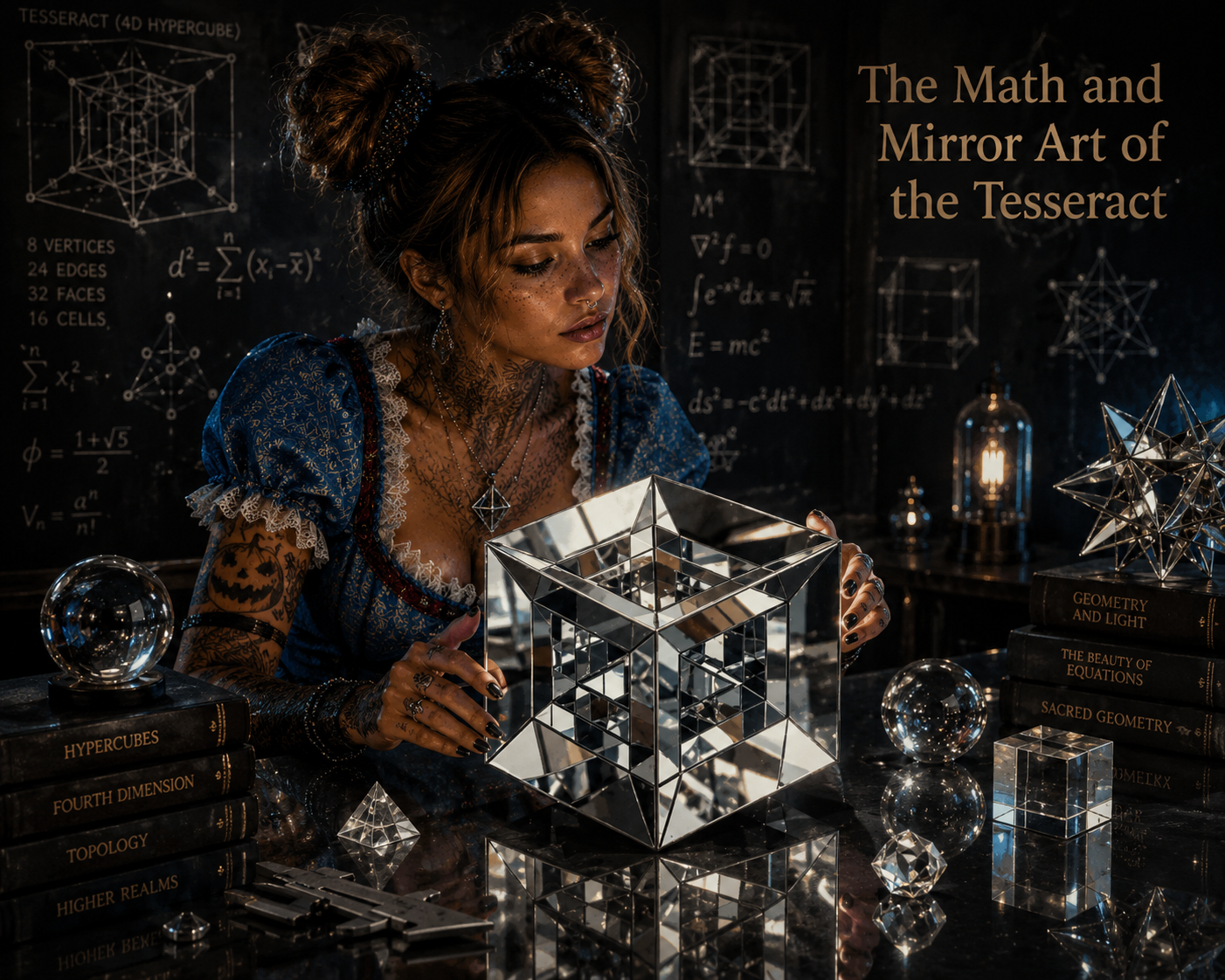
At night, in the open expanse of a festival, a mirrored cube can interrupt the ordinary agreement between eye and world. A person approaches its surface, sees a field of light continuing far beyond the frame, and hesitates. Is there a room inside? Is there a corridor? Is the object larger than it appears? The math and mirror art begins in that hesitation. I build for the moment when perception recognizes a structure but cannot quite locate it in familiar space.
The Math and Mirror Art Begins With Projection
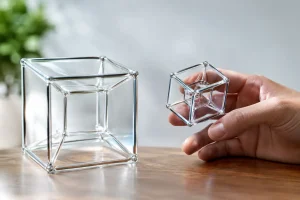
A tesseract is a four dimensional hypercube. It relates to a cube in the same way a cube relates to a square. A square has four edges and occupies two dimensions. If that square moves through a new direction perpendicular to its plane, it creates a cube with twelve edges. If a cube could move through another direction perpendicular to every direction available in three dimensional space, it would create a tesseract.
That final movement is impossible to perform physically, because human bodies, buildings, and tools occupy three spatial dimensions. Yet mathematics can describe it precisely. A tesseract has sixteen vertices, thirty two edges, twenty four square faces, and eight cubical cells. Those numbers are not poetic metaphor. They are the actual combinatorial anatomy of the form.
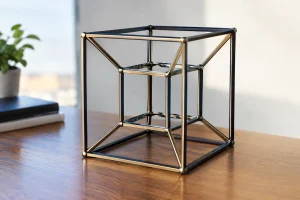
The problem is translation. No physical sculpture can contain a literal fourth spatial direction, but a three dimensional object can show the projection of a four dimensional one. A familiar tesseract drawing places a smaller cube inside a larger cube, then connects corresponding corners. It is not the tesseract itself, just as a shadow of a hand is not a hand. It is evidence cast into a lower dimension.
My Tesseract takes that projected geometry seriously as a sculptural skeleton. The frame establishes a readable sequence of cubes and connections. Light gives the form energy. Mirrors complicate the boundary of the object, so that the projection no longer behaves like a static textbook diagram. It becomes an environment that feels unstable, expansive, and strangely inhabitable.
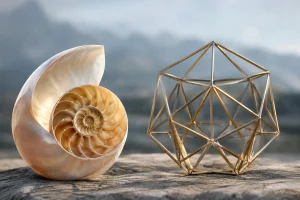
Sacred geometry often enters this conversation because repeated proportion, symmetry, and nested forms can provoke an immediate sense of significance. That response deserves respect, but it does not require vague claims. Geometry is already extraordinary. Symmetry compresses information. Repetition makes structure legible. A hypercube projection asks the mind to infer an order that cannot be directly seen, and that act of inference can feel almost ceremonial.
Reflection Turns Geometry Into Apparent Space
Infinity mirror art is built from a clear physical principle. A reflective rear surface sends light back toward the viewer. A partially reflective front surface both reflects and transmits light. Between them, illuminated elements repeat through multiple bounces. Each bounce loses some intensity, so the sequence gradually fades rather than extending endlessly in a literal sense.
The eye reads that diminishing sequence as depth. Bright repetitions appear close, dimmer repetitions appear distant, and the mirrored cavity seems to recede. The result depends on the balance between the front mirror, the rear mirror, ambient light, and the brightness of the LEDs. Too much transmission at the front and the interior loses its recursive force. Too much reflectivity and the viewer cannot enter the image at all.
This is why mirror work is not simply a visual trick. It is a controlled optical system. The angle of each surface matters. The placement of every light source matters. Even the material thickness affects the perceived spacing of repetitions. A slight misalignment can turn a compelling field of depth into visual noise.
In a five foot Tesseract, the scale changes the physics of the encounter. The viewer is no longer looking at a small box held at arm’s length. The light field occupies a substantial portion of vision. A step to the side shifts the reflection. A person standing nearby becomes part of the composition, multiplied into the structure. The work is interactive because the image responds continuously to position, attention, and movement.
Programmable LEDs add time to this spatial system. A fixed light pattern can reveal the architecture of the frame, while a slow pulse can make the interior feel as if it is breathing. A sequence traveling along connected edges can suggest a path through the projected hypercube. Faster movement can fragment spatial certainty, especially when the viewer is already in a state of sensory intensity at a festival or immersive event.
There is a tradeoff. More animation is not always more powerful. If every edge competes for attention, the geometry disappears beneath spectacle. I use light as a way to reveal structure, conceal structure, and then reveal it again. The best interactive moments leave room for the mind to complete the form.
Why the Tesseract Feels Larger Than Its Dimensions
Human vision does not measure space in a single clean calculation. It combines binocular disparity, motion, perspective, brightness, occlusion, memory, and expectation. Mirrors disrupt several of these cues at once. A reflected edge appears to continue behind a surface that the body knows is solid. A figure appears both near and far. Movement produces changing viewpoints, but the apparent depth does not behave like ordinary architecture.
That contradiction creates a productive tension. The nervous system keeps trying to stabilize the scene, and the sculpture keeps offering another interpretation. For some viewers, the experience resembles a lucid dream. A lucid dream can feel vivid and coherent while also carrying a quiet awareness that its rules are different. The mind is present inside the illusion, observing itself accept and question the world simultaneously.
This does not prove that a mirror sculpture opens a portal to another dimension. The more interesting truth is that perception has limits, and those limits are visible when familiar cues are rearranged with enough precision. The fourth dimension becomes emotionally plausible not because the sculpture claims to show it directly, but because the sculpture makes ordinary three dimensional certainty feel less complete.
The body is part of the equation
Interactive installation art is often described as immersive, but immersion is not only a matter of size. It emerges when the visitor’s body changes the work. In front of a hyperdimensional mirror sculpture, standing still is one condition, walking is another, and sharing the space with strangers is another still. Every position creates a different alignment of reflection, color, and apparent depth.
At Burning Man and other large scale art gatherings, this interaction becomes communal. Someone may raise a hand toward a reflected corridor. Another person may crouch to find a new sight line. A group can watch itself fracture into luminous copies, then laugh at the impossible crowd apparently extending into the distance. The mathematics remains exact, but the encounter becomes social, bodily, and spontaneous.
Outdoor installation introduces real constraints that are as important as the concept. Dust, wind, power distribution, heat, transport, structural stability, and light pollution all shape the final work. A piece that functions beautifully in a dark studio must be engineered differently for an unpredictable desert night. The frame must carry its geometry honestly. The electrical system must support programmable behavior reliably. Mirrors must be protected without losing optical clarity.
Craft is where visionary ideas meet consequence. The claim of higher dimensional space only gains force when the object is physically convincing.
Virtually Stepping Inside the Form
An augmented reality activation extends the sculpture’s interactive logic. With an AR headset, viewers can virtually step inside the Tesseract rather than remaining outside its mirrored threshold. The physical installation establishes scale, reflection, and material presence. The virtual experience can alter the spatial rule set, placing the viewer among the connected cells of the hypercube projection.
This is not a replacement for the sculpture. It is a second instrument for investigating the same question. What does it feel like to inhabit a structure whose mathematics exceeds normal intuition? In physical space, the answer comes through reflected depth and embodied movement. Virtually, it can come through impossible scale, shifting orientation, and the sensation of crossing a boundary that the mirror only implies.
The most compelling interactive art does not demand that viewers understand every equation before they enter. It gives them an experience worth questioning afterward. A mathematician may trace the edge relationships. A physicist may study the optical cavity. A dreamer may simply feel that the room has briefly acquired another direction. All of those responses belong to the work.
The next time a mirror seems to open farther than the space behind it should allow, stay with the confusion for a moment. That small failure of certainty is not a mistake in seeing. It is an invitation to imagine what perception leaves outside the frame.