
A mirror can make a room appear to continue beyond its walls. Add precise geometry, controlled light, and recursive reflections, and the mind begins to report something stranger: a space with no obvious end. Nothing physical has expanded, yet the experience of space has changed completely. That tension is where I begin. How perception shapes reality is not only a question for philosophers or neuroscientists. It is a material question, one that can be built in wood, glass, LEDs, reflective film, and mathematics.
The eye is not a camera recording a neutral universe. It is part of a living system that extracts patterns, estimates distance, predicts motion, and creates a coherent world from incomplete signals. Immersive art can reveal that process by giving perception just enough evidence to form an impossible conclusion. A tesseract made of mirrors and light becomes an invitation to feel a dimension that cannot be directly seen.
How Perception Shapes Reality Through Light
Light is information. Before there is color, form, depth, or movement, there is light entering the eye. The brain then performs an extraordinary act of interpretation. It uses contrast to locate edges, gradients to estimate curvature, overlapping forms to infer distance, and changing viewpoints to construct a world with volume.
This is why an infinity mirror can feel much deeper than its physical dimensions. Two reflective surfaces face one another, with a source of light between or around them. Each reflection carries an image of the light to the opposite surface, which reflects it again. The result is a recursive visual sequence that appears to travel away from the viewer.
The apparent tunnel is not an illusion in the trivial sense of something false. The photons are real. The reflections are real. The depth is a genuine perceptual event, produced by a physical system. What changes is the brain’s interpretation of where the illuminated geometry exists. A five foot structure can become an encounter with apparent infinity.
The effect depends on tradeoffs. Higher reflectivity can sustain more visible repetitions, but every mirror surface also absorbs or transmits a small amount of light. Each cycle becomes dimmer. LED brightness, reflective quality, interior darkness, viewing angle, and the spacing of structural elements all determine whether the recursion feels crystalline, atmospheric, or shallow. The feeling of another dimension emerges from engineering as much as imagination.
A Tesseract Is a Shape, Not a Fantasy
The tesseract is the four dimensional analogue of a cube. A point has no dimensions. Extend it along a new direction and it becomes a line segment. Extend the line in a direction perpendicular to its length and it becomes a square. Extend the square perpendicular to its two dimensions and it becomes a cube. One more perpendicular extension produces a tesseract.
Human bodies inhabit three spatial dimensions, so that final direction cannot be pointed to in ordinary space. Still, the mathematics is exact. A tesseract has 16 vertices, 32 edges, 24 square faces, and 8 cubic cells. A cube has six square faces. A tesseract has eight cubes as its boundary structure.
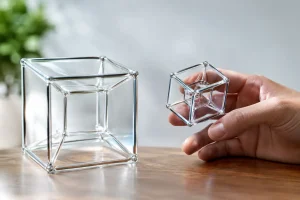
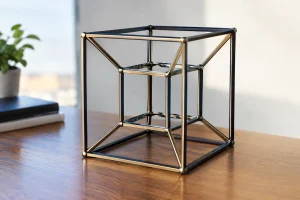
A common visual representation looks like a cube inside another cube, connected at corresponding corners. That image is a projection, not the full object, much as a drawing of a cube on paper is a two dimensional projection of a three dimensional form. The drawing preserves some relationships and distorts others. Lines overlap. Angles shift. Spatial information is compressed.
This is not a failure of representation. It is the central opportunity. Projection is how inaccessible dimensions become thinkable. A shadow turns a three dimensional hand into a two dimensional silhouette. A tesseract projection turns a four dimensional structure into a form that can be examined by three dimensional minds. My sculptures use this principle, then push it into an interactive perceptual environment where reflection multiplies the projection beyond a single fixed image.
Why recursive geometry feels dimensional
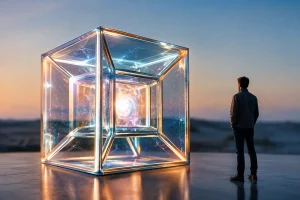
A viewer standing before an illuminated hypercube does not simply see a geometric diagram. The body becomes involved. Small movements of the head shift sightlines through mirrored planes. Bright points repeat, edges appear to pass behind other edges, and the interior seems to reorganize as perspective changes. The work is interactive even before any headset is involved because perception itself is interactive.
That bodily involvement matters. Abstract geometry becomes more convincing when it is encountered through motion, scale, and orientation. The brain does not only calculate space from a static image. It tests hypotheses through movement. If a luminous structure seems to recede as the viewer shifts position, the mind grants it a kind of spatial authority, even when reason knows the physical enclosure is limited.
The Tesseract is built around this conversation between certainty and contradiction. Its frame gives the eye a legible mathematical order. Its mirrors deny ordinary depth. Its programmable LEDs create sequences that can emphasize edges, nodes, pulses, or apparent movement through the form. The structure remains finite. The experience refuses to stay finite.
Perception Is Prediction Under Pressure
Neuroscience increasingly describes perception as an active process of prediction. The brain does not wait passively for sensory data. It continually proposes what is likely to be present, then adjusts when incoming signals disagree. This makes perception fast and useful, but it also makes it susceptible to carefully designed ambiguity.
Mirrors create one of the richest forms of ambiguity because they preserve visual detail while relocating it. A reflection has the texture, color, and motion of an object, but it is not positioned where the eye initially expects it to be. Multiple mirrors compound the problem. The viewer sees copies that appear both present and unreachable.
In an immersive installation, that uncertainty can become expansive rather than disorienting. At Burning Man and other large scale festival environments, the surrounding darkness intensifies the effect. Familiar visual anchors fall away. The glowing geometry becomes a temporary world with its own rules. Thousands of people may approach the same sculpture, yet each person builds a slightly different reality from their angle, movement, memory, and emotional state.
This is one reason altered perception does not require abandoning physics. Physics provides the conditions. Perception supplies the world that is felt. A lucid dream offers a related example. During lucidity, a dreamer recognizes that the environment is generated by the mind, but the floor can still seem solid, the horizon can still feel vast, and impossible architecture can still produce awe. Knowing the mechanism does not cancel the experience.
The Interactive Threshold Between Worlds
Augmented reality introduces a second layer to this question. With an interactive headset, viewers can virtually step inside a hyperdimensional sculpture. The physical work remains present, but virtual forms can extend its geometry, alter scale, or suggest pathways through spaces the body cannot enter.
The most interesting use of this technology is not escape from physical reality. It is a more precise encounter with the gap between physical structure and perceived structure. The headset gives a viewer another set of spatial cues. The mirror sculpture supplies embodied scale, reflection, and light. Together, they make an interactive threshold where the fourth dimension can be approached as both concept and sensation.
There is a necessary limit here. No installation can prove that a fourth spatial dimension lies hidden beside a festival field or behind a mirrored panel. Mathematics allows higher dimensional spaces with complete rigor, while human sensory experience remains adapted to three dimensions. Art does something different from proof. It makes the limit perceptible. It lets the viewer feel the edge of what the senses can confidently claim.
That edge is not empty. It is where curiosity becomes active. Stand before a recursive field of light long enough and a simple question begins to vibrate beneath the geometry: if the mind can turn reflections into infinity, what else might reality contain that perception has not yet learned to see?