
A cube can command a room. A tesseract makes the room feel less certain of its own boundaries. Tesseract explained in its simplest form is a journey from familiar geometry into a fourth spatial dimension – and, in sculptural light art, an invitation to watch that impossible idea appear to breathe, recede, and expand before your eyes.
For collectors drawn to mathematical beauty, futuristic architecture, and art that creates an immediate pause in conversation, the tesseract is more than a symbol. It is a visual proposition: space may be far stranger, and far more alive, than it first appears.
Tesseract Explained: Start With the Dimension Shift
A tesseract is the four-dimensional counterpart to a cube. It is also called a hypercube. The easiest way to understand it is to follow a sequence that begins with shapes we can actually hold and see.
A point has no dimensions. Move that point in one direction and it creates a line, which has one dimension. Move the line in a new perpendicular direction and it creates a square, with two dimensions. Move the square in a third perpendicular direction and it creates a cube, the familiar three-dimensional form.
Now imagine moving that entire cube in a fourth direction, one that is perpendicular to the three directions available in ordinary space. The result is a tesseract.
That final step cannot be physically performed in the way we can draw a square or build a cube, because human experience is rooted in three spatial dimensions. Still, mathematics describes the form precisely. A tesseract has 16 vertices, 32 edges, 24 square faces, and eight cubic cells. A cube has six square faces; a tesseract has eight cubes as its boundary elements.
The distinction matters. A tesseract is not simply a cube inside another cube. That familiar image is a projection – a three-dimensional translation of a form that exists in four dimensions.
Why a Tesseract Looks Like a Cube Within a Cube
When a three-dimensional object is represented on a flat page, it must be projected into two dimensions. Perspective drawing gives us convincing images of cubes, corridors, and architecture, but the image is not the object itself. Parallel lines converge. Equal lengths appear unequal. Depth becomes an illusion made by geometry.
The same principle applies when a tesseract is shown in three dimensions. Its most recognizable projection appears as a smaller cube nested within a larger cube, with corresponding corners joined by lines. The connecting lines suggest an additional direction that cannot be directly seen.
This is why tesseract imagery can feel both orderly and destabilizing. Your eye understands the cube. Then it tries to resolve the relationships between the cubes, only to encounter a form whose true spatial logic exceeds the room around it.
There are many possible projections of a tesseract, just as a cube can cast many different shadows depending on its orientation to a light source. Some tesseract projections look like nested boxes. Others become skewed, angular, or almost organic. None is the full four-dimensional object. Each is an interpretation shaped by the viewpoint.
The Fourth Dimension Is Spatial, Not Time
Popular culture often calls time the fourth dimension. In physics, spacetime does combine three dimensions of space with one of time, and that framework is essential to modern science. But in pure geometry, a tesseract uses a fourth spatial dimension.
That difference keeps the idea clear. A tesseract does not mean a cube traveling through time. It means a cube extended in a direction that is mathematically valid but inaccessible to direct human perception.
This is also why a rotating tesseract projection seems to perform visual impossibilities. In a true four-dimensional rotation, the form rotates through planes that have no exact counterpart in everyday experience. When projected into three dimensions or onto a screen, inner and outer edges can appear to exchange places. The object seems to fold through itself, although the mathematics remains perfectly consistent.
For art, that tension is the point. The viewer does not need to solve the entire equation to feel the shift. The mind recognizes structure, then encounters the limit of its own spatial intuition.
From Mathematical Object to Infinity Mirror Sculpture
A tesseract sculpture is not a literal four-dimensional object installed in a living room, gallery, or private office. It is something more compelling in practice: a crafted three-dimensional framework that uses proportion, reflection, light, and controlled perspective to evoke hyperdimensional space.
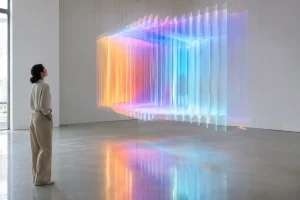
Infinity mirrors intensify the effect. A reflective chamber, positioned lighting, and a precise tesseract structure can send illuminated geometry into apparent depth. Edges repeat beyond the physical enclosure. The central form may feel like a portal, a luminous architectural volume, or an endless sequence of cubes slipping away from the viewer.
The illusion works because it gives the eye two competing signals. The sculpture has a clearly defined physical boundary, yet its reflected geometry refuses to remain within it. Light establishes a depth that feels far greater than the sculpture’s actual dimensions.
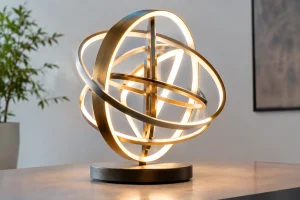
Programmable LED lighting adds another layer. A static white glow can emphasize the tesseract’s clean, gallery-like geometry. Slow color movement can turn its internal space atmospheric and meditative. More kinetic programs can make the reflection field feel active, almost computational. The best setting depends on the environment. A restrained palette may suit a serene architectural interior, while saturated color sequences can become the visual center of an entertainment space or collector’s installation.
Why the Tesseract Has Such Presence in Interior Design
Most wall art is encountered as an image. A hypercube-inspired infinity mirror changes as you move past it, as ambient light changes, and as its own internal color programs evolve. It behaves less like a picture and more like an event held in a physical object.
That makes scale and placement unusually consequential. A compact piece can become a precise focal point in an entry, study, or curated hallway. A larger commissioned sculpture has the authority to anchor a double-height living area, media room, hospitality setting, or gallery wall. It should have room to be approached from different angles, because movement is part of the experience.
Material choices matter as much as the concept. Crisp edges, carefully controlled joins, high-quality mirror surfaces, and intentional light diffusion separate a collectible sculpture from a novelty effect. The geometry must feel exact enough to honor its mathematical source, while the illumination must retain depth rather than flattening the form into decoration.
A custom work can also be designed around the space it inhabits. Dimensions, mounting requirements, power access, finish, and lighting control all influence the final experience. Smartphone-controlled programming is especially valuable when the owner wants the work to shift from quiet architectural light during the day to a more dramatic environment for evening gatherings.
Sacred Geometry, Science Fiction, and What the Form Actually Means
The tesseract holds a rare position in visual culture. It belongs to rigorous mathematics, yet it also appears in science fiction, digital art, speculative architecture, and contemporary spiritual imagery. That broad appeal is not an accident. The shape gives visual form to a recurring human fascination: the possibility that reality contains structures beyond ordinary sight.
For some collectors, its power is intellectual. The sculpture becomes a material encounter with dimensional geometry. For others, it is intuitive and symbolic – a gateway, a threshold, or a meditation on infinity. Neither response needs to cancel the other.
Still, a discerning approach avoids treating the tesseract as proof of hidden physics or a universal ancient emblem. Its beauty does not need inflated claims. The known mathematics is already astonishing, and the artistic interpretation is strongest when it makes that astonishment tangible.
Nicky Alice approaches the form as a collector-scale meeting point between exacting fabrication and perceptual theater. The tesseract is the framework; light, reflection, and the viewer’s own movement complete the work.
What to Look for in a Tesseract Artwork
A serious tesseract piece should reward attention beyond its first visual impact. Look first at the geometry. Are the proportions confident, the lines resolved, and the nested spatial relationships intentional? A hypercube-inspired form can be stylized, but it should not feel accidental.
Then consider the depth system. Infinity effects depend on alignment, reflectivity, LED placement, and the balance between brightness and shadow. Too much light can erase the sense of distance. Too little can make the interior lose definition. The most mesmerizing works preserve both the sharpness of the structure and the mystery of the void around it.
Finally, consider authorship and permanence. For a limited-edition or commissioned light sculpture, signed documentation, numbered editions, and a certificate of authenticity matter. So does serviceability. Lighting technology should support the work’s longevity, not turn a significant art purchase into a disposable electronic object.
A tesseract belongs in a space where curiosity is welcome. Place one where people can stop, change position, and let their eyes test the edges. The reward is not merely understanding a four-dimensional shape. It is living with an object that keeps reminding you how much wonder can exist just beyond the visible frame.