
A tesseract can make a room feel as if its walls have become negotiable. Light appears to recede beyond the physical frame, cubes seem to pass through one another, and the eye keeps searching for an edge that will settle the image. Yet the idea that time is not the fourth dimension is essential to understanding what this experience is actually asking us to see.
For collectors drawn to hyperdimensional art, this is more than a technical correction. It is the difference between a familiar science-fiction shorthand and a far more compelling proposition: a sculpture can offer a glimpse of spatial possibility that the human senses were not built to hold all at once.
Why Time Is Not the Fourth Dimension in Geometry
The phrase fourth dimension is used in two different conversations, and they are often blended together. In physics, especially relativity, time is treated as part of four-dimensional spacetime: three dimensions of space plus one dimension of time. That model is extraordinarily powerful for describing motion, gravity, and causality.
In geometry, however, the fourth dimension usually means a fourth spatial direction. It is an extension of length, width, and height, not a clock ticking forward. A point is zero-dimensional. A line extends in one spatial dimension. A square occupies two. A cube occupies three. Continue the pattern in another direction perpendicular to all three familiar spatial axes, and you have a four-dimensional hypercube, more commonly called a tesseract.
That distinction matters because time does not behave like an ordinary spatial axis. You can move left or right, forward or back, up or down. You cannot stroll backward through Tuesday with the same freedom. Relativity also gives time a different mathematical role from space, which is why the geometry of spacetime cannot be reduced to simply adding another room-like direction to a cube.
So, is time a dimension? In the context of spacetime, yes. Is it the fourth spatial dimension imagined by a tesseract? No. Both statements can be true, and the tension between them is exactly where the subject becomes visually electric.
The Tesseract Is a Shape, Not a Metaphor
A cube has six square faces, twelve edges, and eight vertices. A tesseract has eight cubical cells, thirty-two edges, and sixteen vertices. We cannot see the complete four-dimensional object directly because our visual world is organized around three spatial dimensions. What we can see is a projection.
Think of a shadow cast by a cube. The shadow is two-dimensional, but it contains clues about a three-dimensional form. Its angles shift as the cube moves; overlapping lines reveal structure without ever giving the full object away. A tesseract projection works similarly. It renders a higher-dimensional structure in the lower-dimensional space we inhabit.
The familiar image of a cube nested inside another cube, joined at corresponding corners, is one possible projection of a tesseract. It is not the tesseract itself any more than a square is a cube. Still, it is a potent visual translation because it allows the mind to sense a structure that exceeds the surface in front of it.
This is why hypercube-inspired sculpture carries more conceptual force than a decorative geometric pattern. Its best versions do not merely repeat squares. They stage a confrontation between what the eye recognizes and what the mind cannot fully stabilize.
A projection asks the viewer to participate
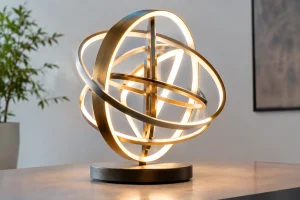
A static diagram explains. A sculptural light work implicates. As viewers shift position, reflections alter, illuminated edges advance or fall away, and the apparent interior reorganizes. The object becomes less like an image and more like an event.
That perceptual instability is not a flaw to be solved. It is the point. A four-dimensional object cannot arrive intact in a three-dimensional room, so the work uses projection, reflection, sequence, and optical depth to let perception do some of the building. The viewer completes a portion of the structure in real time.
Infinity Mirrors Turn Geometry Into Experience
An infinity mirror does not create literal infinite space. It creates repeated reflections between reflective surfaces, producing the sensation of a corridor of light that extends far beyond the sculpture’s actual depth. When this mechanism meets tesseract geometry, the result is more than an optical trick.
The illuminated framework supplies a disciplined architectural language: edges, vertices, intervals, symmetry. The mirror field disrupts ordinary scale. A compact sculpture can suggest an interior that feels monumental, while a larger installation can seem to open a luminous chamber inside the wall itself.
Programmable LED lighting adds another variable. A fixed white glow emphasizes formal clarity and the precision of the geometry. Slow color transitions can make the structure feel atmospheric, almost ceremonial. Pulsing or directional sequences can suggest rotation, transmission, or a system activating across an unseen axis. None of these modes makes the object four-dimensional in a literal scientific sense. They do something more honest and more affecting: they make dimensional thought physical.
For a collector, that distinction protects the work from empty spectacle. The light is not there to distract from the form. It gives the form duration. It lets the sculpture reveal different readings over the course of an evening, across a room, or in the brief instant when a guest stops mid-conversation and looks again.
What Dimensional Art Changes in a Room
Most art occupies a wall. Hyperdimensional light sculpture alters the viewer’s relationship with the wall. It can create a visual center without relying on a conventional image, bringing precision and mystery into the same field of view.
In a restrained modern interior, a tesseract-inspired work can introduce complexity without visual clutter. The silhouette remains ordered and architectural, while the mirrored depth creates the surprise. In a darker media room, private lounge, gallery corridor, or entry space, the piece can become a threshold: an object that signals the room is designed for more than utility.
Scale should be considered carefully. A smaller work can be jewel-like and intensely concentrated, especially when viewed at close range. A large custom commission has a different responsibility. It must hold its own against ceiling height, furniture mass, sightlines, and ambient light without flattening into a bright rectangle. The strongest installations allow enough negative space for the geometry to breathe.
Color also changes the emotional register. Cool whites and electric blues can read as cerebral and architectural. Amber, magenta, and saturated spectrum programs make the work more kinetic and theatrical. There is no universal best setting. The right choice depends on whether the collector wants a meditative focal point, an after-dark atmosphere, or a visual signature that evolves with the room.
The Value of Knowing What You Are Looking At
Calling every mysterious geometric artwork a fourth-dimensional object can make the idea feel vague. Understanding the actual premise makes the encounter richer. A tesseract-inspired sculpture is not claiming to break physics or deliver a portal through the wall. It is using the rigor of mathematical form to create an encounter with perceptual limits.
That is a more ambitious artistic position. It respects geometry rather than borrowing its vocabulary as decoration. It also gives the collector a story worth telling: this is a handcrafted projection of a higher spatial possibility, intensified through reflective depth and programmable light.
Nicky Alice approaches the tesseract in that spirit, treating the hypercube not as a novelty but as a sculptural framework for immersive light. Custom scale, power configuration, and lighting behavior matter because each commission must answer to its setting. A piece installed above a fireplace, in a double-height entry, or at the end of a gallery-like hallway should feel authored for that exact point of arrival.
Let the Question Stay Open
The most rewarding dimensional art does not demand that every viewer understand tensor mathematics before feeling its pull. It simply gives the eye an impossible-feeling order to inhabit. The intellect follows because it wants to know why the form refuses to behave like a normal object.
When choosing a tesseract or hypercube-inspired work, look beyond brightness and novelty. Ask whether the geometry remains compelling when the lighting is still, whether the materials reward close viewing, and whether the depth changes as you move. Those qualities turn a luminous sculpture into a lasting presence – one that leaves room for the most valuable response a work of art can provoke: look again.